PhysicsExam code: 4PH1
Movement & Position
Forces & Motion
Definition and equation
- Acceleration is the rate of change of velocity, that is, how much the velocity changes each second
- Equation:
a = Δv / t = (v − u) / t
- where:
- a = acceleration in metres per second squared (m/s²)
- u = initial velocity (m/s)
- v = final velocity (m/s)
- t = time over which the velocity changes (s)
- The units of acceleration, m/s², come from "change in m/s, per s", because the velocity changes by a metres per second every second
Sign of the acceleration
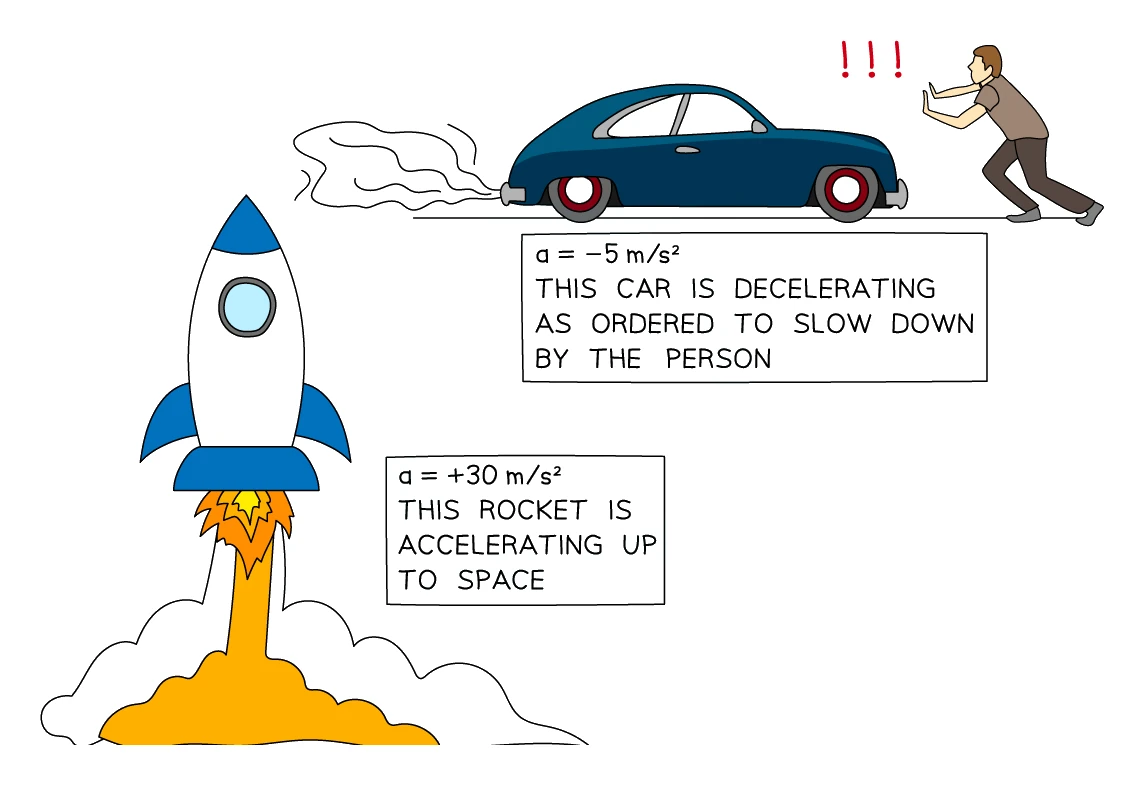
- If the calculated value of a comes out positive, the object is gaining speed in the direction it is already moving (it is accelerating)
- If the calculated value of a comes out negative, the object is losing speed; this is called a deceleration
- The sign therefore carries physical meaning, because a minus sign in front of an acceleration is the maths telling you the motion is slowing
Worked example
Finding acceleration from a velocity–time graph
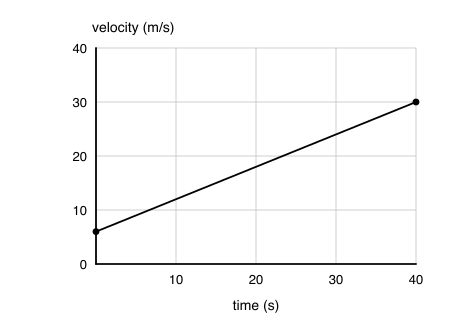
A straight line on a velocity–time graph passes through the point (6 m/s, t = 0) and rises to (30 m/s, t = 40 s).
Solution:
- Change in velocity: 30 − 6 = 24 m/s
- Time interval: 40 s
- Acceleration = change in velocity ÷ time = 24 ÷ 40 = 0.6 m/s²