MathematicsExam code: 0580
Vectors
Vectors and Transformations
Parallel vectors
- Two vectors are parallel exactly when one is a scalar multiple of the other, so b = ka for some number k
- To prove it for two expressions, factorise both and show the same bracket falls out of each
- 6a + 4b factorises to 2(3a + 2b), and 9a + 6b factorises to 3(3a + 2b)
- So 9a + 6b = 1.5(6a + 4b), which makes them parallel
- A negative k means parallel but pointing the opposite way
- Say explicitly that one is a multiple of the other, since that statement is what earns the mark
Collinear points
- Three points are collinear when they all lie on one straight line
- Show it by finding two vectors joining the points, showing they are parallel, and noting that they share a common point
- The shared point is essential: parallel alone only means the lines have the same direction, not that they are the same line
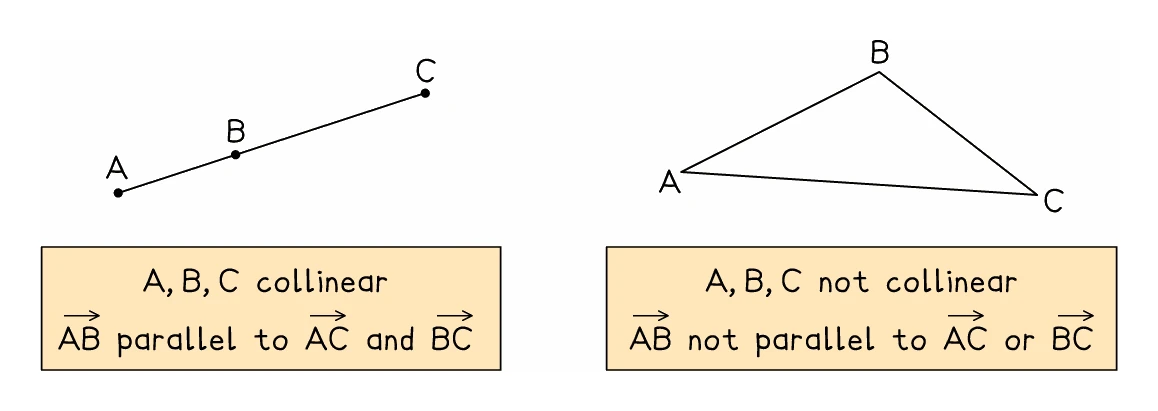
- The syllabus names showing vectors parallel, showing three points collinear, and ratio and similarity problems as the things to be able to do
Worked example
Showing two vectors are parallel
In a diagram, AB = 2a + 3b and CD = 4a + 6b. Show that AB and CD are parallel.
Solution:
- Two vectors are parallel exactly when one is a scalar multiple of the other
- Look for a common factor in CD
- 4a + 6b = 2(2a + 3b)
- The bracket is AB, so CD = 2 × AB
- CD is a scalar multiple of AB, therefore AB and CD are parallel
- Saying only that "the letters are the same" is not a proof: the statement that must appear is that one vector is a multiple of the other
- If the two also shared a point, that same working would prove the points collinear: parallel plus a common point is what collinear needs
Worked example
Where two lines meet, from a parallel side
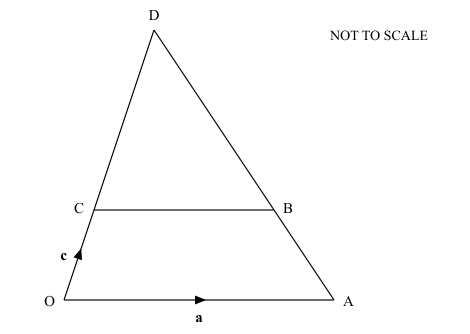
O is the origin, OA = a and OC = c. B is the point with CB = ⅔a, so CB is parallel to OA. The lines OC and AB are extended to meet at D. Find the position vector of D, and the vector BD, in terms of a and c.
Solution:
- CB is parallel to OA, so triangles DCB and DOA are similar: they share the angle at D, and the parallel sides make their other angles equal
- The scale factor from triangle DOA to triangle DCB is CB ÷ OA = ⅔, so DC is ⅔ of DO
- That leaves OC as ⅓ of OD, so OD = 3 × OC
- The position vector of D is 3c
- Reach B from O through C: OB = OC + CB = c + ⅔a
- BD = OD − OB = 3c − (c + ⅔a)
- So BD = 2c − ⅔a
- Check: DB is ⅔ of DA, so BD should be ⅔ of AD; AD = 3c − a, and ⅔(3c − a) = 2c − ⅔a, which matches