MathematicsExam code: 0580
Vectors
Vectors and Transformations
The length of a vector
- The magnitude is the length of the vector, written with modulus bars as |a| or |AB|
- It is always positive, because a length cannot be negative, and the direction plays no part
- The two components form the short sides of a right-angled triangle with the vector as the hypotenuse, so Pythagoras gives the length
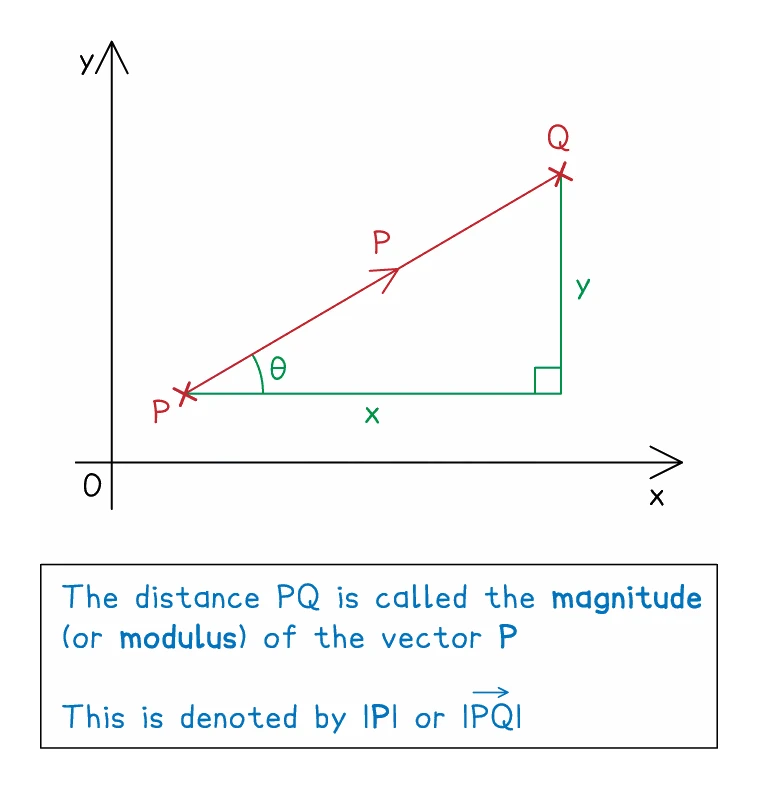
- For a column vector with components x and y, the magnitude is √(x² + y²)
- The magnitude of (8, −6) is √(64 + 36) = √100 = 10
- The magnitude of (5, 12) is √(25 + 144) = √169 = 13
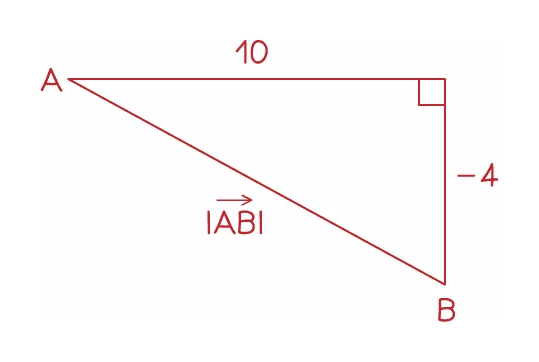
- Reading the components off a diagram works the same way: the vector AB below runs 10 across and 4 down, so |AB| = √(10² + 4²) = √116 = 2√29, which is 10.8 to 3 significant figures
- Leave the answer as a simplified surd on the non-calculator paper, and wherever an exact value is asked for
Worked example
Column vectors and a magnitude
a = (3, −2) and b = (−1, 5), written as column vectors. Find 2a + 3b as a single column vector, and find the magnitude of a − b.
Solution:
- Deal with the scalars first: 2a = (6, −4) and 3b = (−3, 15)
- Add the tops and the bottoms separately: 6 + (−3) = 3 and −4 + 15 = 11
- So 2a + 3b = (3, 11)
- For the magnitude, first find a − b: 3 − (−1) = 4 and −2 − 5 = −7
- So a − b = (4, −7)
- The magnitude is √(4² + (−7)²) = √(16 + 49) = √65
- 65 = 5 × 13 has no square factor, so |a − b| = √65 is the exact answer: leave it like that on the non-calculator paper (it is 8.06 to 3 significant figures)
Worked example
A missing coordinate from a magnitude
P is the point (2, −1) and Q is the point (k, 5). The magnitude |PQ| is 3√5. Find the two possible values of k.
Solution:
- PQ = Q − P: top k − 2, bottom 5 − (−1) = 6, so PQ = (k − 2, 6) as a column vector
- Square the magnitude to remove the root: (3√5)² = 3² × 5 = 45
- Pythagoras on the components: (k − 2)² + 6² = 45
- So (k − 2)² = 45 − 36 = 9
- 9 has two square roots, 3 and −3, so k − 2 = 3 or k − 2 = −3
- k = 5 or k = −1
- Check: k = 5 gives (3, 6) and k = −1 gives (−3, 6), and both have magnitude √(9 + 36) = √45 = 3√5