Vectors
Vectors and Transformations
Position vectors
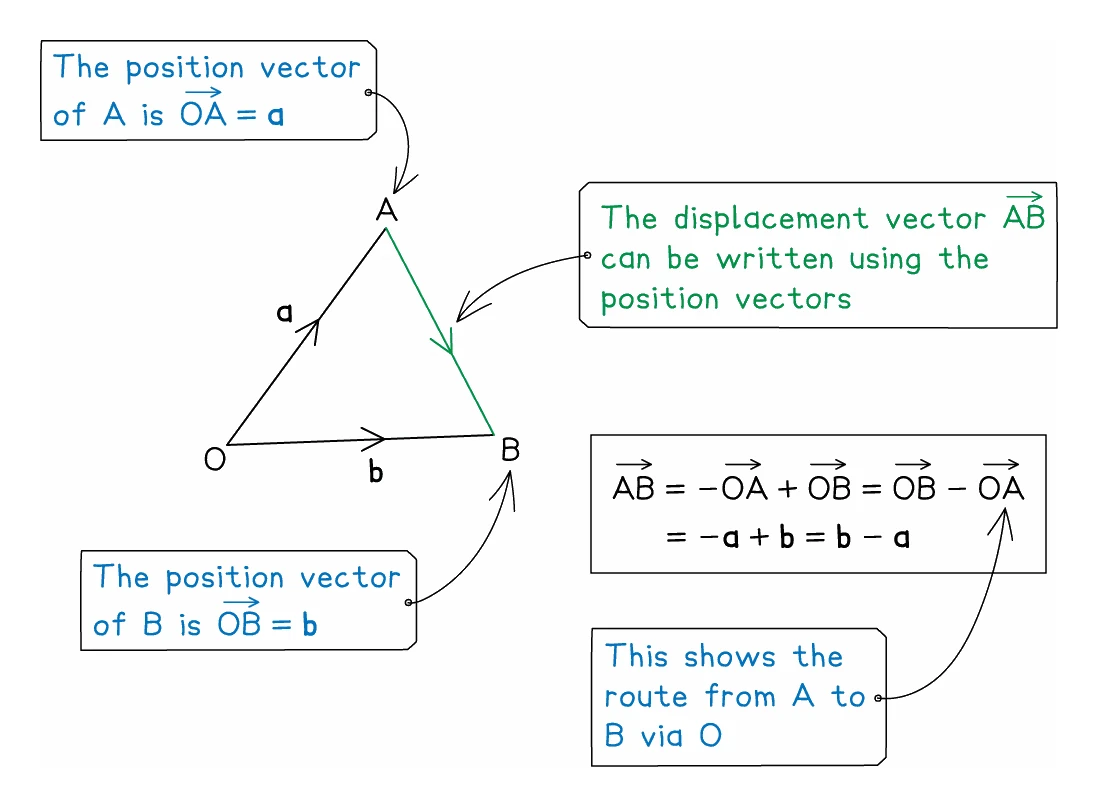
- A position vector gives the location of a point relative to the origin, so the position vector of A is OA
- A question asking for "the position vector of P" wants OP, so your route must start at O
- The vector between two points is found by going backwards to the origin and forwards again: AB = OB − OA
- Reading that as "end minus start" is the quickest way to remember it
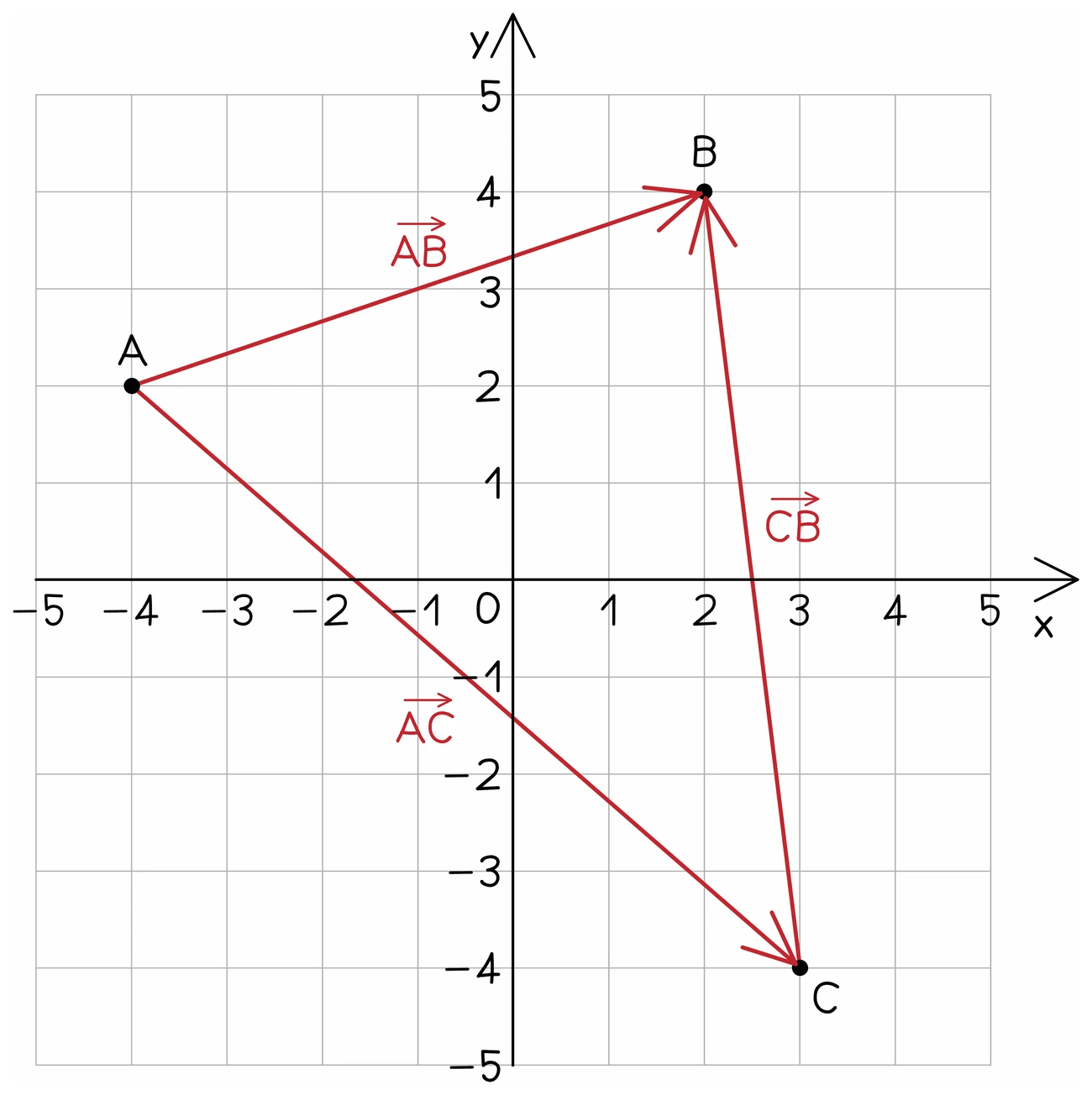
Worked example
From coordinates to a column vector and back
A is the point (−3, 4) and B is the point (2, −1). Find the vector BA. Then find the coordinates of C, where BC = (−7, 3) written as a column vector.
Solution:
- BA goes from B to A, so take B's coordinates away from A's: end minus start
- Top: −3 − 2 = −5
- Bottom: 4 − (−1) = 5
- So BA = (−5, 5) as a column vector, 5 left and 5 up
- For C, start at B and add the movement BC
- x: 2 + (−7) = −5, and y: −1 + 3 = 2
- So C is the point (−5, 2), written as coordinates because the question asks for coordinates
Exam tip
The vector BA starts at B
A vector written the wrong way round, such as AB given when BA was asked for, has both signs flipped, and the schemes give it only one of the two marks, no more than an answer with just one number right. When a question names A and then B but asks for BA, sketch the move from B to A before you subtract, and check that your signs match it.
Finding a path
- Any vector across a diagram can be built by travelling along vectors you already know, in any route that works
- Travelling with an arrow adds that vector; travelling against it subtracts
- Different routes give different-looking expressions that simplify to the same thing, and mark schemes accept any correct path
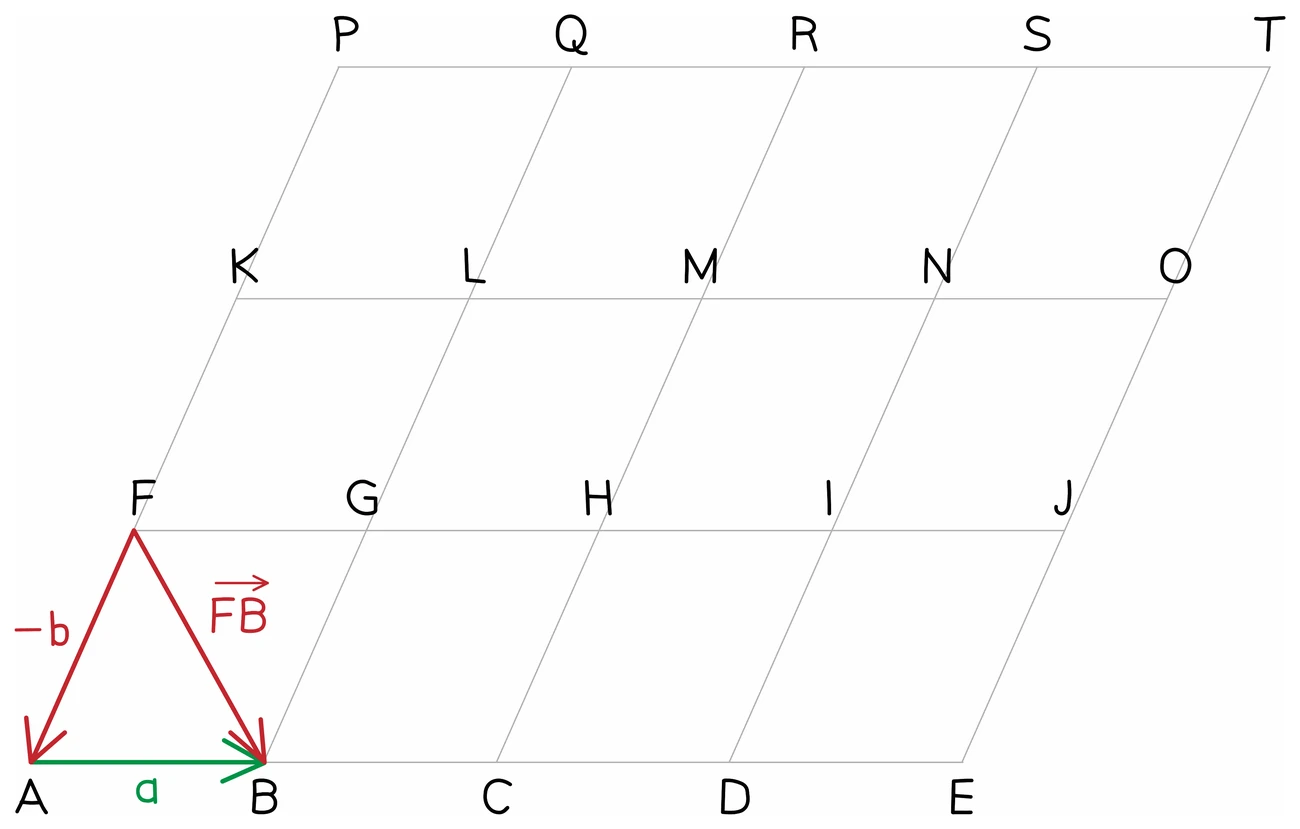
- Collect like terms at the end, because "give your answer in its simplest form" appears on almost every one of these questions
Exam tip
Write the route before you simplify
Questions asking for a vector in terms of two given vectors are set in 11 of the 21 papers. Write the route in letters first, such as OM = OA + AM: the schemes give a mark for a correct route along the lines of the diagram even if nothing else is right. A correct but unsimplified answer usually earns every mark except the last, which needs the like terms collected.
Worked example
A point dividing a line in a ratio
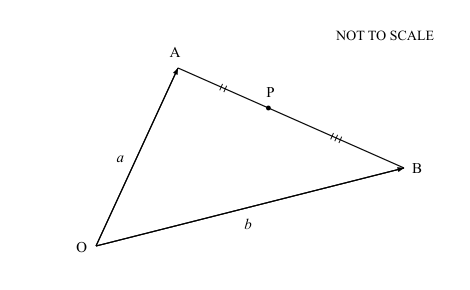
In triangle OAB, OA = a and OB = b. The point P lies on AB so that AP : PB = 2 : 3. Find OP in terms of a and b, simplified as far as possible.
Solution:
- Travel from O to P by going along OA and then part of AB
- First find the whole of AB: AB = OB − OA = b − a
- The ratio 2 : 3 splits AB into 5 equal parts, and P is 2 of them along from A
- So AP = ⅖(b − a)
- Now OP = OA + AP = a + ⅖(b − a)
- Expand: OP = a + ⅖b − ⅖a
- Collect the a terms: OP = ⅗a + ⅖b
- So OP = ⅗a + ⅖b
- Check: at the far end, O to B would give a + 1(b − a) = b, as it should