MathematicsExam code: 0580
Basic Probability
Probability
Measuring likelihood
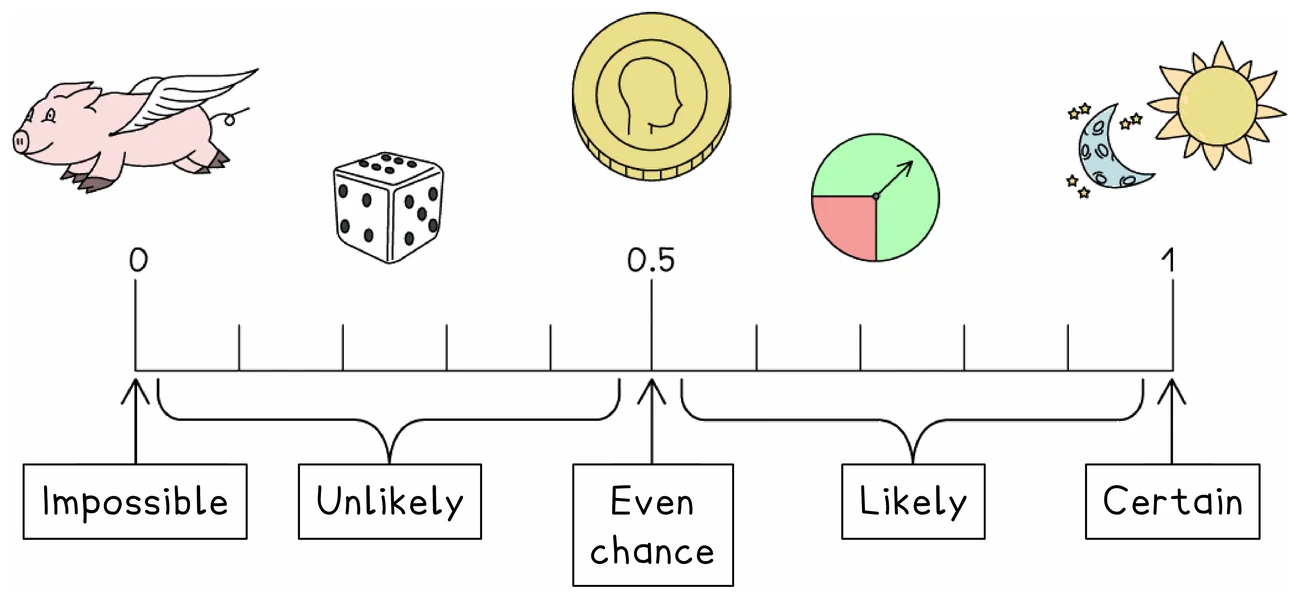
- Every probability is a number from 0 to 1, where 0 means impossible and 1 means certain
- Halfway, at 0.5, the outcome is as likely to happen as not
- Answers may be given as a fraction, a decimal or a percentage, and all three are accepted, but a ratio such as 7 : 20 or words such as "7 out of 20" can lose the mark
- Where the question does not specify, a fraction is usually safest, since it stays exact
- A probability outside 0 to 1 is always an error, so check any answer above 1 or below 0
The words that carry meaning
- An experiment is repeated to produce results, and each repeat is a trial
- An outcome is one possible result; an event may be a single outcome or several of them taken together
- The sample space collects every possible outcome, and is usually set out either as a list or in a table
- Something is fair when every outcome is equally likely, and biased when they are not
- Picking at random means every item has the same chance of being chosen
Notation
- The probability of event A is written P(A), and the probability of A not happening is P(A′)
- n(A) counts the outcomes in event A, matching the set notation used with Venn diagrams