Firms' Costs, Revenue & Objectives
Microeconomic Decision Makers
Several derived costs follow from FC and VC.
| Concept | Formula |
|---|---|
| Total variable cost (TVC) | Variable cost per unit × Quantity (Q) |
| Total cost (TC) | Total fixed cost (TFC) + Total variable cost (TVC) |
| Average fixed cost (AFC) | TFC ÷ Q |
| Average variable cost (AVC) | TVC ÷ Q |
| Average total cost (ATC) | TC ÷ Q (also AFC + AVC) |
Average total cost is sometimes written AC (average cost) instead of ATC. The two mean exactly the same thing, and both abbreviations are recognised in exam answers.
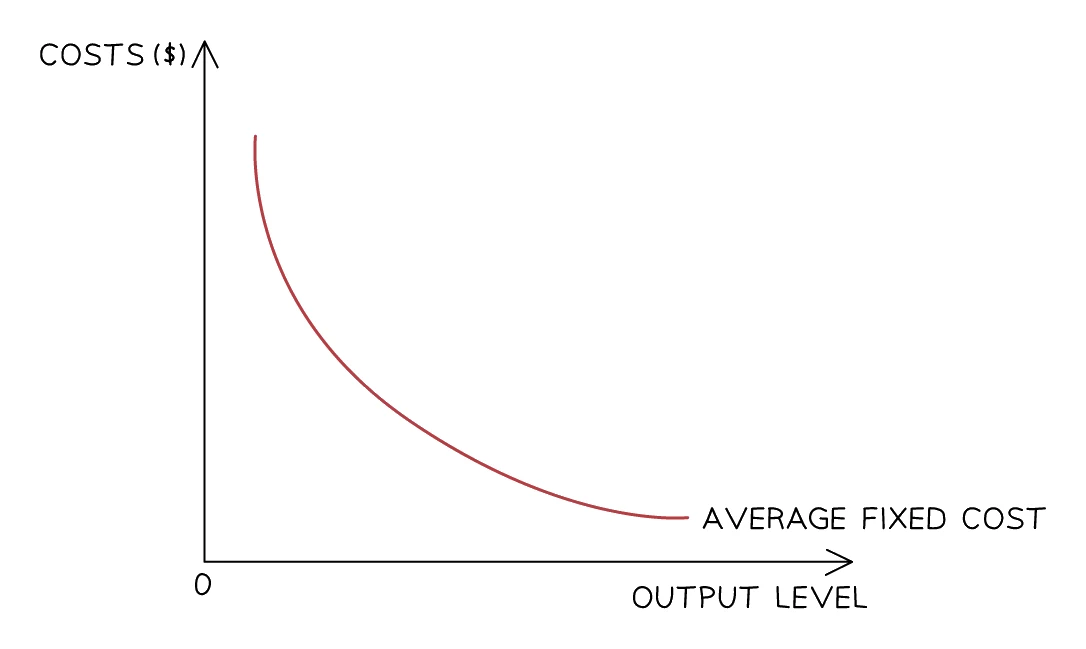
Because a fixed total is spread over more and more units, average fixed cost falls continuously as output rises, steeply at first and then flattening out. This is one reason a firm's average total cost (ATC) tends to fall as it produces more.
Common exam question
Calculating a cost from figures or a graph
Question: Work out average total, fixed or variable cost, or fixed cost, from totals, a table or a total cost graph, or say how average cost is calculated (1 mark, multiple choice).
Set in 7 of the 13 multiple-choice papers. Find the right total, then divide by output. Fixed cost is total cost at zero output, the same at every output; total variable cost is total minus fixed cost. Wrong options reuse the numbers: a total for the average asked for, or another average. Check the units: one table was in thousands.
For the average after one more unit, rebuild the total: four units averaging $15 cost $60, so a fifth costing $20 gives $80 ÷ 5 = $16. For how ATC changes, calculate each value rather than assume a U shape.
Asked in 1 of the 11 structured papers, as a one-mark data part (total cost ÷ number produced); an answer in millions needed at least two decimal places.
Worked example
Calculating TC, ATC, TR and profit from a data set
A firm has fixed costs of $800 per week. It produces 200 units, with a variable cost of $3 per unit. It sells every unit at a price of $8.
Solution:
- Total variable cost (TVC) = $3 × 200 = $600
- Total cost (TC) = TFC + TVC = $800 + $600 = $1,400
- Average total cost (ATC) = TC ÷ Q = $1,400 ÷ 200 = $7 per unit
- Total revenue (TR) = price × quantity sold = $8 × 200 = $1,600
- Profit = TR − TC = $1,600 − $1,400 = $200 profit
Worked example
Finding fixed cost, AFC and AVC from total cost
A print shop's total cost is $450 a week when it prints nothing and $1,650 a week when it prints 300 posters. Calculate its fixed cost, and its average fixed, average variable and average total cost at 300 posters.
Solution:
- Fixed cost = total cost at zero output = $450, and it is still $450 at 300 posters
- Total variable cost (TVC) = TC − FC = $1,650 − $450 = $1,200
- Average fixed cost (AFC) = FC ÷ Q = $450 ÷ 300 = $1.50
- Average variable cost (AVC) = TVC ÷ Q = $1,200 ÷ 300 = $4.00
- Average total cost (ATC) = TC ÷ Q = $1,650 ÷ 300 = $5.50
- Check: AFC + AVC = $1.50 + $4.00 = $5.50, the same as ATC
Keep each average with its own total: $450 is the fixed cost, not the AFC, and $5.50 is the average total cost, not the average variable cost.