Firms' Costs, Revenue & Objectives
Microeconomic Decision Makers · 5 question types
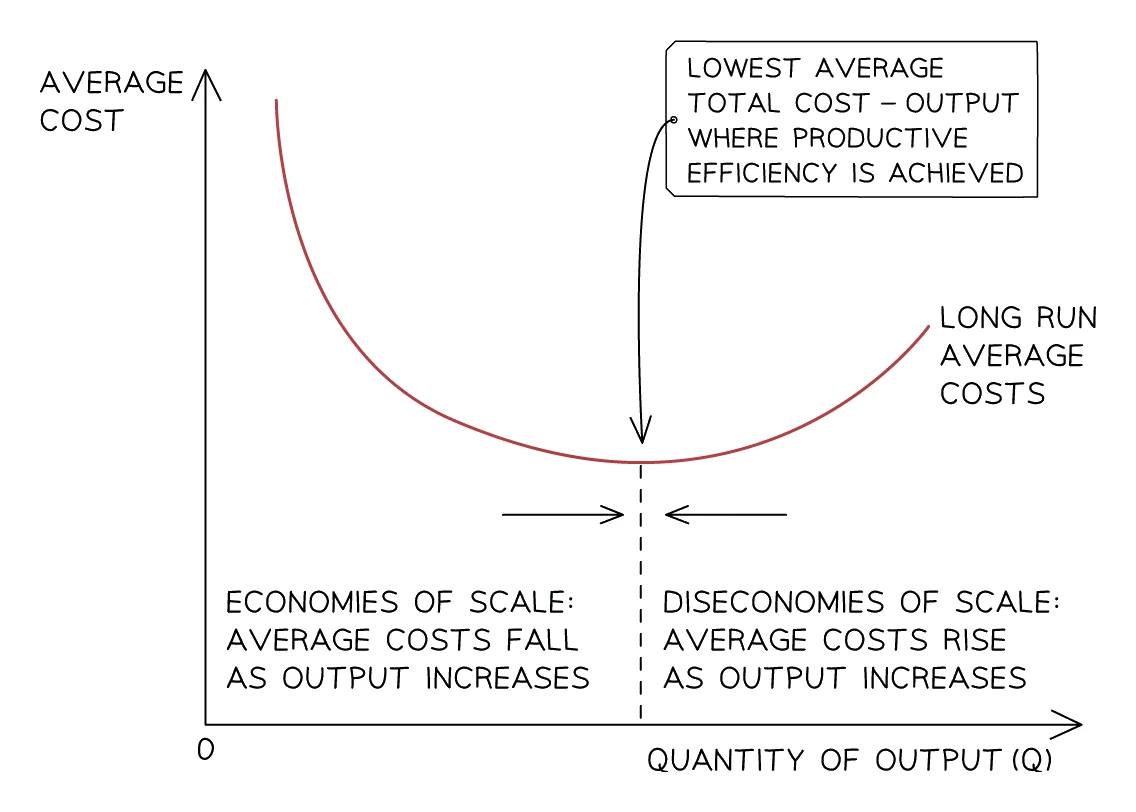
As a firm gets larger, its typically falls for a while and then, beyond some point, starts to rise. Two opposing forces are at work.
Economies of scale are the fall in long-run average cost that a firm enjoys as it grows in size and output.
Diseconomies of scale are the rise in long-run average cost that a firm suffers once it becomes too large to run efficiently.
The point on the long-run average-cost curve where economies stop and diseconomies begin is the lowest point on the curve, where average cost is at its minimum.
Internal economies of scale
These are cost savings the firm captures as it grows. The syllabus only requires you to explain how internal economies affect a firm as its scale of production changes, but six types are commonly distinguished and naming them earns credit.
| Type | What it is |
|---|---|
| Technical | Larger machines, specialised production lines, longer production runs that lower unit cost (e.g. a car assembly line that makes 1,000 cars a day has far lower unit cost than a workshop making 5 a day). |
| Financial | Big firms can borrow at lower interest rates (banks see them as lower risk) and can issue shares; small firms pay more for finance. |
| Marketing | Advertising and branding spread across millions of units of output; the cost per unit sold is tiny. |
| Managerial | Large firms can hire specialist managers for finance, marketing, HR, operations. Small firms have one owner doing everything badly. |
| Purchasing | Bulk-buying discounts when a firm orders raw materials in huge quantities. |
| Risk-bearing | Large firms diversify across products, markets and regions; a bad year in one area is offset by a good year in another. |
Analyse how growing in size affects average total cost (6 marks)
What comes up: "Analyse how increasing output affects a firm's average total cost", or "Analyse the benefits a firm may gain from growing in size" (6 marks). Both want a structured chain of reasoning about why average total cost first falls and then rises.
Write: A firm that grows can gain economies of scale (1): for example, purchasing economies from bulk-buying raw materials reduce the cost per unit (1), or technical economies from larger, more specialised machinery lower the cost per unit produced (1). The mark scheme also credits financial, managerial and marketing economies. Beyond a certain scale the firm may suffer diseconomies of scale (1): communication problems between management layers, coordination failures across divisions, or falling worker motivation can all raise average total cost (1).
Watch out: Do not state only that "costs fall". The second mark in each pair is for explaining why cost per unit falls as output rises. For diseconomies, the mark scheme credits communication problems, control problems and poor industrial relations as specific examples, so name at least one.
Internal diseconomies of scale
Once a firm grows past the output at which long-run average cost is at its minimum, several problems begin to drive average cost back up.
| Type | What goes wrong |
|---|---|
| Communication | Messages get distorted as they pass through more layers of management; decisions are based on partial or wrong information. |
| Coordination | A huge firm with many factories, departments and divisions struggles to keep everyone working toward the same goal. |
| Motivation | Individual workers feel like a tiny cog in a giant machine; productivity falls. |
| Control | Senior managers cannot oversee everything; sub-divisions develop their own (sometimes inefficient) practices. |