Firms' Costs, Revenue & Objectives
Microeconomic Decision Makers · 5 question types
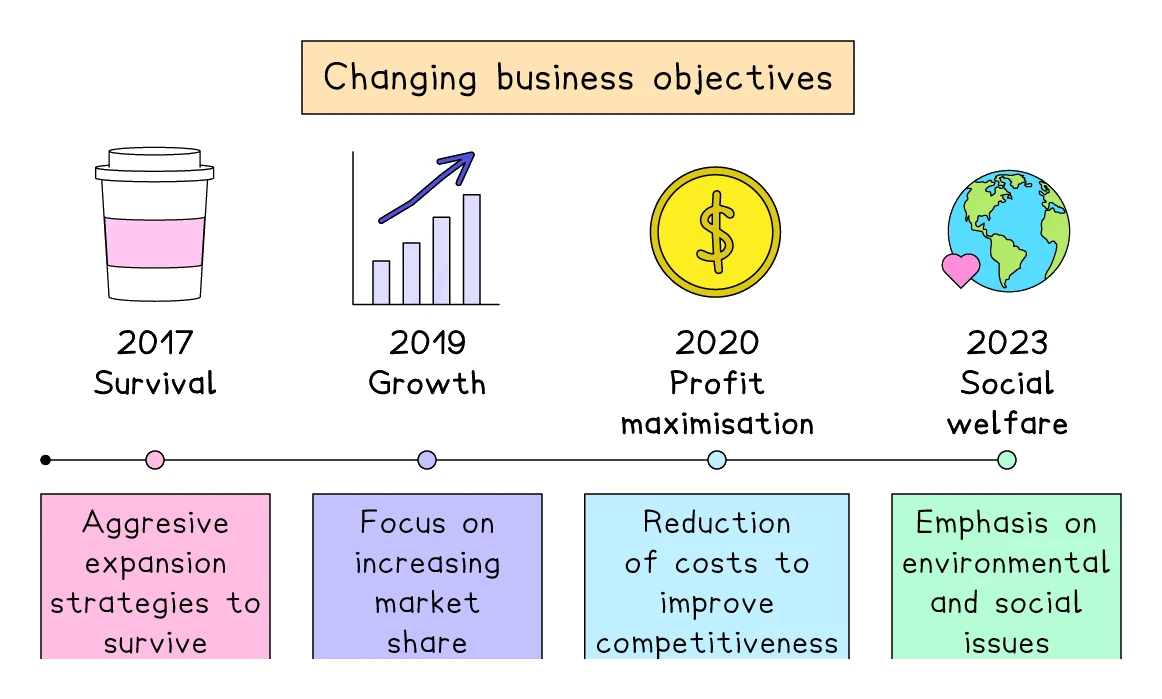
A firm's owners decide what the firm is trying to achieve. Four objectives recur in exam questions.
| Objective | What the firm prioritises |
|---|---|
| Profit maximisation | Maximising the gap between TR and TC. The textbook "rational" objective and the default for most private firms. |
| Growth | Maximising revenue, market share, or number of employees rather than profit, often to access economies of scale. |
| Survival | Staying in business at all costs. Common for new start-ups (roughly a quarter of newcomers do not last 12 months) and for established firms during recessions. |
| Social welfare | Producing benefits for society or the environment alongside profit. Common for charities, social enterprises and sustainability-focused businesses. |
Objectives can change over time. A firm might focus on survival in its first year, switch to growth once it is established, then settle into as a mature business. A previously profit-focused firm might switch to social welfare if its owners or shareholders increasingly value sustainability.
Explain an objective other than profit maximisation (4 marks)
What comes up: "Explain two objectives a firm may have other than maximising profit" — a 4-mark question rewarding two identified objectives, each with a one-line development.
Write (two marks each): (1) Survival — a new firm or one in a recession may aim only to stay in business, accepting low or no profit so it does not have to close. (2) Growth — a firm may aim to increase its size, market share or sales revenue, partly to gain economies of scale that lower its average cost. (3) Social welfare — a charity, social enterprise or sustainability-focused firm may aim to benefit society or the environment rather than to make the largest possible profit.
Watch out: State the objective and why the firm pursues it. Naming "growth" alone, without the reason (market share, economies of scale, or higher total profit), earns only the identification mark, not the explanation mark.