Firms' Costs, Revenue & Objectives
Microeconomic Decision Makers · 5 question types
Fixed costs (FC) are costs that stay the same whatever the firm produces. They have to be paid even if output is zero, and they do not rise when output rises.
Variable costs (VC) are costs that change directly with the level of output. They rise as production rises and fall as production falls.
| Type | Definition | Typical examples |
|---|---|---|
| Fixed costs | Independent of output | Rent on premises, business-rate property tax, insurance, loan interest, salaries of permanent staff |
| Variable costs | Move with output | Raw materials, piece-rate wages, packaging, energy used in production, delivery fuel |
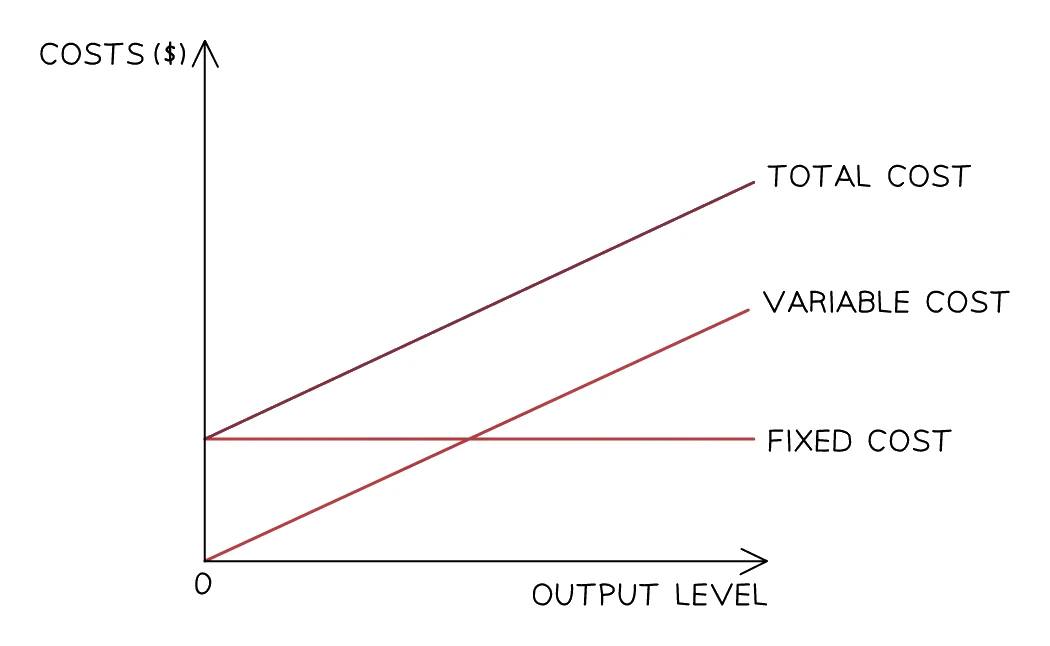
Plotted against output, fixed cost is a horizontal line (unchanged by output), total variable cost rises from the origin, and total cost is the two added together, so it starts at the level of fixed cost and rises parallel to the variable cost line.
Two distinctions that examiners specifically test:
- Wages can be fixed or variable. A permanent salaried manager is a fixed cost (paid the same whether output is high or low). A piece-rate factory worker who is paid per unit produced is a variable cost.
- are a short-run concept. Over the long run, every cost becomes variable (a firm can sell its premises, terminate insurance contracts, repay loans). Here, "fixed" is shorthand for "fixed in the short run".
A common slip: confusing fixed costs with . Fixed costs still exist in the short run; sunk costs are costs that have already been paid and can never be recovered (e.g. money spent on a market-research report that is now in the firm's drawer).
Defining a fixed cost (2 marks)
What comes up: "Define, with an example, a fixed cost" — a standard 2-mark definition question.
Write (two marks): (1) A cost that does not change with the level of output, or a cost that must be paid even when output is zero. (2) An example, such as rent on premises, insurance premiums, or loan interest payments.
Watch out: Stating only that a fixed cost "does not change" without linking it to output earns no marks. The mark scheme requires the connection to output (or to zero output) explicitly. Wages can be accepted as an example only when you make clear they are a fixed salary rather than a piece-rate payment.