Energetics
Physical Chemistry · 3 question types
What calorimetry measures
- uses temperature change to measure heat transfer in a chemical reaction
- Two settings appear:
- Reactions in solution (neutralisation, dissolving, metal displacement) — energy transferred to or from the surrounding solution
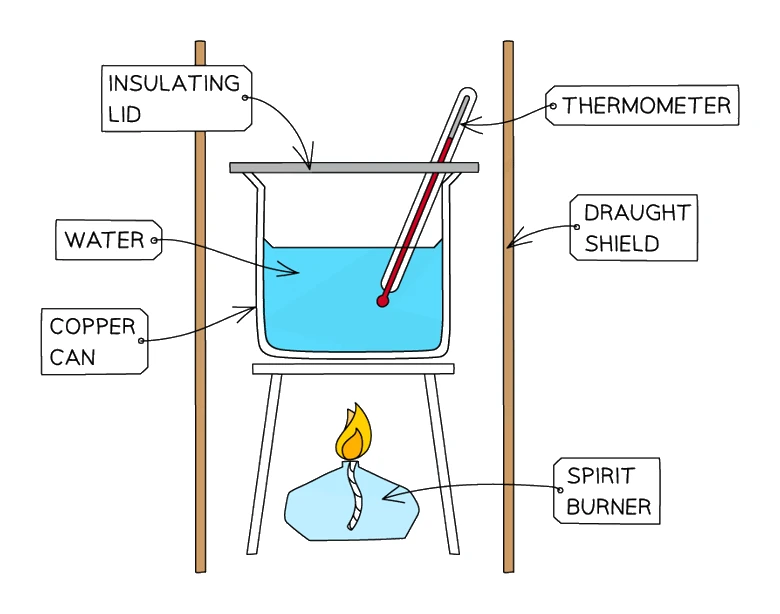
- Combustion of fuels — energy transferred to a known mass of water above a spirit burner
Assumptions used to keep the maths tractable
- The solution has the same density as water (1.00 g cm⁻³), so 100 cm³ of solution has a mass of 100 g
- The solution has the same specific heat capacity as water, 4.18 J g⁻¹ °C⁻¹
- No energy escapes from the cup, and the container itself takes up none of the heat
- The reaction goes to completion
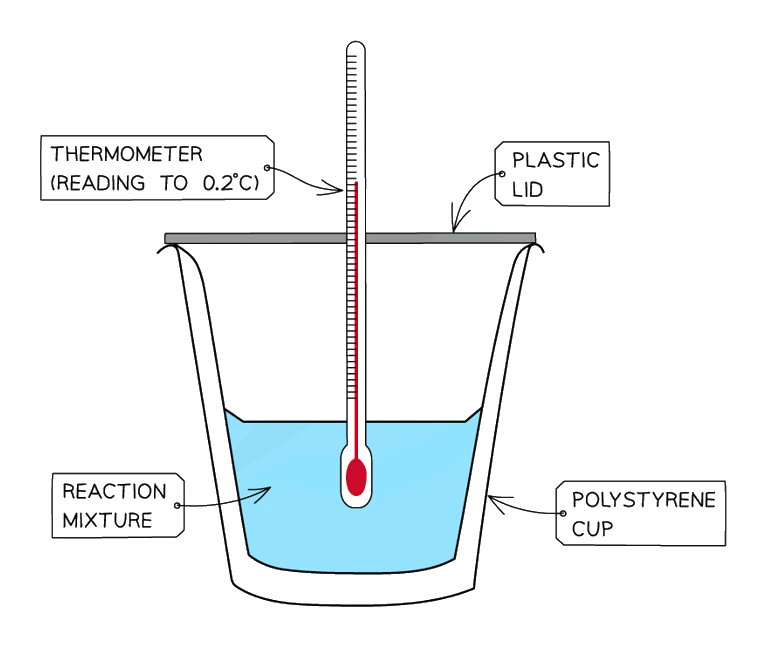
Why a polystyrene cup gives a more accurate result
Question: Explain why a polystyrene cup, rather than a glass beaker, makes the measured temperature change more accurate (1–2 marks).
Asked in 5 of the 23 papers, once as part of a six-mark comparison of two methods. The first mark is that polystyrene is an insulator (a poor conductor of heat); the second is what follows, less heat is lost to the surroundings, so the recorded temperature change is nearer the true one. Say "less" or "reduces": "no heat loss" is rejected.
Match the direction to the reaction. For an endothermic reaction the cup's job is to stop heat entering from the surroundings, and "prevents heat loss" is rejected there. The metal can used to burn a fuel is the opposite case: it is chosen because the metal conducts heat better than glass, so the heat passes through it into the water. The mark needs that comparison, and an answer about insulation is rejected.
Calorimeter for reactions in solution
- Method:
- Use a measuring cylinder to add a known volume of one reactant to the cup
- Note the initial temperature with a thermometer once the reading has steadied
- Add an excess of the second reactant in one go, stir continuously, and watch the temperature
- Record the maximum (for exothermic) or minimum (for endothermic) temperature reached
- Why an excess of the second reactant: it ensures the first is the so the full amount of energy is released or absorbed
Why the mixture is stirred
Question: Give a reason, or two reasons, why the student stirs the mixture or the water (1–2 marks).
Asked directly in 2 of the 23 papers, and it is also one of the credited points in a third paper's comparison of two methods. The mark is for an even temperature throughout the liquid, so that the thermometer records the true highest (or lowest) reading. When a solid is added, the second reason is that the solid dissolves more quickly. Say dissolving, not reacting: "to speed up the reaction" earns nothing, and two of the three schemes say to ignore it.
A related one-mark question asks why the spirit burner is weighed immediately after the flame is put out: so that no fuel is lost by evaporation before the mass is read.
Reading the thermometer and completing the temperature table
Question: Read the thermometer diagram and complete the temperature table (start, highest or lowest, and change) to the nearest 0.1 °C (2 marks).
Set in 4 of the 23 papers. Read the scale to one decimal place and write every value that way, including one that lands on a whole number (21.0, not 21): a value not given to 0.1 °C is penalised, though only once. Usually the temperature change is already printed, so you read one temperature and work out the other: add the change for a rise, take it away for a fall (the lowest temperature in an endothermic change). That value carries follow-through from your reading, so a misread thermometer still earns its mark when the arithmetic is right. When the change itself is asked for (one paper), it is the difference between the two readings, written as a positive number. Putting the two readings in each other's rows earns one of the two marks.
Calorimeter for combustion of a fuel
- Method:
- Weigh out a fixed mass of water inside a copper can, and clamp the can above the burner
- Weigh the spirit burner with the fuel; record the initial mass
- Read the starting temperature of the water against a thermometer dipping into the can
- Light the burner and stir the water gently
- When the water has risen by about 20 °C, blow out the flame and record the final temperature
- Re-weigh the burner; the loss in mass is the mass of fuel burnt
- Main sources of error:
- Heat lost to the surrounding air rather than to the water
- Heat absorbed by the copper can rather than the water
- Incomplete combustion (visible black soot on the underside of the can confirms this)
Why the measured value is lower than the data-book value
Question: Give reasons why the value of ΔH from the experiment is lower than the data-book value, or why the temperature reached is lower than the calculated maximum (1–2 marks).
Asked in 3 of the 23 papers. Any of these earns a mark: heat is lost to the surroundings (or to the apparatus), the fuel undergoes incomplete combustion, the metal can absorbs some of the heat, or some fuel evaporates instead of burning (or is impure). The solution version has one answer, heat lost to the surroundings, and "energy is lost" is ignored unless heat or thermal energy is named.
Two papers ask you to name the black solid on the base of the can, and one also asks why it forms: it is carbon (soot), made by incomplete combustion because the supply of air (oxygen) is limited.