Energetics
Physical Chemistry
Energy in to break bonds, energy out to make bonds
- During a reaction:
- Existing bonds in the reactants must be broken — this takes energy IN (an endothermic step)
- New bonds in the products are formed — this gives energy OUT (an exothermic step)
- Whether the overall reaction is exothermic or endothermic depends on which of these is larger:
- If energy released from forming new bonds > energy needed to break old bonds → exothermic (ΔH negative)
- If energy needed to break old bonds > energy released from forming new bonds → endothermic (ΔH positive)
- Mnemonic for the direction: bond breaking is the END of the bond, so it is END-othermic; bond making is EX-othermic
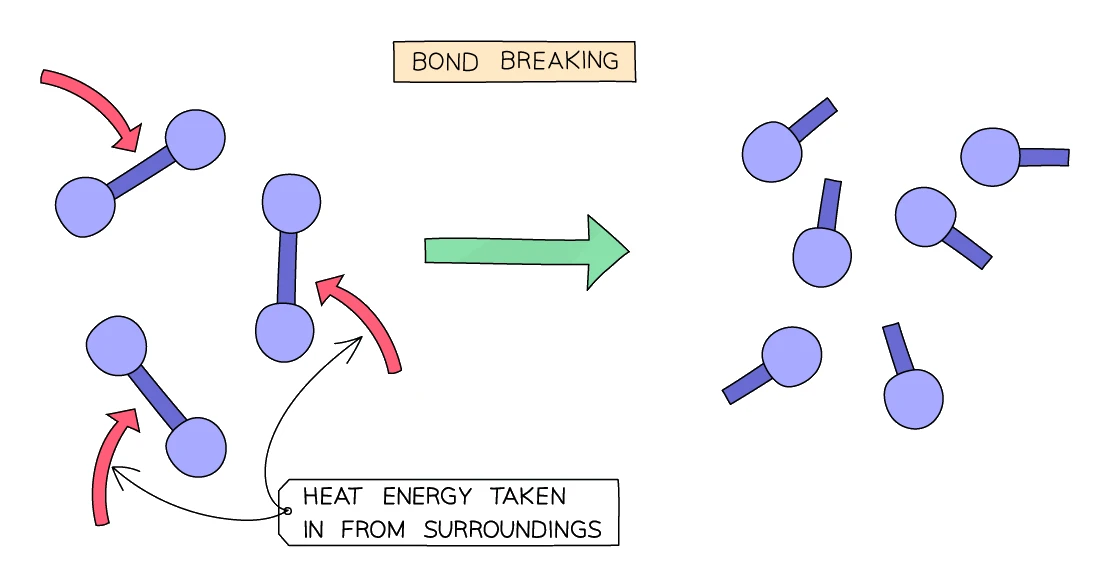
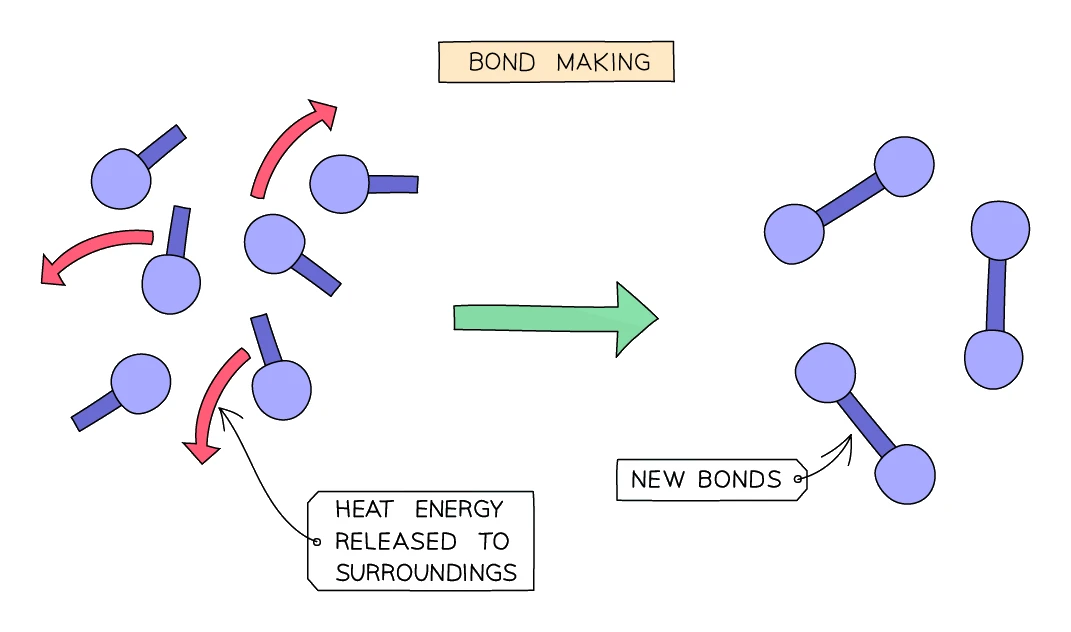
Bond energy values
- The of a given bond is the energy needed to break one mole of that bond, in the gas phase, in kilojoules per mole (kJ mol⁻¹)
- Bond energies are quoted in data books as positive values (the amount of heat that has to be supplied to snap that bond apart)
- Stronger bonds have larger bond energies (e.g. the triple bond N≡N is much larger than the single bond N−N)
Calculating ΔH from bond energies
- General method:
- Write out the equation with every bond shown explicitly (a "displayed formula")
- Energy in = sum of the bond energies of every bond in the reactants
- Energy out = sum of the bond energies of every bond in the products
- ΔH = (energy in) − (energy out)
- A negative answer means the products are at lower energy → exothermic; a positive answer → endothermic
Common exam question
Bond-energy calculations and the sign of ΔH
Question: Use the bond energies given and the displayed formulae to calculate the enthalpy change of the reaction, including a sign, or show that it is approximately the value stated (3–4 marks).
Set in 8 of the 23 papers, all on Paper 2. One mark is the total for the bonds broken, one for the bonds made, and the last is broken minus made with its sign; count each bond across every molecule in the equation. The totals are marked ignoring sign, but the final ΔH needs one: negative when more energy is released making bonds than taken in breaking them. Bonds unchanged by the reaction may be left out of both totals (either route is accepted).
For "show that", working must be shown and the bare target value scores nothing; when a value is asked for, a correct signed answer needs no working. Two papers reverse it, giving ΔH and asking for one bond energy (second worked example below).
Worked example
Calculating ΔH from bond energies
Hydrogen reacts with fluorine: H₂ + F₂ → 2HF. Use the bond energy data to calculate ΔH. Bond energies: H−H = 436 kJ/mol, F−F = 158 kJ/mol, H−F = 568 kJ/mol.
Solution:
- Energy in to break the bonds in the reactants = 436 (H−H) + 158 (F−F) = 594 kJ
- Energy out when the bonds in the products form = 2 × 568 (two H−F) = 1136 kJ
- ΔH = energy in − energy out = 594 − 1136 = −542 kJ/mol
- More energy is released forming the two H−F bonds than is taken in breaking H−H and F−F, so the reaction is exothermic
Worked example
Finding an unknown bond energy from ΔH
Ethene reacts with hydrogen to form ethane: C₂H₄ + H₂ → C₂H₆, ΔH = −124 kJ/mol. Bond energies: C=C = 612 kJ/mol, C−H = 412 kJ/mol, H−H = 436 kJ/mol. Calculate the bond energy of the C−C bond.
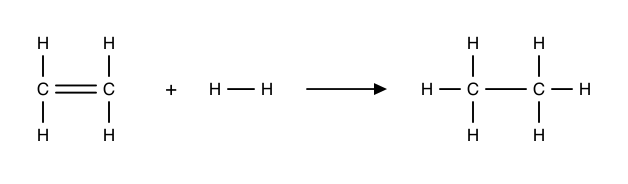
Solution:
- Bonds broken: one C=C, one H−H and four C−H, so 612 + 436 + (4 × 412) = 2696 kJ
- Bonds made: one C−C (call it x) and six C−H, so x + (6 × 412) = x + 2472 kJ
- ΔH = broken − made: −124 = 2696 − (x + 2472) = 224 − x
- x = 224 + 124 = 348 kJ/mol
- Quicker: only the bonds that change need counting, and 612 + 436 − (x + 2 × 412) = −124 gives the same x
Common exam question
Explaining why a reaction is exothermic using bond energies
Question: Explain, in terms of the bonds broken and the bonds made, why the reaction is exothermic (2–3 marks), or why its enthalpy change is zero (2 marks).
Set in 5 of the 23 papers, with the zero version in 2 more, all on Paper 2. The credited ideas: breaking bonds takes in energy (endothermic), making bonds releases energy (exothermic), and the comparison, more energy is released making the new bonds than is taken in breaking the old ones. On three marks each idea is a mark (the comparison mark depends on the first two), but a full comparison sentence on its own scores all the marks on either version. Reversing either direction (energy released on breaking, or needed for making) scores zero, and contradicting yourself caps the answer at one mark. Arguments about the number of bonds are ignored.
For the zero case (an ester forming or hydrolysing), say that the same bonds are broken and made, C−O and O−H, so the energy taken in equals the energy given out.