Ecology & Food Chains
Ecology and the Environment · 8 question types
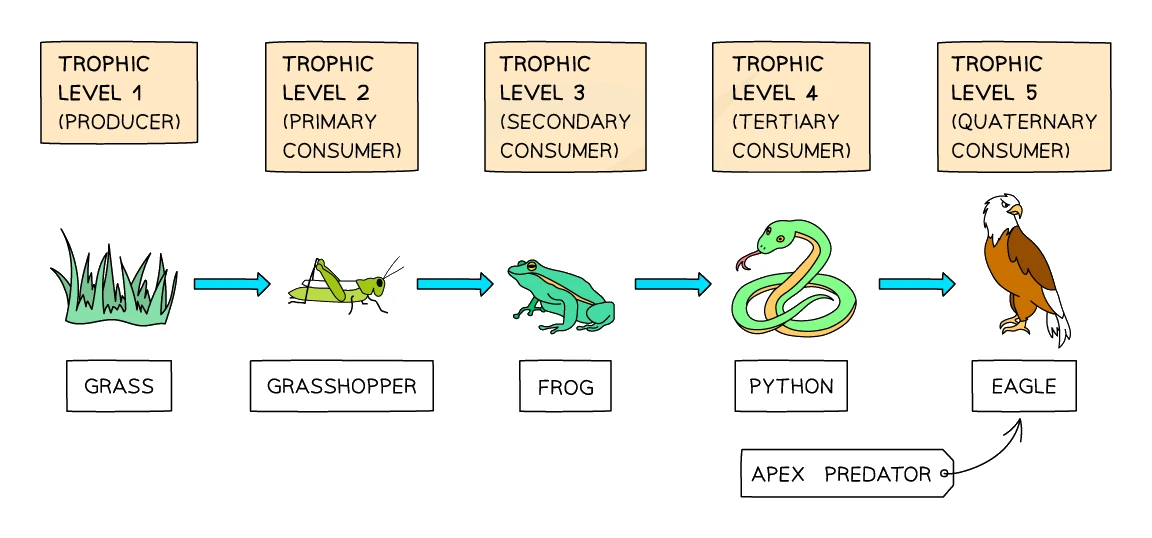
A food chain is a diagram showing the transfer of energy from one organism to the next as one organism eats another. Each step in a food chain is called a .
The trophic levels
| Trophic level | What organisms eat | Examples |
|---|---|---|
| 1st: Producers | Make their own food by photosynthesis, using light energy | Plants, algae, photosynthetic bacteria |
| 2nd: Primary consumers | Eat producers (herbivores) | Cows, caterpillars, rabbits |
| 3rd: Secondary consumers | Eat primary consumers (carnivores or omnivores) | Foxes, frogs, songbirds |
| 4th: Tertiary consumers | Eat secondary consumers (top predators) | Eagles, sharks, lions |
| Decomposers | Feed on dead organisms and waste | Bacteria, fungi, earthworms |
The first trophic level is always a because producers are the only organisms that can convert light energy from the Sun into the chemical energy needed by everything else.
Reading a food chain
A typical food chain is written as a sequence of organisms with arrows pointing in the direction of energy transfer:
grass → rabbit → fox
- Grass (1st trophic level, producer) is eaten by the rabbit
- Rabbit (2nd, primary consumer) is eaten by the fox
- Fox (3rd, secondary consumer) is the top of this chain
Arrows point from the eaten organism to the eater (i.e. in the direction energy flows). The arrow means "is eaten by".
Most natural food chains have four trophic levels at most, because too much energy is lost between levels for a fifth one to be supportable.
Food webs
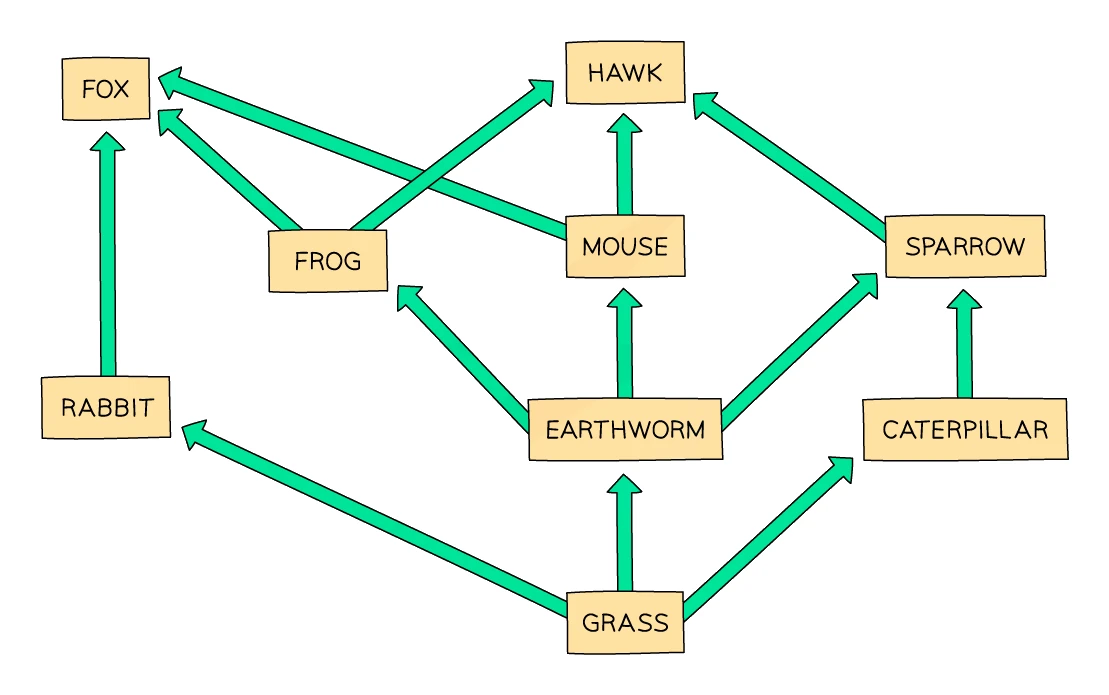
In any real ecosystem, organisms eat many different things, and most are eaten by many different predators. A food web is a diagram showing the network of all the food chains in an ecosystem. The same organism can occupy different trophic levels in different chains.
Species removal: knock-on effects in a food web
Removing a species from a food web can affect every other species in it, sometimes dramatically:
- If a predator is removed, its prey species can multiply unchecked, eventually overgrazing the producers and crashing the whole system.
- If a prey species is removed, its predators have less food and decline; species that depended on it for some other role (e.g. seed dispersal) are also affected.
- If a producer is removed (e.g. an invasive species kills all the grass), every herbivore that ate it suffers, and every carnivore that ate the herbivore is hit too.
A well-known example: sea otters in the Pacific eat sea urchins. Sea urchins eat kelp. When sea otters were hunted to near-extinction in the 19th century, sea urchin numbers exploded, the urchins ate all the kelp, and the kelp forests collapsed. Restoring sea otters has restored the kelp.
Reading a food web: identifying trophic levels and predicting population changes
What comes up: the exam gives a food web diagram and asks you to identify the producer, name a secondary or tertiary consumer, or explain the effect on one organism if another is removed or declines.
Write (three marks for a "predict and explain" question): (1) state which population increases or decreases; (2) give the reason linked to food availability (e.g. less food because its prey species has declined, or more food because competition has been removed); (3) trace the knock-on effect one step further up or down the web.
Watch out: arrows in a food web point in the direction of energy transfer (from eaten to eater). If a predator is removed from a web, do not say its prey "gains a predator" — say its prey population increases because it is no longer being eaten. Always link population change to a specific food-availability or predation reason, not just "because there are fewer predators."