Ecology & Food Chains
Ecology and the Environment · 8 question types
Energy enters every ecosystem as sunlight captured by producers. From there it passes through each trophic level by feeding.
The 10% rule
Only about 10% of the energy at one trophic level is transferred to the next. The other ~90% is lost in various ways. This is the famous "10% rule" of ecology, although the actual figure varies between 5% and 20% in real food chains.
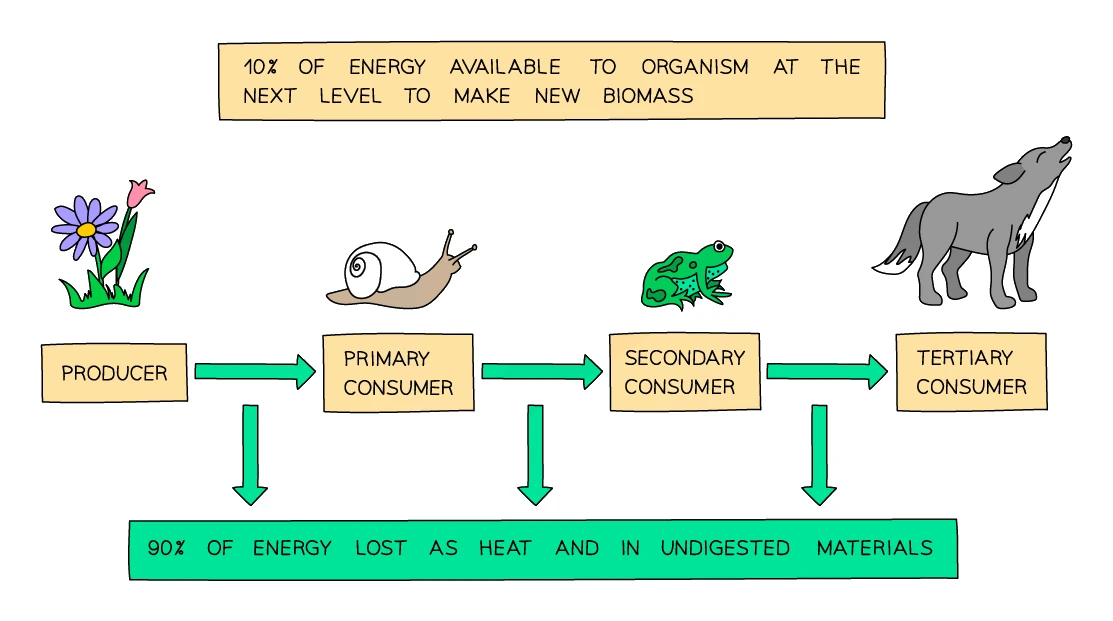
Where the lost energy goes
The 90% of energy that does not make it to the next trophic level is lost in several ways:
| Where the energy goes | Why |
|---|---|
| Heat from respiration | Every organism respires constantly, releasing some energy as heat. Warm-blooded animals (mammals, birds) lose a lot here |
| Movement | Energy is used to contract muscles, breathe, pump blood, etc. None of this energy ends up in the consumer that eats them |
| Excretion | Energy in metabolic waste (urea, CO₂) leaves the body in urine and breath |
| Egestion (faeces) | Some food is not digested or absorbed; it passes through the gut unchanged and leaves as faeces. The energy in it goes to decomposers, not to the predator at the next level |
| Uneaten parts | Predators rarely eat everything. Bones, claws, fur, teeth, roots and bark all contain energy that the predator skips |
| Heat lost to surroundings | Especially in mammals and birds that keep a constant body temperature |
Explaining why energy is lost between trophic levels
Question: Explain why only a small proportion of the energy (or biomass) in one trophic level is passed to the next, or why a higher proportion reaches a predator along a shorter food chain (3–4 marks).
Asked in 4 of the 23 papers. Each separate route earns a mark: energy released by respiration and lost as heat, energy used in movement, parts of the organism not eaten, organisms that die and decompose uneaten, undigested food egested in faeces, and urea excreted in urine. "Energy is lost" alone scores nothing in explain questions: say where it goes. Faeces and urine are separate marks, but "excretes faeces" or "excretes undigested food" earns only one of them, so keep egestion and excretion as two sentences. Respiration, heat and movement are sometimes a single mark, so always add the waste routes. When two chains are compared, the first mark is for the shorter chain having fewer transfers, then two routes of loss.
Why food chains are short
Because so much energy is lost at each step, the chain runs out of usable energy after only a few levels. Most food chains end at the third or fourth trophic level. You almost never see a fifth-level predator (something that eats top predators) because there is too little energy left.
Calculating efficiency of energy transfer
The efficiency of energy transfer between two trophic levels is:
percentage efficiency = (energy at higher level ÷ energy at lower level) × 100
The same formula works for biomass, which is closely linked to energy.
Calculating the efficiency of energy transfer
In a lake, the energy stored in the producers is 24 000 kJ/m²/year, in the primary consumers 2160 kJ/m²/year and in the secondary consumers 324 kJ/m²/year. Calculate the percentage efficiency of energy transfer from producers to primary consumers and from primary to secondary consumers, and state which transfer is more efficient.
Solution:
- Efficiency = (energy at the higher level ÷ energy at the lower level) × 100
- Producers to primary consumers: 2160 ÷ 24 000 × 100 = 9.0%
- Primary to secondary consumers: 324 ÷ 2160 × 100 = 15.0%
- The transfer from primary to secondary consumers is the more efficient one (15.0% against 9.0%).
A correct answer with no working earns full marks in these calculations, and a rounded or an unrounded value is accepted. If a question gives the percentage instead, work backwards: 6% of 40 000 kJ reaching 30 animals is 2400 kJ shared between them, so 80 kJ each.
Why farming is more efficient if you eat plants
The 10% rule has a practical implication. If 1000 kJ of plant energy is grown:
- Eat the plants yourself → you get ~100 kJ (after digestion losses).
- Feed the plants to cattle and eat the cattle → cattle get ~100 kJ from plants; you get ~10 kJ from cattle.
A vegetarian diet uses far less land, water and energy per person than a meat-based diet. This is why feeding the world's growing population is partly about shifting some meat consumption to plants.