Ecology & Food Chains
Ecology and the Environment
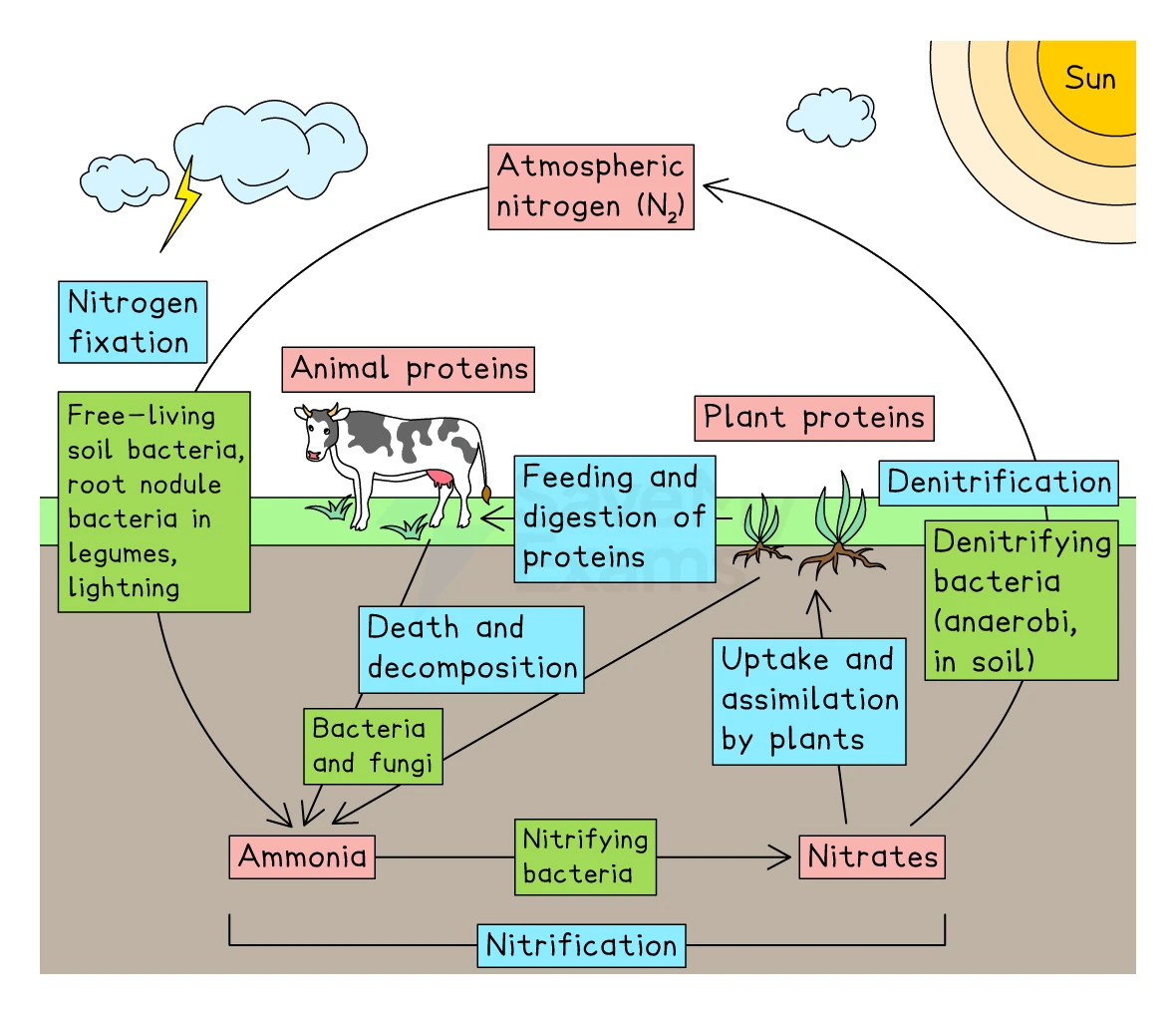
Nitrogen is needed by every living thing to make proteins (and DNA, which contains nitrogen-rich bases). The atmosphere is 78% nitrogen gas (N₂), but this form is chemically unreactive and most organisms cannot use it directly. The nitrogen cycle shows how nitrogen is converted into usable forms and back again.
The four key processes
| Process | What it does | Carried out by |
|---|---|---|
| Nitrogen fixation | Converts N₂ from the air into ammonium (NH₄⁺) and then nitrate ions (NO₃⁻) that plants can use | Nitrogen-fixing bacteria in soil and in legume root nodules; also lightning; also industrial fertiliser production |
| Nitrification | Converts ammonia (from decomposition) into nitrites, then into nitrates | Nitrifying bacteria in the soil |
| Decomposition (ammonification) | Breaks down nitrogen-containing waste (urea, dead bodies) into ammonia in the soil | Decomposers (bacteria and fungi) |
| Denitrification | Converts nitrates in the soil back to N₂ gas, releasing it to the atmosphere | Denitrifying bacteria, in anaerobic conditions (waterlogged soil) |
The full cycle
- N₂ gas in the atmosphere is converted to nitrate in the soil by nitrogen-fixing bacteria. These bacteria come in two main types:
- Free-living bacteria in the soil (e.g. Azotobacter)
- Mutualistic bacteria (e.g. Rhizobium) living in root nodules of leguminous plants (peas, beans, clover, lentils). These plants make excellent crops in rotation because they enrich the soil with nitrogen.
- Plants absorb nitrate from the soil through their roots by active transport.
- Plants use the nitrate to build amino acids and then proteins.
- Animals eat plants (or other animals), taking nitrogen-containing molecules into their own bodies and building their own proteins from them.
- Animals excrete nitrogenous waste (mostly urea) and eventually die.
- (bacteria and fungi) break down dead bodies and waste, releasing ammonia into the soil.
- Nitrifying bacteria convert ammonia → nitrites → nitrates, returning the nitrogen to a form plants can use.
- In waterlogged or compacted soils, denitrifying bacteria convert nitrates back into N₂ gas that returns to the atmosphere.
Named bacteria you should know
| Group | Job | Example |
|---|---|---|
| Nitrogen-fixing bacteria | Fix N₂ gas from the air into ammonium/nitrate compounds | Rhizobium (in legume root nodules), Azotobacter (free-living) |
| Nitrifying bacteria | Convert ammonia into nitrites then nitrates | Nitrosomonas (ammonia → nitrite), Nitrobacter (nitrite → nitrate) |
| Denitrifying bacteria | Convert nitrates back to N₂ gas | Pseudomonas |
Why farmers manage the nitrogen cycle
Crops remove nitrogen from the soil with every harvest. If farmers do nothing, the soil eventually runs out of nitrogen and crop yields fall. Solutions include:
- Adding fertiliser that contains nitrate ions (industrially fixed nitrogen)
- Crop rotation with legumes, which restore nitrogen via their root-nodule bacteria
- Ploughing waterlogged fields to introduce oxygen and reduce denitrification (denitrifying bacteria need anaerobic conditions)
- Spreading manure, which decomposers convert to ammonia and then nitrate
Common exam question
Naming the processes and bacteria of the nitrogen cycle
Question: Name the processes (or the bacteria) labelled on a nitrogen cycle diagram, or describe how ammonia from waste is converted into nitrates (1 mark per label, 2–3 for a description).
Asked in 6 of the 23 papers, all on Paper 2. Match the arrow to its conversion: nitrogen fixation turns nitrogen gas into ammonium or nitrates (nitrogen-fixing bacteria); nitrification turns ammonium into nitrite and then nitrate (nitrifying bacteria); denitrification turns nitrates back into nitrogen gas (denitrifying bacteria); decomposition of protein and urea releases ammonia (decomposer bacteria and fungi). Naming either the process or its bacteria earns the mark. For the description, write both nitrification steps: one scheme ignores "ammonium to nitrate" because it skips nitrite, and gives that mark only for ammonium to nitrite or nitrite to nitrate. The multiple-choice distractors are the three other groups: decomposers release ammonia, denitrifying bacteria remove nitrates, and nitrogen-fixing bacteria do not make them from ammonium.