Ecology & Food Chains
Ecology and the Environment · 8 question types
Food chains can be drawn as ecological pyramids, where each trophic level is shown as a horizontal bar. The width of the bar represents the amount of something at that level. There are three types of pyramid.
Pyramid of numbers
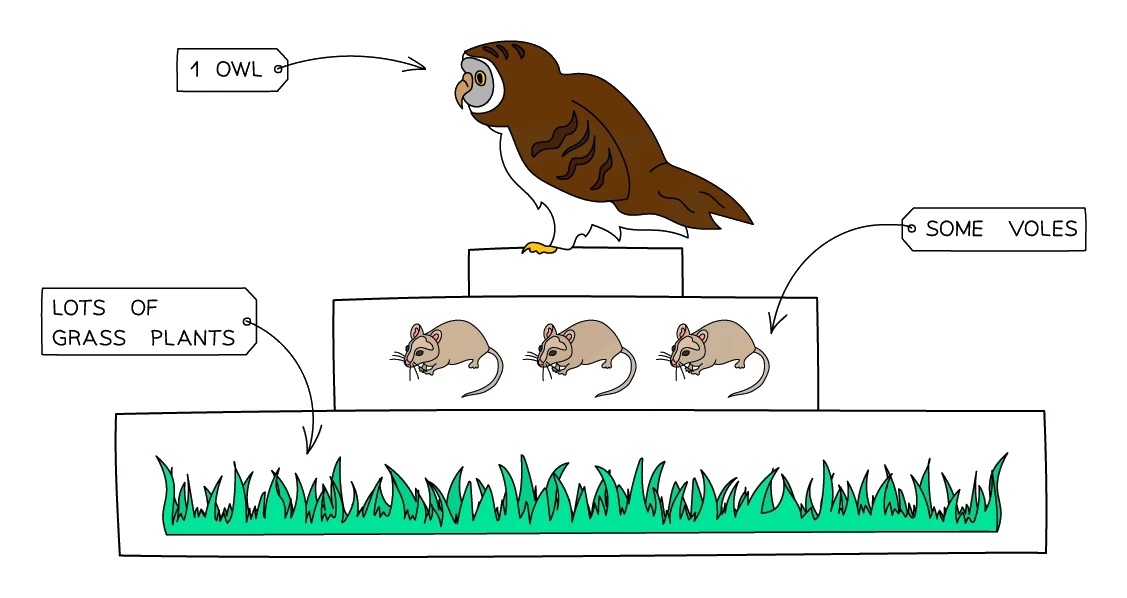
A pyramid of numbers shows how many organisms are at each trophic level. The width of each bar is proportional to the number of individuals.
For most food chains, this gives a true pyramid shape:
grass (millions of plants) → vole (thousands) → owl (few)
But pyramids of numbers are not always pyramid-shaped. If many small organisms feed on one large organism, the producer level is narrower than the consumer level:
oak tree (1) → caterpillar (thousands) → robin (a few) → flea (many)
This gives an awkward shape with a narrow base.
Pyramid of biomass
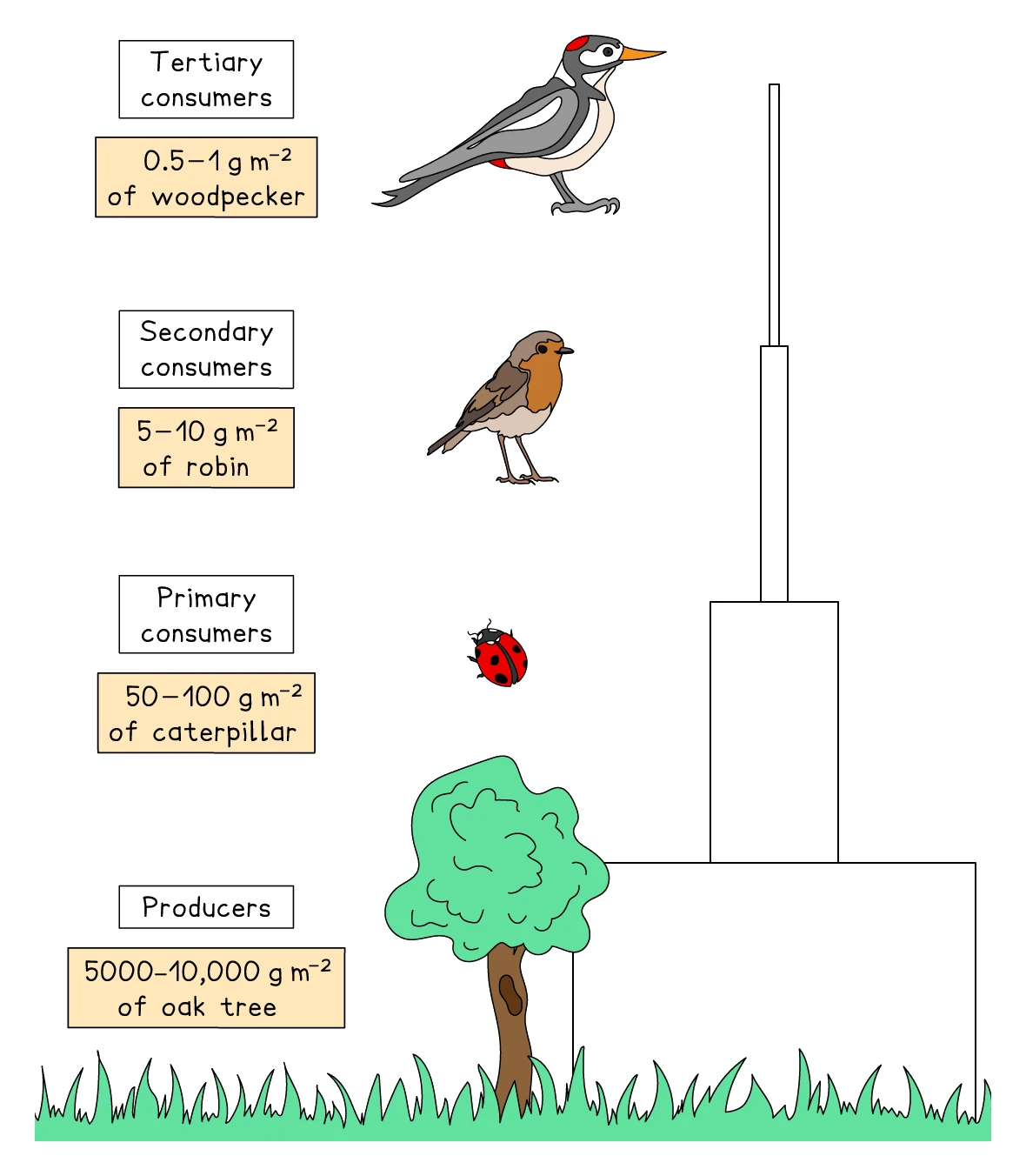
A pyramid of shows the total mass of living matter at each trophic level (in g/m² or kg per area).
Pyramids of biomass are almost always pyramid-shaped, because the biomass at each level is always less than the level below. The example above looks normal in biomass terms:
oak tree (huge mass) → caterpillars (small mass) → robins (smaller mass) → fleas (tiny mass)
Pyramid of energy
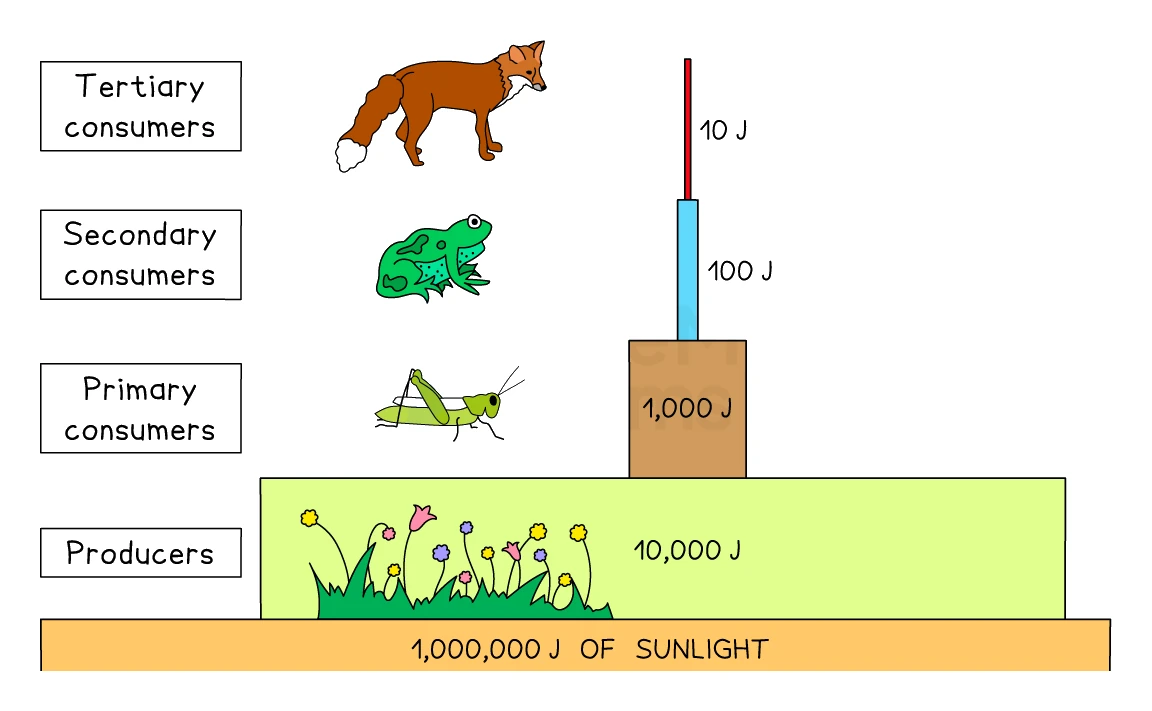
A pyramid of energy shows the energy stored in the biomass at each trophic level (in kJ/m²/year).
Pyramids of energy are always pyramid-shaped. Energy is lost at every level, so there is always less stored energy at higher trophic levels than at lower ones. This is true for every food chain without exception.
Why bigger animals are rarer
The pattern of "many small organisms supporting fewer large ones" appears everywhere because of the energy loss between levels. A square kilometre of grassland can feed thousands of rabbits, but only a few foxes can live off the rabbits. This is why top predators are rare in most ecosystems.