Ecology & Food Chains
Ecology and the Environment · 8 question types
You cannot count every individual organism in a large area, so ecologists sample: count what is in a small area, then scale up to estimate the whole population.
Quadrats
A quadrat is a square frame, often 0.5 m × 0.5 m or 1 m × 1 m, placed on the ground. You count all the individuals of the species you are interested in inside the quadrat.
Quadrats are mainly used for plants and slow-moving animals (snails, limpets). They are no use for fast animals like birds or mammals, which would run away.
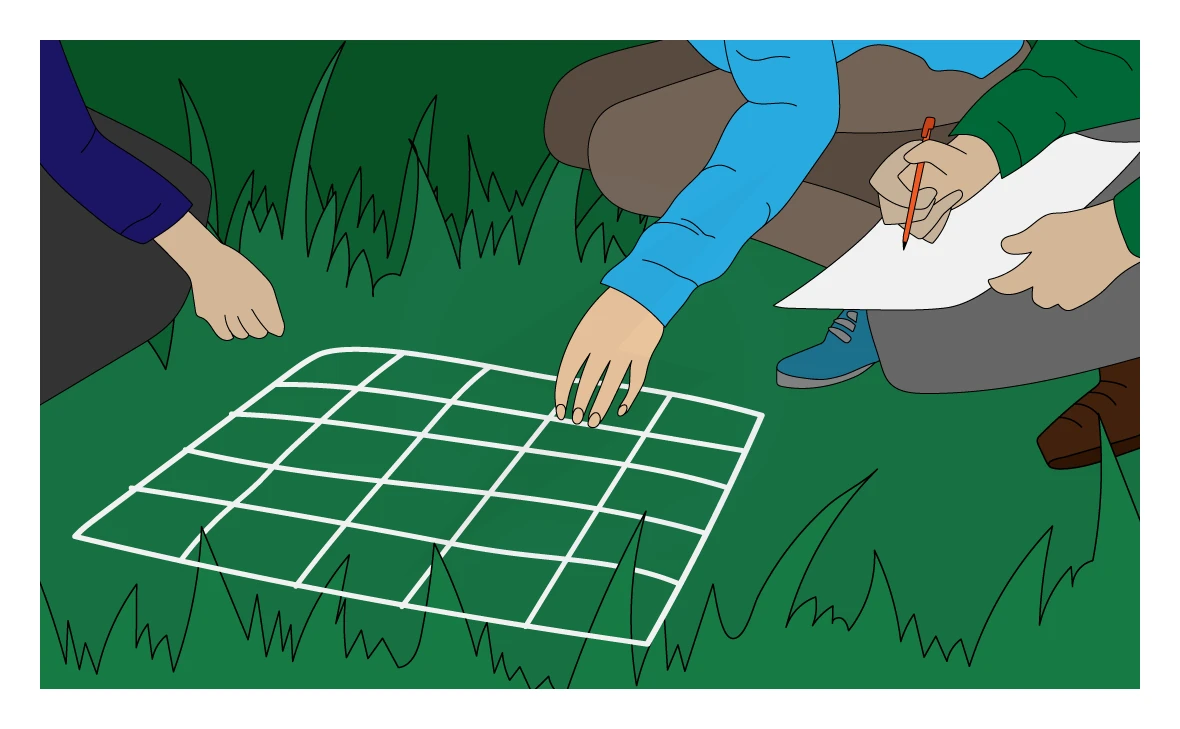
Using a quadrat to estimate population size
- Mark out the area to be sampled (e.g. a 10 m × 10 m square) using two tape measures.
- Place the at a random position by generating two random numbers (one for each coordinate). Random placement is essential: a biased choice of position (e.g. only sunny patches) would give a biased result.
- Count and record the number of individuals of the target species inside the quadrat.
- Repeat at least 10 times at different random positions, and take a mean count per quadrat.
- Calculate the total population using:
estimated total population = (mean count per quadrat) × (total area ÷ area of one quadrat)
Two ways to measure with a quadrat
- Count individuals: works well for things like dandelions or daisies that you can clearly count.
- Percentage cover: works for plants like grass, moss or clover that you cannot count individually. Estimate the percentage of the quadrat area covered by the species.
Line transects (showing how a species varies along a gradient)
If a species is not evenly distributed but instead changes along a gradient (e.g. seaweed species change from the high tide line down to the sea), a quadrat placed randomly is not the right tool. Instead use a line transect:
- Lay a tape measure in a straight line across the area, along the gradient (from one extreme to the other).
- At regular intervals along the line (e.g. every 1 m, or every 5 m, depending on the length), place a quadrat.
- Count the species in each quadrat as before.
- Plot the results as a graph of abundance vs distance along the transect.
A line transect is perfect for studying changes from a sunny field edge into a shaded woodland, or from a polluted river bank along the gradient of pollution.
Capture-recapture (for mobile animals)
Quadrats do not work for animals that move (mice, fish, butterflies). Instead use the capture-recapture method:
- Capture a sample of the animals using a humane trap. Count them (let's say you catch n₁ individuals).
- Mark each one (e.g. small dot of paint, plastic tag).
- Release them back into the habitat.
- Wait long enough for the marked animals to mix back in with the rest of the population.
- Capture a second sample (count = n₂). Among them, count how many are marked from the first sample (m).
- Estimate the total population using:
estimated total population = (n₁ × n₂) ÷ m
Assumptions and limitations of capture-recapture
The capture-recapture method only gives an accurate estimate if:
- The population size has not changed between the two captures (no births, deaths, or migration)
- The mark does not harm the animal or make it easier for predators to see
- Marked animals mix back in randomly (don't avoid the traps the second time)
- Sampling is random
In real ecological studies, these assumptions are never perfectly true, but with care the estimate is usually within 10–20% of the true value.
Estimating population size from quadrat data
A student counts buttercup plants in 12 randomly placed 1 m × 1 m quadrats across a field that is 60 m × 50 m. The counts are: 4, 7, 3, 6, 5, 8, 4, 6, 5, 7, 4, 5.
Solution:
- Total count across all quadrats = 4 + 7 + 3 + 6 + 5 + 8 + 4 + 6 + 5 + 7 + 4 + 5 = 64
- Mean count per quadrat = 64 ÷ 12 = 5.33 plants per quadrat
- Total field area = 60 × 50 = 3000 m²; each quadrat = 1 m² so the scaling factor = 3000 ÷ 1 = 3000
- Estimated total population = 5.33 × 3000 = ~16 000 buttercup plants