MathematicsExam code: 0580
Volume and Surface Area
Lengths, Areas and Volumes
Prisms and cylinders
- A prism is any solid with the same cross-section all the way along, and its volume is that cross-sectional area times its length
- On this specification "prism" is defined broadly, so a cylinder is a prism with a circular cross-section, and even a cylindrical sector counts
- So a triangular prism whose cross-section has area 24 cm² and whose length is 15 cm has volume 24 × 15 = 360 cm³
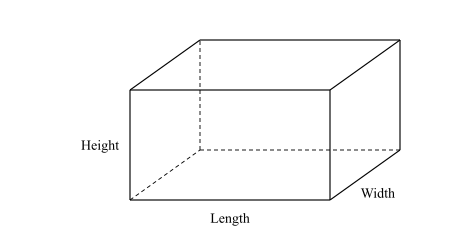
- A cuboid is a prism with a rectangular cross-section, and its volume is length × width × height
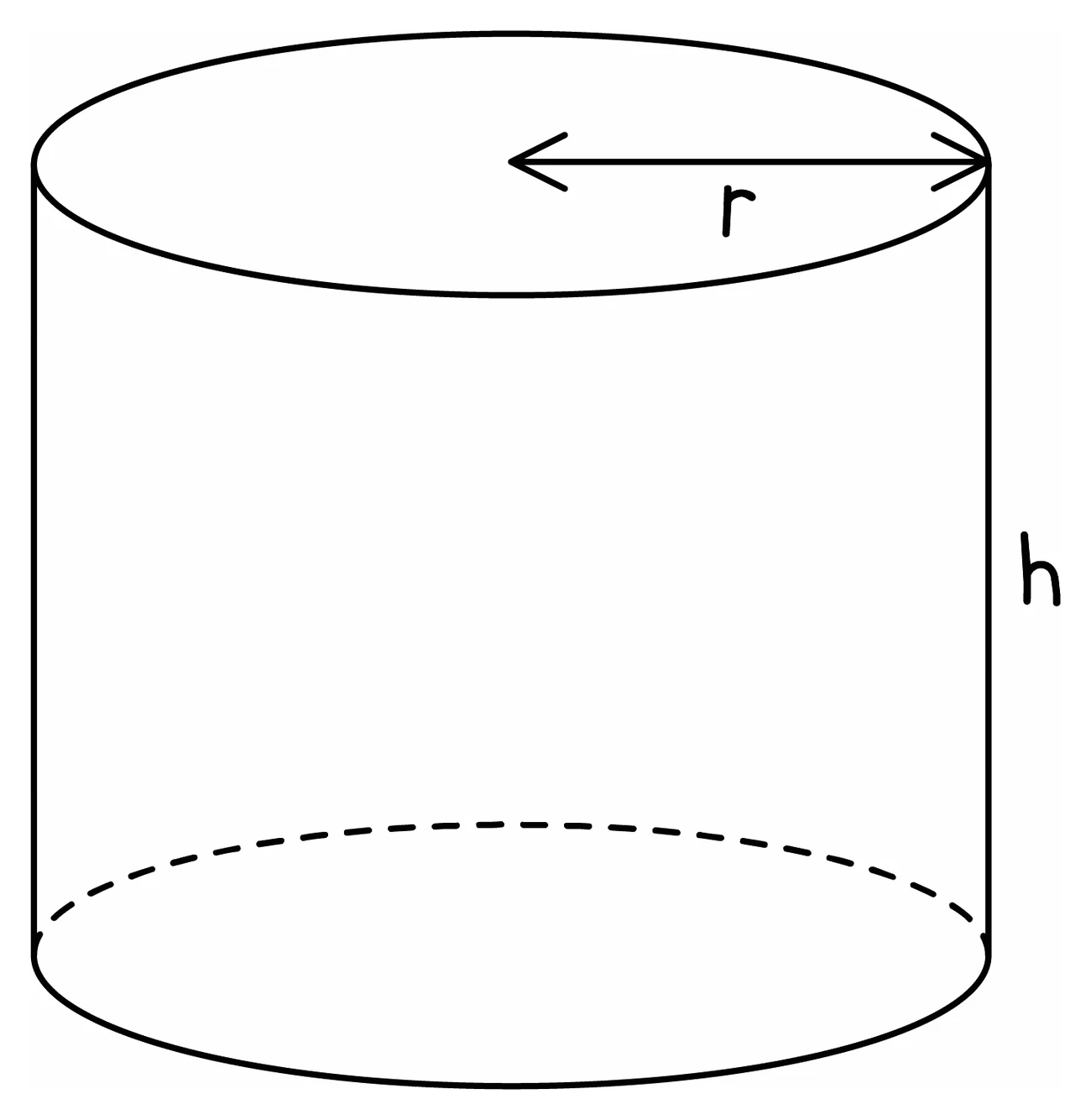
- For a cylinder the cross-section is a circle, which is why V = πr²h
Worked example
A volume in m³, cm³ and litres
A water tank is a cuboid 1.5 m long, 0.8 m wide and 0.6 m deep. Find its volume in m³ and in cm³, and the number of litres it holds.
Solution:
- Volume = 1.5 × 0.8 × 0.6 = 0.72 m³
- One metre is 100 cm, so 1 m³ is 100 × 100 × 100 = 1 000 000 cm³
- Volume = 0.72 × 1 000 000 = 720 000 cm³
- One litre is 1000 cm³, so divide by 1000
- Capacity = 720 000 ÷ 1000 = 720 litres
- Check by changing the lengths to centimetres first: 150 × 80 × 60 = 720 000 cm³
- The length factor of 100 is cubed because three lengths are multiplied, so multiplying 0.72 by 100 would be wrong
Pyramids, cones and spheres
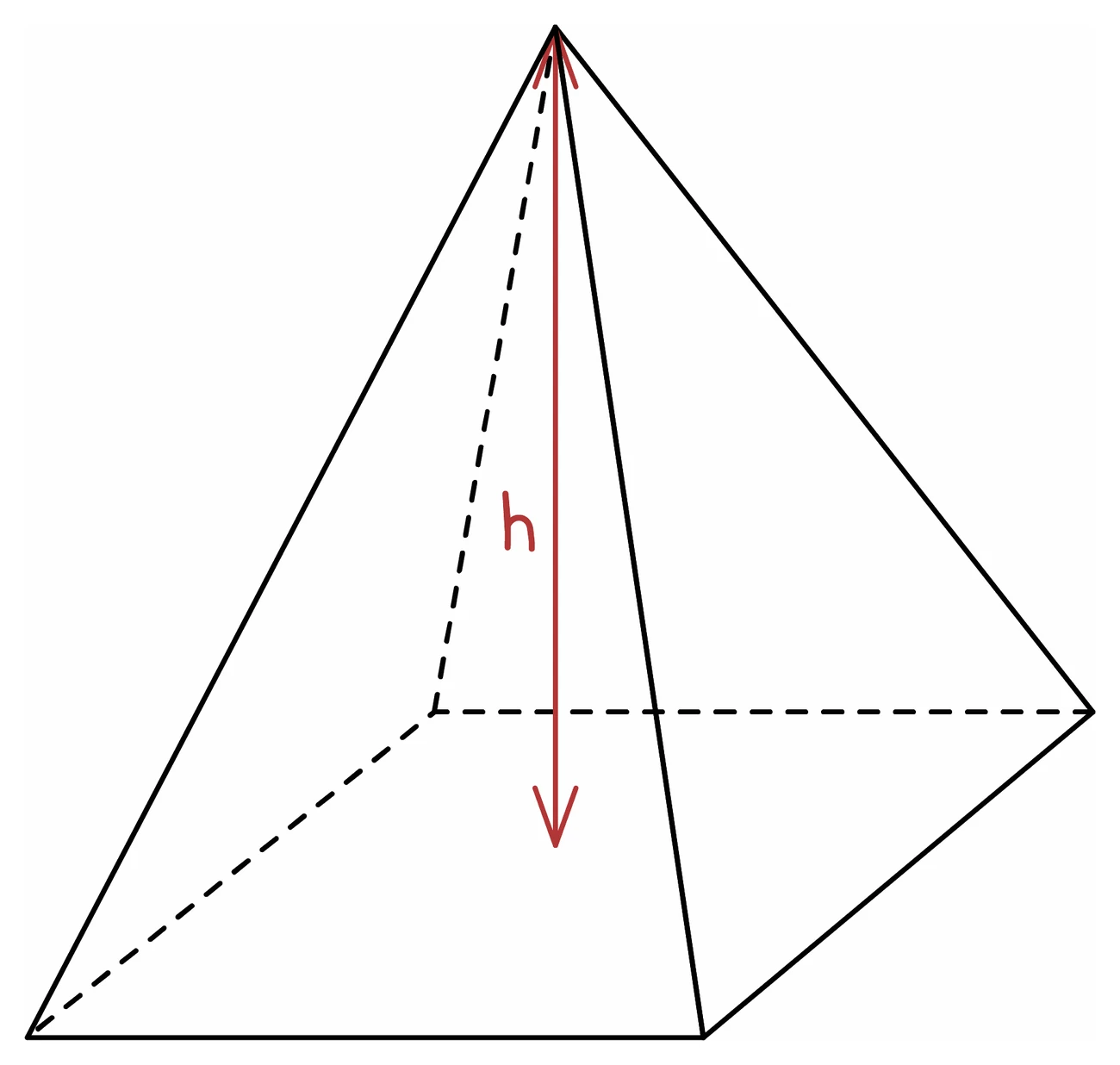
- A pyramid has volume ⅓ × base area × perpendicular height, and the height must run straight down from the apex to the base
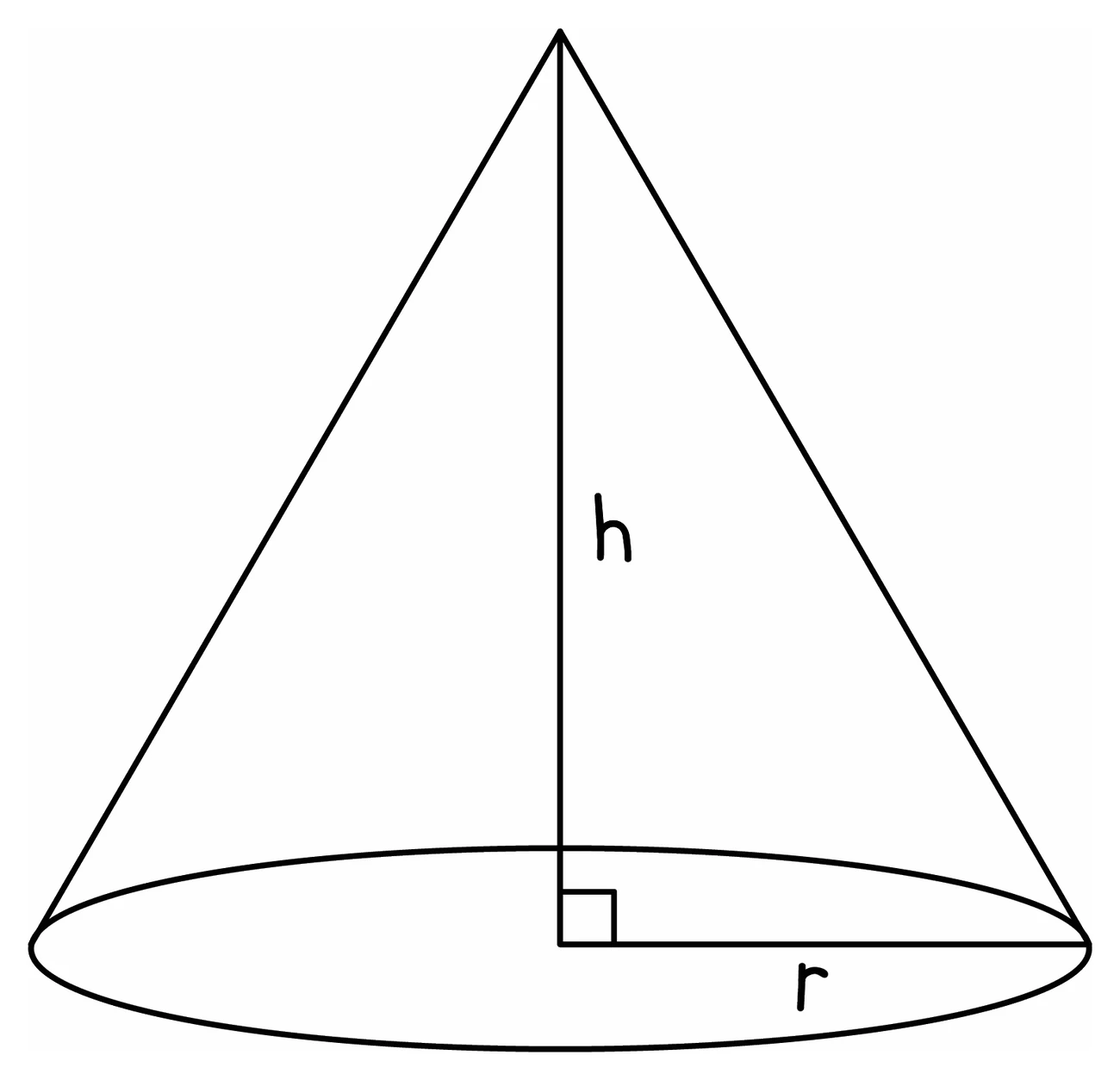
- A cone is a pyramid on a circular base, so its volume is ⅓πr²h, again using the perpendicular height
- The sloping edge of a cone is longer than its perpendicular height, and Pythagoras converts between them since the radius, the height and the sloping edge form a right-angled triangle
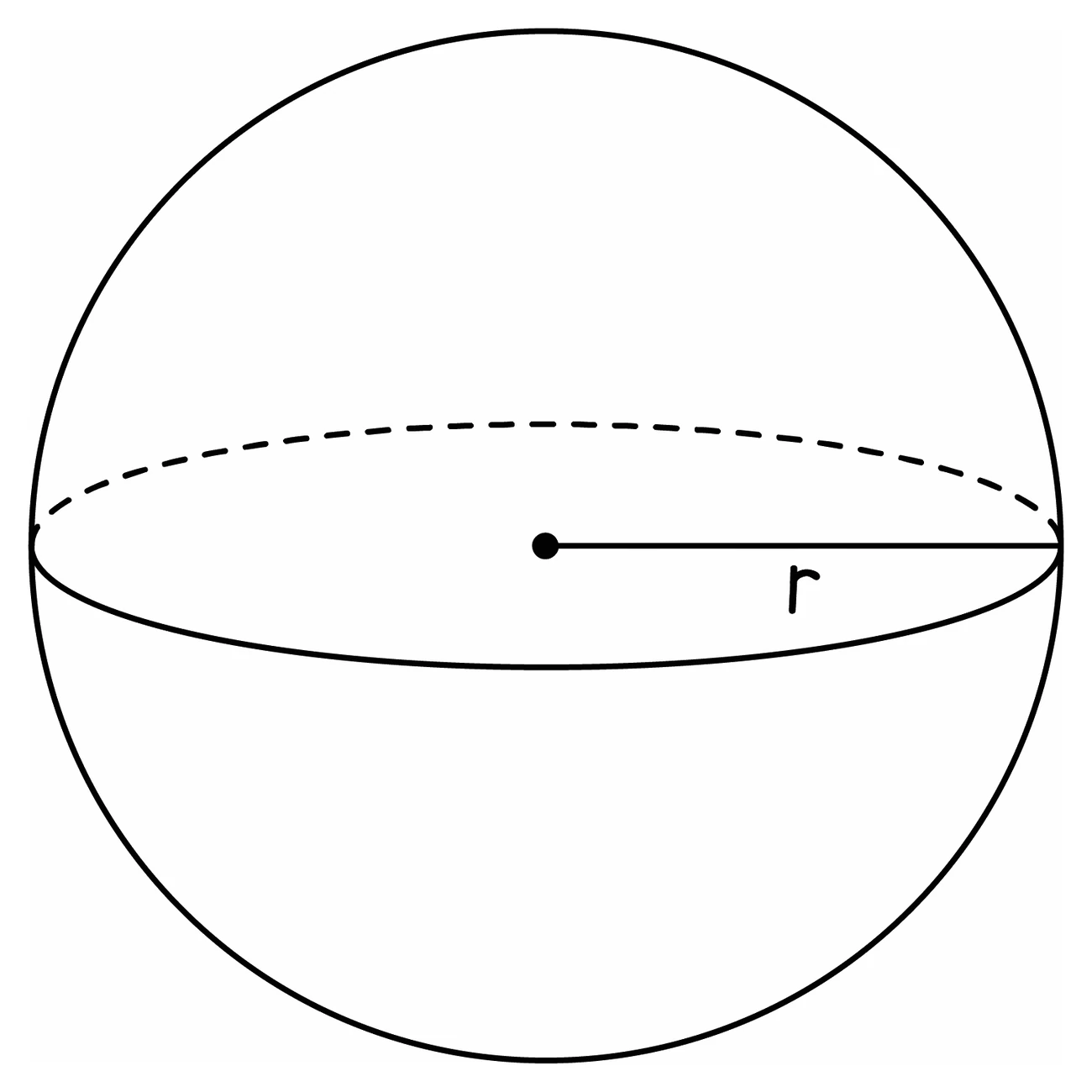
- A sphere has volume 4/3 πr³, and a hemisphere is half of that
Worked example
A cone from its sloping edge
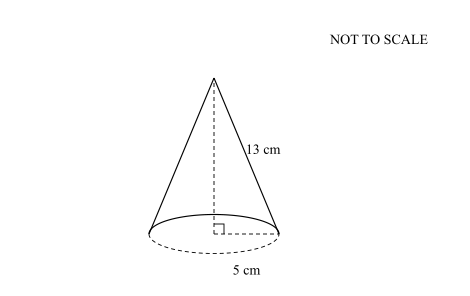
A cone has base radius 5 cm and sloping edge 13 cm. Find its volume in terms of π.
Solution:
- The volume formula needs the perpendicular height, but the sloping edge is given
- The radius, the height and the sloping edge form a right-angled triangle, with the sloping edge as the hypotenuse
- By Pythagoras, h² = 13² − 5² = 169 − 25 = 144
- So h = 12 cm
- Volume = ⅓ × π × 5² × 12 = ⅓ × π × 25 × 12
- Volume = 100π cm³
Worked example
Finding a radius from a volume
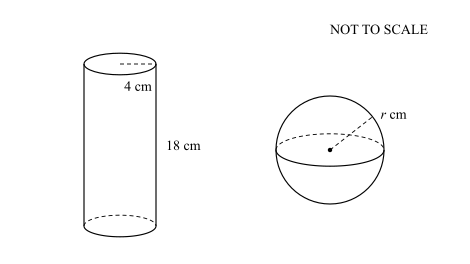
A cylinder has radius 4 cm and height 18 cm. A sphere has the same volume as the cylinder. Find the radius of the sphere.
Solution:
- Volume of the cylinder = π × 4² × 18 = π × 16 × 18 = 288π cm³
- Call the sphere's radius r and set its volume equal to that: 4/3 πr³ = 288π
- Divide both sides by π: 4/3 r³ = 288
- Multiply by 3 and divide by 4: r³ = 288 × 3 ÷ 4 = 216
- Take the cube root: r = ∛216 = 6 cm
- Check: 4/3 × π × 6³ = 4/3 × 216π = 288π
- Keeping π as a symbol lets it cancel, so no calculator is needed