MathematicsExam code: 0580
Volume and Surface Area
Lengths, Areas and Volumes
Building it from the faces
- Surface area is the total of every face and curved surface on the outside of the solid
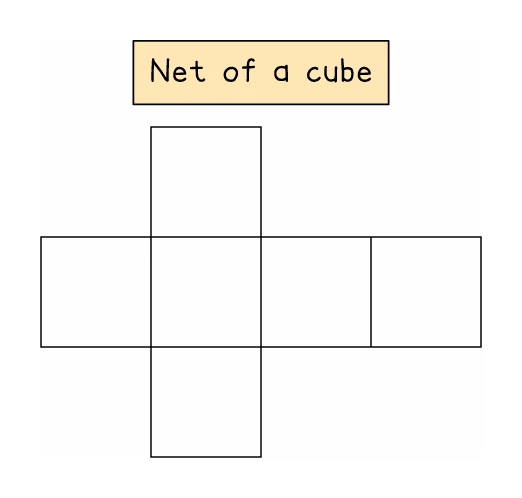
- For a solid with flat faces, work out each face separately and add them, using the net if it helps
- A cuboid 7 cm by 4 cm by 3 cm has faces in three matching pairs: 2(7 × 4) + 2(7 × 3) + 2(4 × 3) = 56 + 42 + 24 = 122 cm²
- A square-based pyramid has one square and four identical triangles
- For a cylinder, add the curved surface to the two circular ends: 2πrh + 2πr²
- For a cone, add the curved surface to the circular base: πrl + πr²
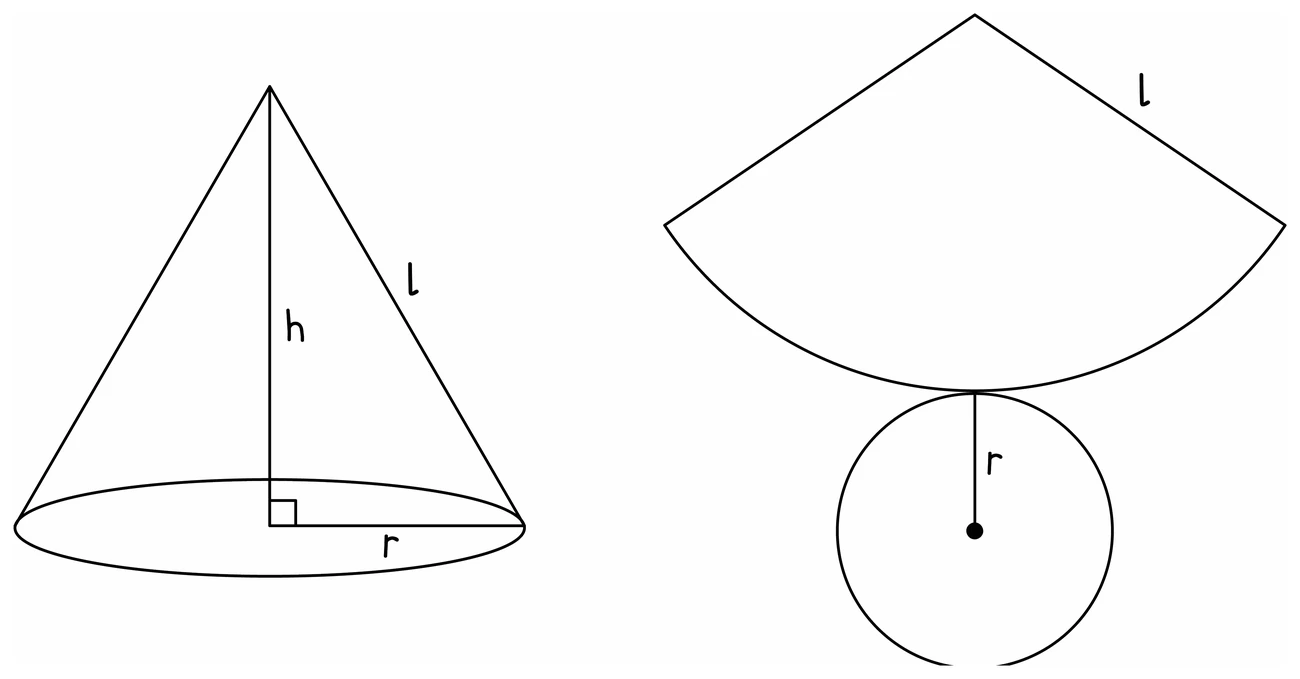
- Only the curved parts are printed, so these totals must be assembled
- Check the units: surface area is always in squared units even though the solid is three-dimensional
Worked example
Total surface area of a cylinder
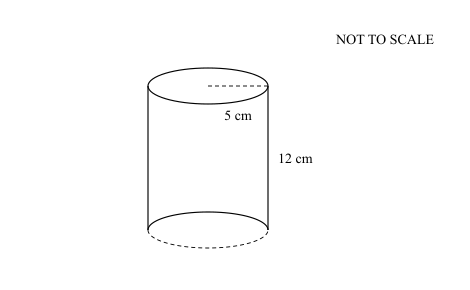
A solid cylinder has radius 5 cm and height 12 cm. Find its total surface area in terms of π.
Solution:
- A solid cylinder has three surfaces: two circular ends and the curved side
- The curved surface area is the one that is printed on the paper: 2πrh
- Curved surface = 2 × π × 5 × 12 = 120π
- Each circular end has area πr² = π × 5² = 25π
- There are two of them, giving 2 × 25π = 50π
- Total surface area = 120π + 50π = 170π cm²
- The total for a cylinder is not printed, only the curved part, so the two ends have to be added by hand
- If the cylinder were open at one end, only one circle would be added