Volume and Surface Area
Lengths, Areas and Volumes
Joining and cutting
- A compound solid is two shapes joined, and a part of a solid is a piece cut from one, such as a hemisphere or a frustum
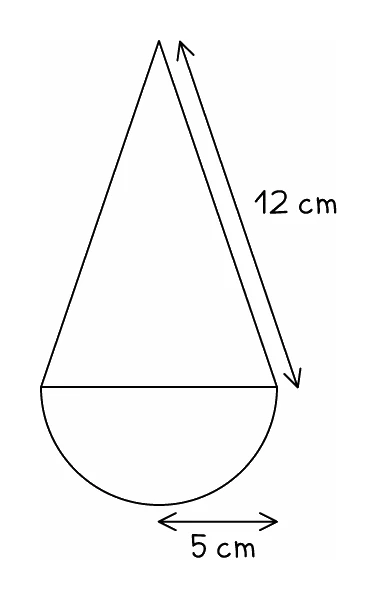
- Volumes simply add or subtract, so a cylinder with a hemisphere on top has the two volumes added
- Surface areas do not simply add, because the faces where the two solids meet are inside the finished solid and are no longer surfaces
- Work along the outside of the solid, listing each surface you would actually touch, then add only those
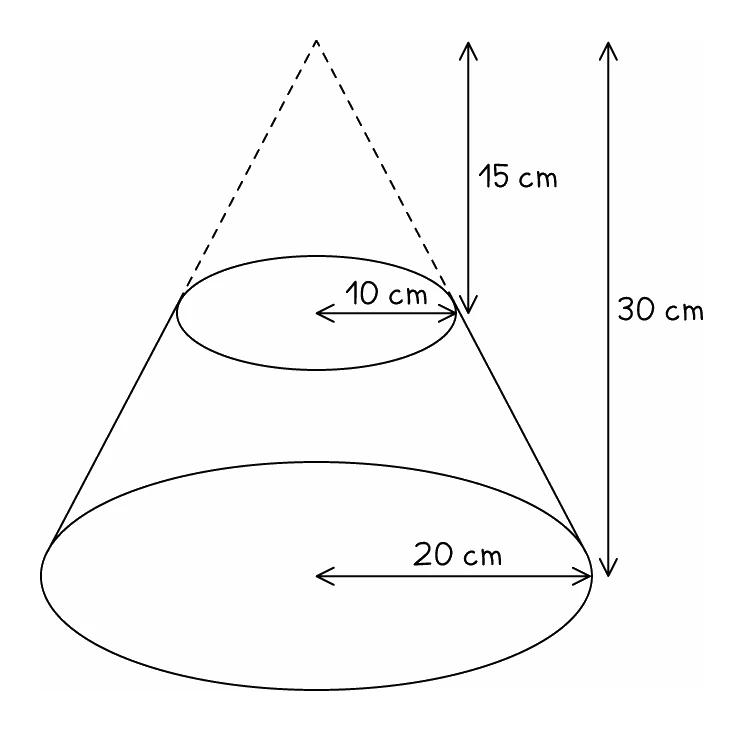
- A frustum is a cone or pyramid with its top cut off parallel to the base, so its volume is the whole solid minus the small one removed, and the syllabus names it directly
Exam tip
Find the missing length of the cut-off part first
A frustum question usually leaves out one length of the cut-off piece (the small cone's radius or height, or the small pyramid's base side). Each length of the small solid is the same fraction k of the matching large one, so find the missing length from that ratio first and write it down: it earns marks of its own. Then subtract the small volume from the large one, or multiply the large volume by 1 − k³.
- Answers may be asked for in terms of π, so keep π symbolic throughout and collect at the end
Worked example
Surface area from a net
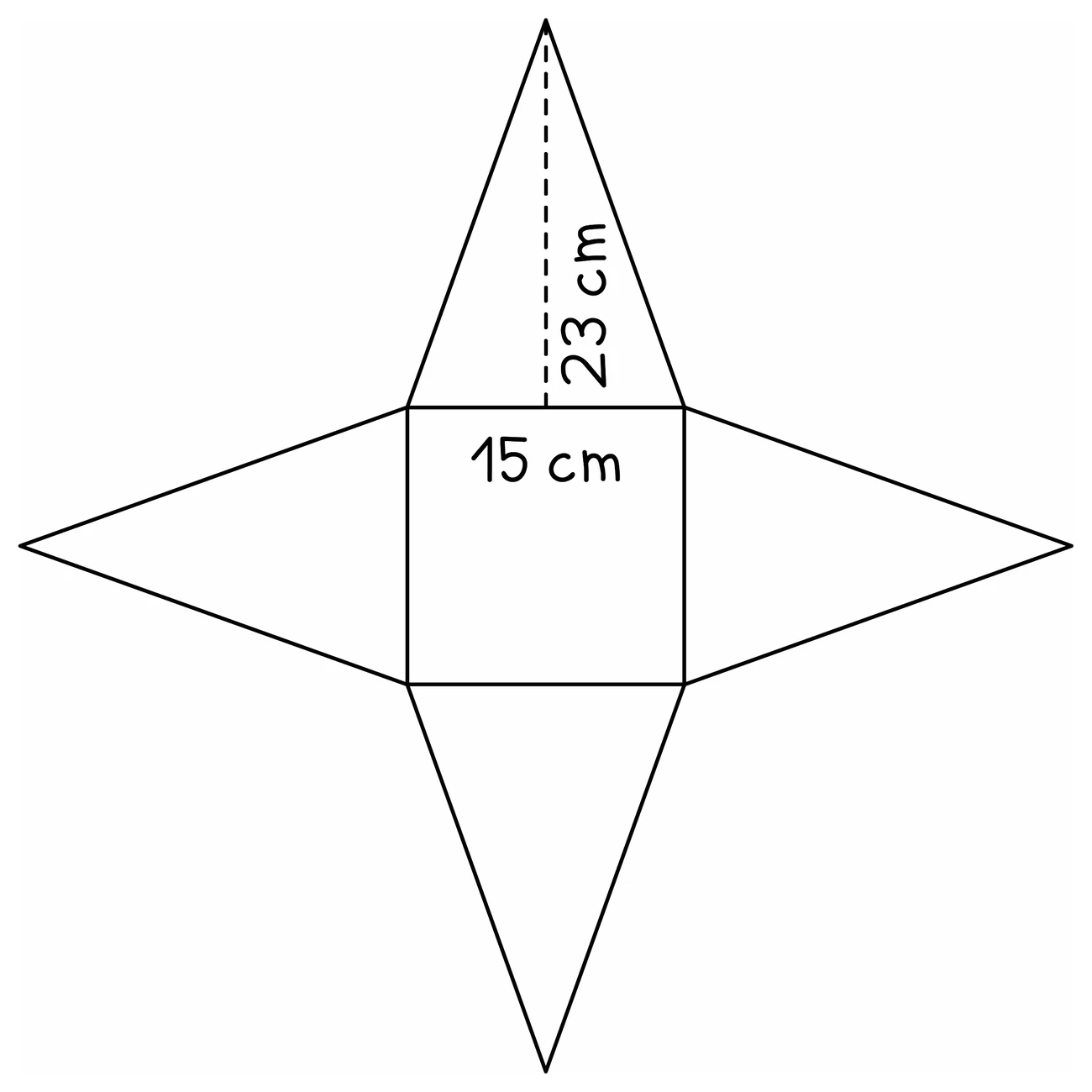
The net of a solid square-based pyramid is shown. Find its total surface area.
Solution:
- A net shows every face laid flat, so the surface area is just the total area of the shapes on it
- There is one square base and four identical triangles
- Square: 15 × 15 = 225 cm²
- Each triangle has base 15 cm and perpendicular height 23 cm
- One triangle: ½ × 15 × 23 = 172.5 cm²
- Four triangles: 4 × 172.5 = 690 cm²
- Total surface area = 225 + 690 = 915 cm²
- The 23 cm is the height of the triangle, not the height of the pyramid — the two are different lengths, joined by Pythagoras
- No formula for this is printed on the paper; it has to be built from the faces
Worked example
Surface area of a joined solid
A solid is made by joining a hemisphere of radius 5 cm to the top of a cylinder of radius 5 cm and height 14 cm. Find its total surface area in terms of π.
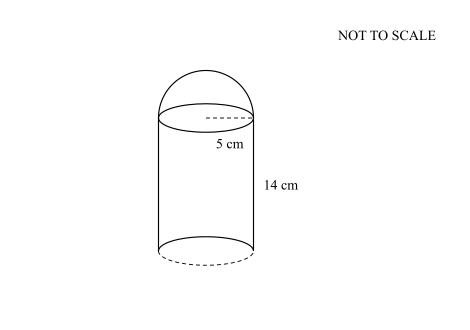
Solution:
- Walk round the outside and list the surfaces that are actually on show
- The curved surface of the cylinder: 2π × 5 × 14 = 140π cm²
- The flat circular base of the cylinder: π × 5² = 25π cm²
- The curved surface of the hemisphere, which is half a sphere: ½ × 4π × 5² = 50π cm²
- The top circle of the cylinder is not counted, because the hemisphere sits on it and it is no longer on the outside
- Total = 140π + 25π + 50π
- Total surface area = 215π cm²
Worked example
Equal total surface areas
A solid cone has base radius 3 cm. A solid hemisphere has radius 5 cm. The two solids have the same total surface area. Find the sloping edge of the cone.
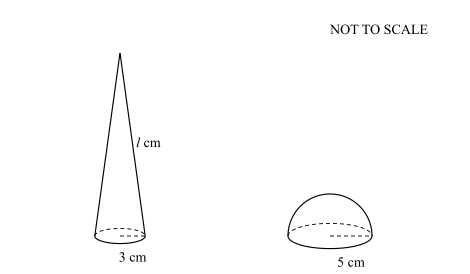
Solution:
- On its own, a solid hemisphere has two surfaces: half the surface of a sphere and a flat circle
- Hemisphere: ½ × 4π × 5² + π × 5² = 50π + 25π = 75π cm²
- The cone has a curved surface, πrl with l the sloping edge, and a circular base
- Cone: π × 3 × l + π × 3² = 3πl + 9π
- Set the totals equal and divide by π: 3l + 9 = 75
- 3l = 66, so l = 22 cm
- Check: 3π × 22 + 9π = 66π + 9π = 75π
- Both flat circles count here, because each one is on the outside of its solid, unlike the hidden join in the example above