MathematicsExam code: 0580
Transformations
Vectors and Transformations
Doing one
- A rotation turns the shape about a fixed point, the centre of rotation, through a multiple of 90°
- Tracing paper may be used in the examination (ask for it, since you cannot bring your own), and it is by far the most reliable method
- Trace the object, press a pencil point onto the centre, turn the paper through the given angle, then copy the image across
- Drawing an arrow on the tracing paper first shows at a glance how far it has turned
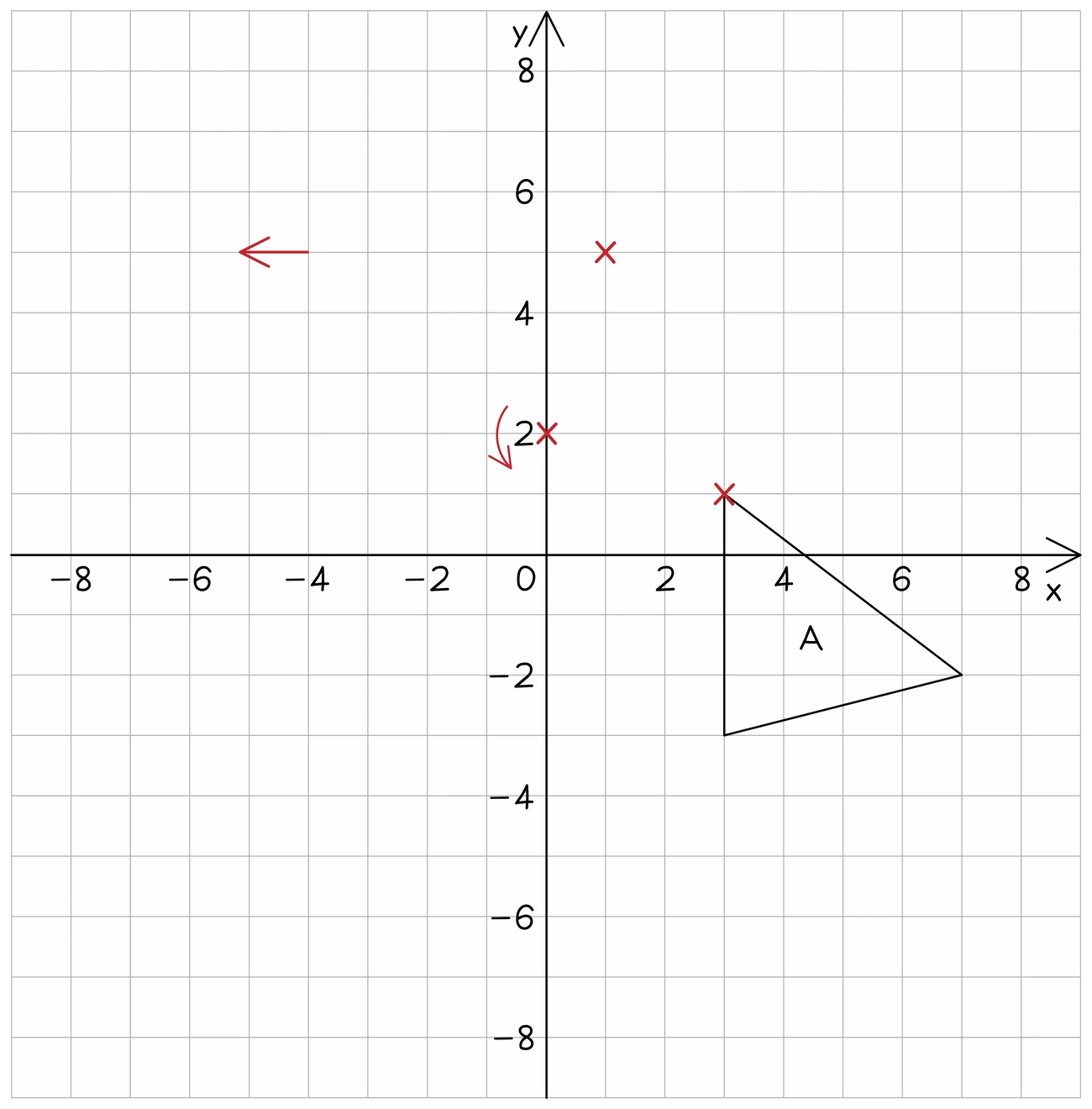
- The size and shape are unchanged, only the position and the orientation
- If the centre lies on the shape, that point is invariant
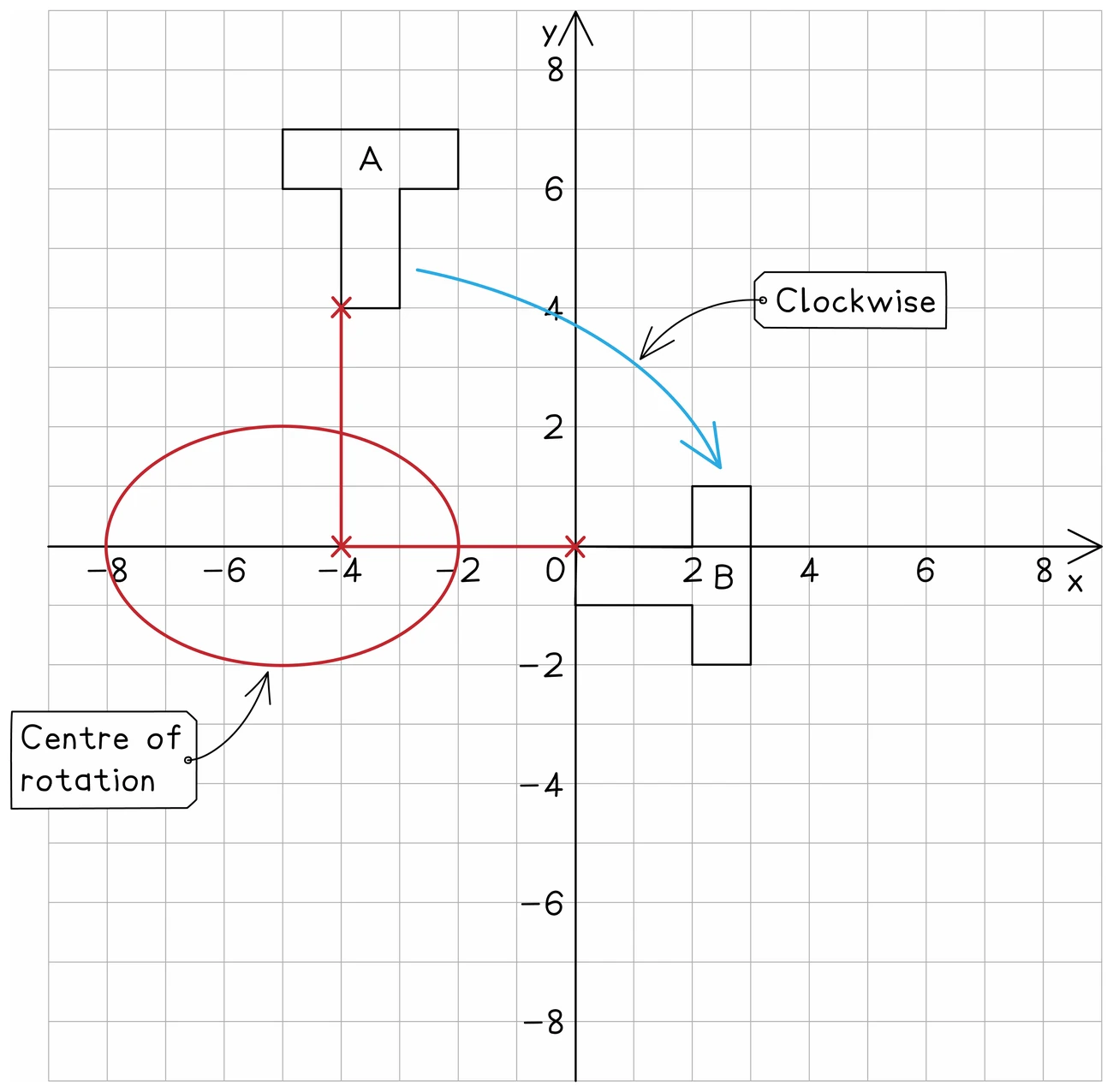
Describing one
- Say rotation, then give the angle with its direction, then the centre as coordinates
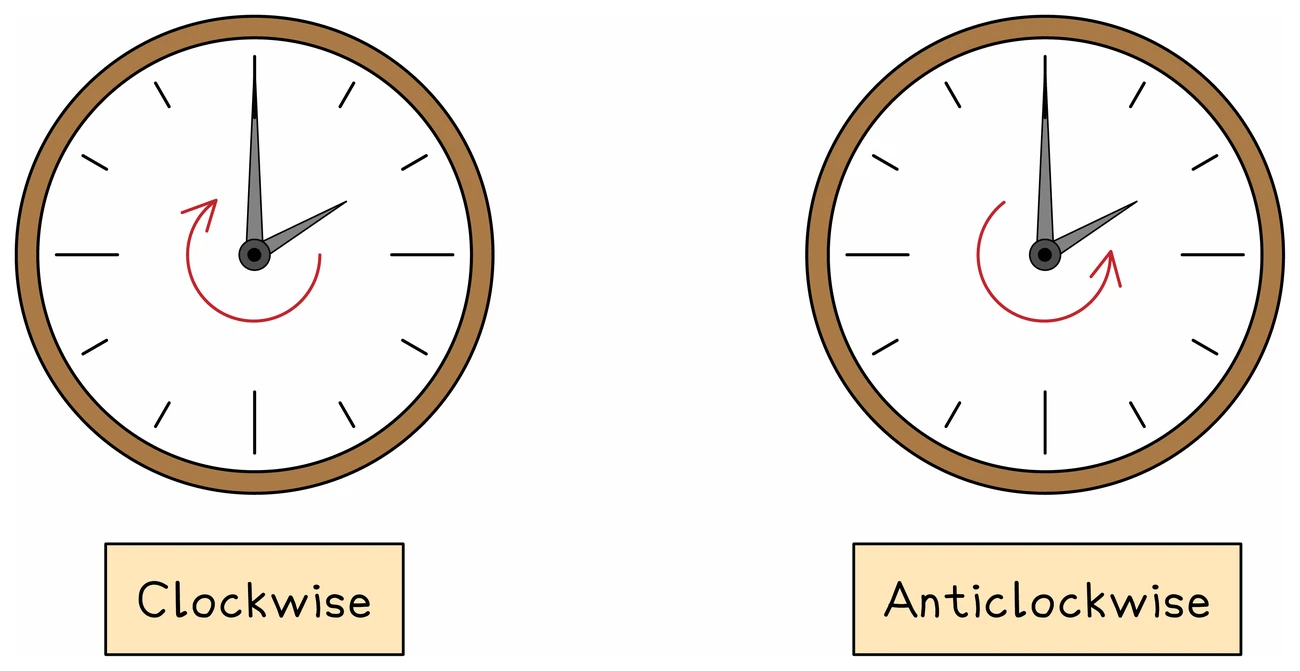
- Half turns need no direction, since 180° clockwise and anticlockwise give the same image
- Mark schemes accept equivalents such as 270° clockwise for 90° anticlockwise, and abbreviations like acw
Worked example
Describing a rotation
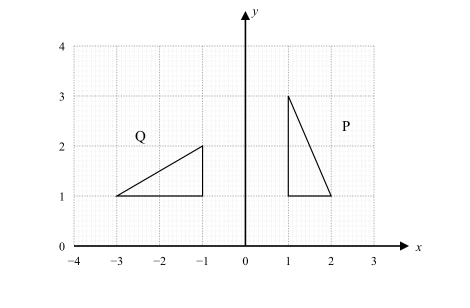
Triangle P has vertices (1, 1), (1, 3) and (2, 1). Triangle Q has vertices (−1, 1), (−3, 1) and (−1, 2). Describe fully the single transformation that maps P onto Q.
Solution:
- P and Q are the same size and shape, and Q is P turned, not flipped: from the right angle, P's longer side points up and its shorter side right, while Q's longer side points left and its shorter side up, so this is a rotation
- Tracing P and turning it shows a quarter turn fits, so the angle is 90°
- Turning anticlockwise takes the vertex (1, 3) round to (−3, 1), which matches Q
- Testing the origin as the centre: it is the same distance from (1, 1) as from (−1, 1), and likewise for the other pairs
- The full description is a rotation, 90° anticlockwise, centre (0, 0)
- Check: a 90° anticlockwise turn about the origin sends (x, y) to (−y, x), and (1, 1), (1, 3), (2, 1) do map to (−1, 1), (−3, 1), (−1, 2)