MathematicsExam code: 0580
Transformations
Vectors and Transformations
Doing one
- A reflection flips the shape across a mirror line, so the image is the same size but the wrong way round
- Every point and its image sit the same perpendicular distance from the mirror line, on opposite sides
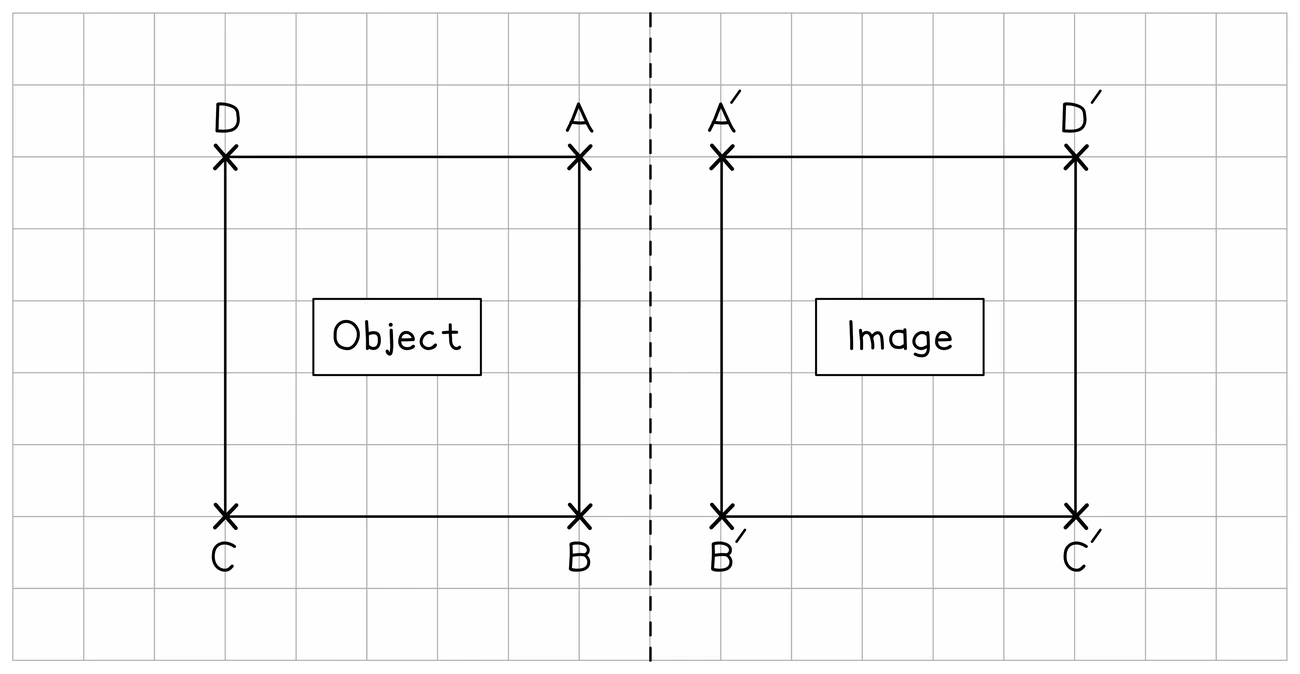
- Take one vertex at a time, count squares straight across to the line at right angles, then continue the same count past it
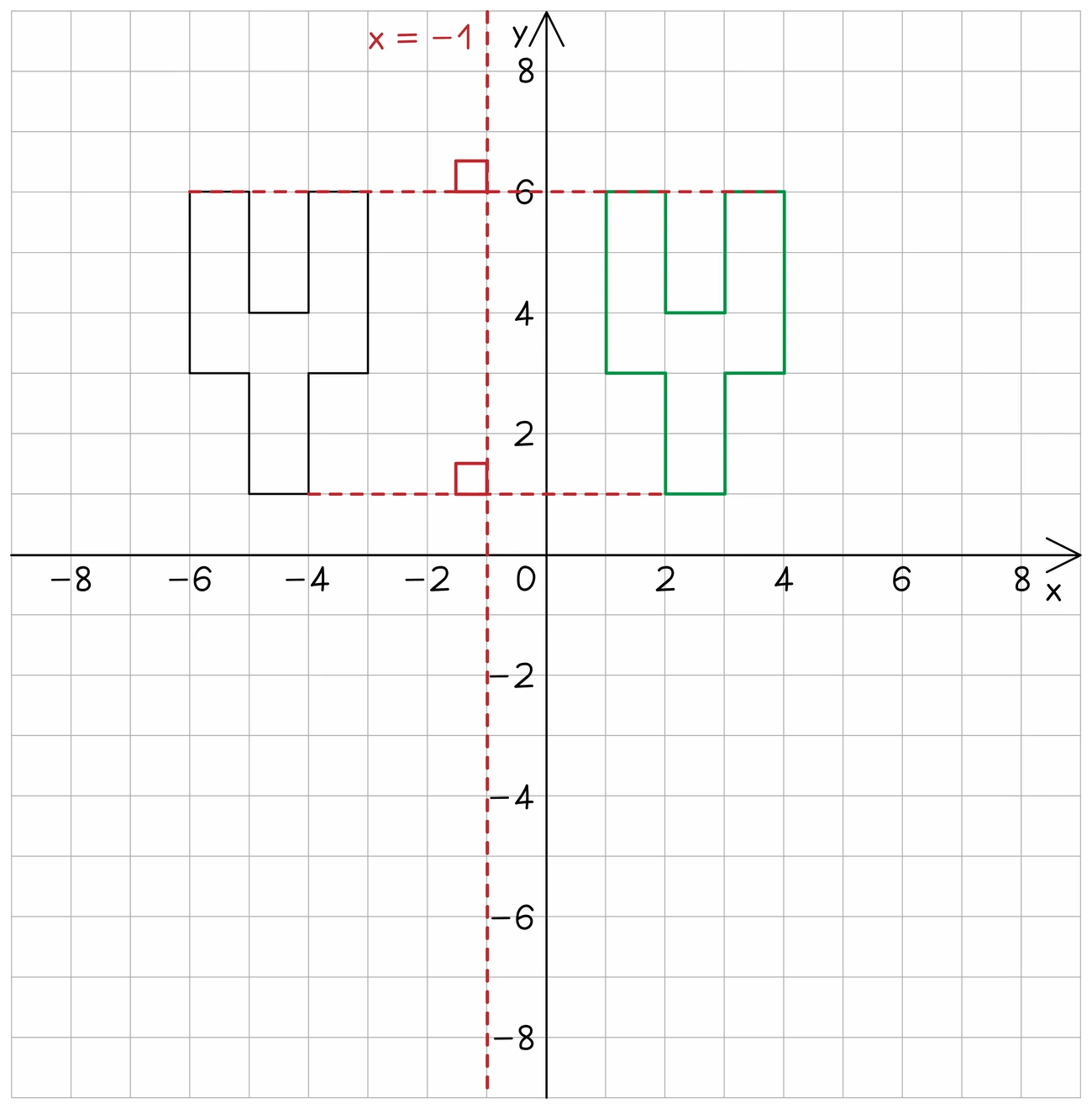
- For a diagonal mirror line such as y = x, count diagonally across the squares rather than horizontally
- Any vertex sitting on the line itself stays exactly where it is, making it invariant
- Where the mirror line passes through the shape, part of it reflects each way
Worked example
Reflecting in the line y = x
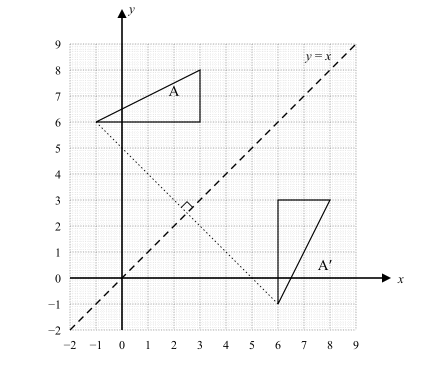
Triangle A has vertices (−1, 6), (3, 6) and (3, 8). Reflect A in the line y = x and draw its image.
Solution:
- Draw the mirror line first, with a ruler: y = x runs diagonally through (0, 0), (1, 1), (2, 2) and so on
- A reflection in y = x swaps the two coordinates of every point, so (a, b) goes to (b, a)
- (−1, 6) goes to (6, −1), (3, 6) goes to (6, 3), and (3, 8) goes to (8, 3)
- Check one pair: (−1, 6) and (6, −1) have midpoint (2.5, 2.5), which lies on y = x, so they sit the same distance either side of the line
- Plot the three points and join them with a ruler: the image has vertices (6, −1), (6, 3) and (8, 3)
- Swapping the coordinates and also changing both signs would reflect in y = −x instead, sending (−1, 6) to (−6, 1)
Describing one
- Say reflection, then state which line the shape was flipped across, written as an equation
- Vertical lines are x = k and horizontal lines are y = k, which is the pair most often swapped over
- The diagonal through the origin sloping up is y = x, and the one sloping down is y = −x
Worked example
Describing a reflection fully
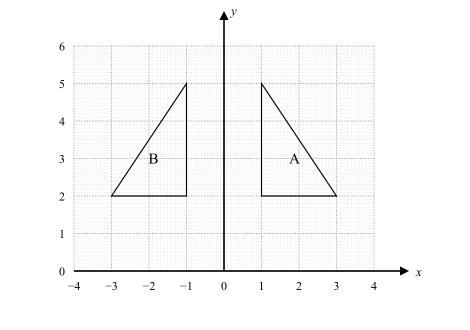
Triangle A has vertices (1, 2), (3, 2) and (1, 5). Its image B has vertices (−1, 2), (−3, 2) and (−1, 5). Describe fully the single transformation that maps A onto B.
Solution:
- The shape is the same size and the same way up, but it has been flipped, so this is a reflection
- Compare one pair of matching points: (1, 2) becomes (−1, 2)
- The y coordinate is unchanged and the x coordinate has changed sign
- The mirror line is therefore vertical, midway between 1 and −1, which is x = 0
- Check on a second pair: (3, 2) becomes (−3, 2), midway again at x = 0
- The answer is a reflection in the line x = 0
- Give the mirror line as its equation: x = 0 is the y-axis