Transformations
Vectors and Transformations
Doing one
- An enlargement resizes the shape by a scale factor from a fixed centre of enlargement
- Each vertex moves along the line from the centre through it, ending scale-factor times as far from the centre
- Multiply each distance from the centre, both across and up, by the scale factor
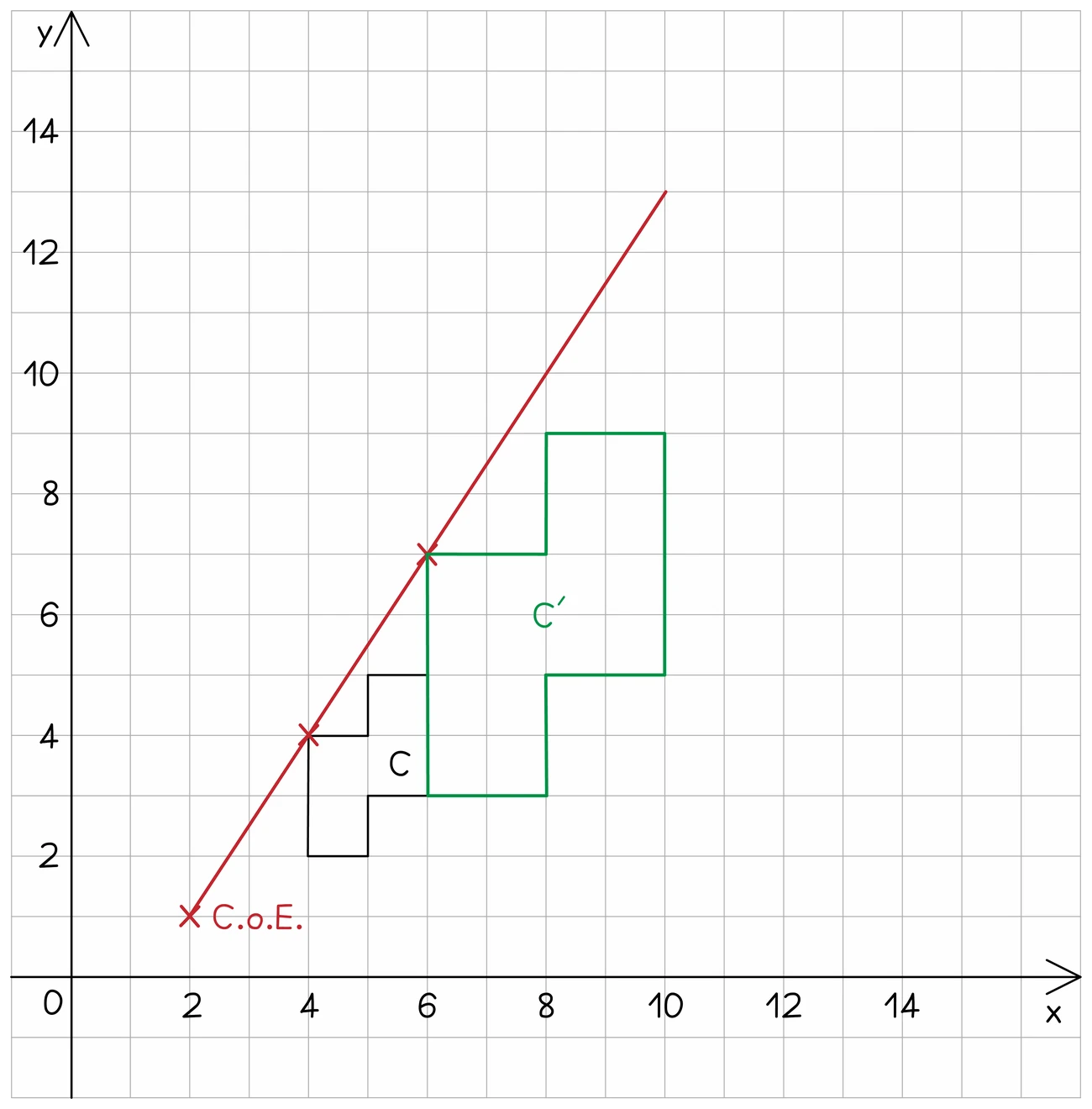
- A scale factor between 0 and 1 makes the image smaller, even though it is still called an enlargement
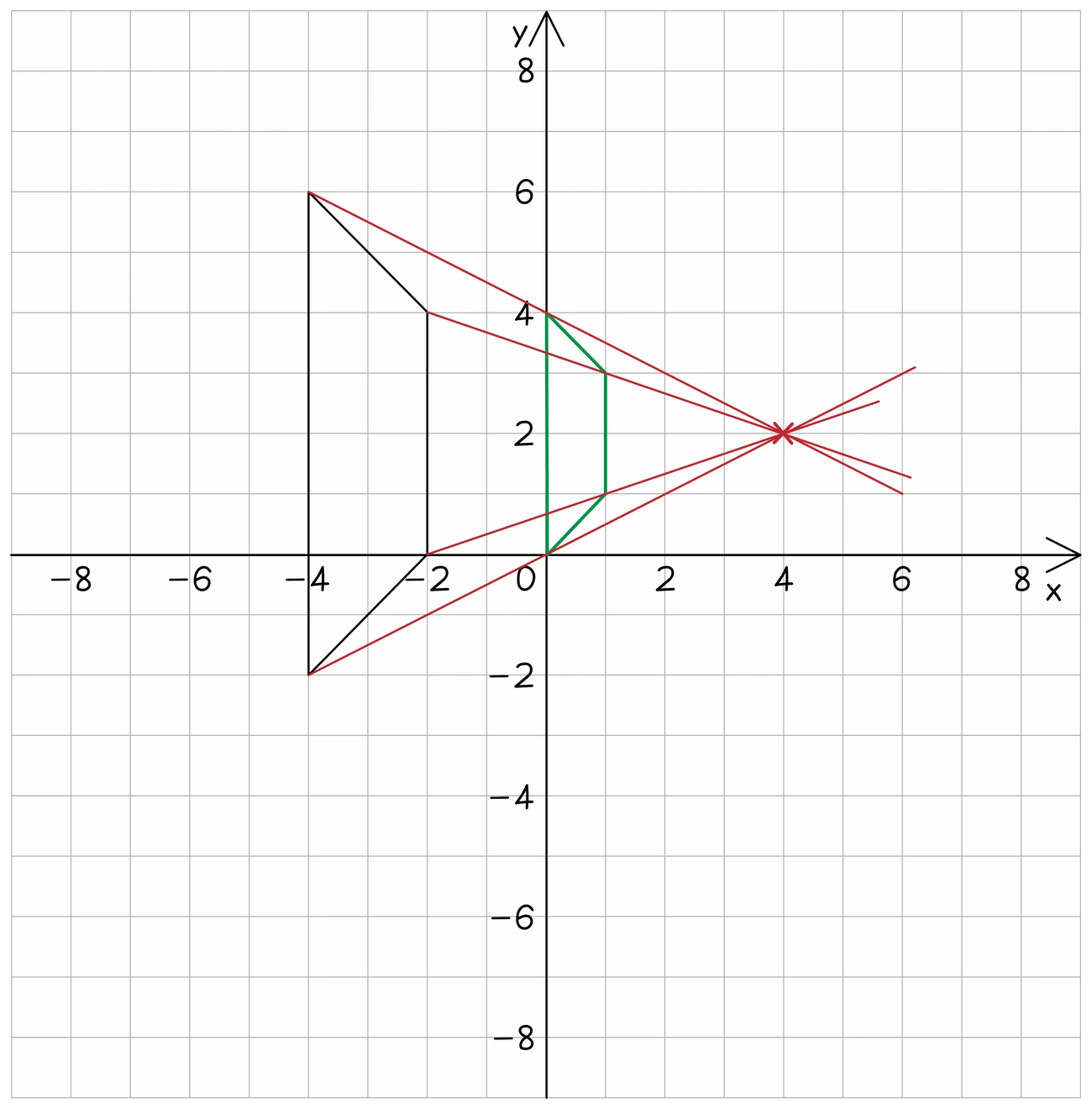
- A negative scale factor throws the image across to the far side of the centre and inverts it, so it acts as a 180° rotation as well as a resize
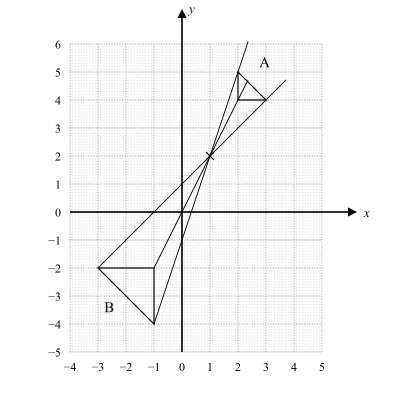
- Every length multiplies by the scale factor, so the image is similar to the object rather than congruent
Describing one
- Say enlargement, then give the scale factor, then the centre as coordinates
- Find the centre by drawing a line through each pair of corresponding vertices and seeing where they all cross
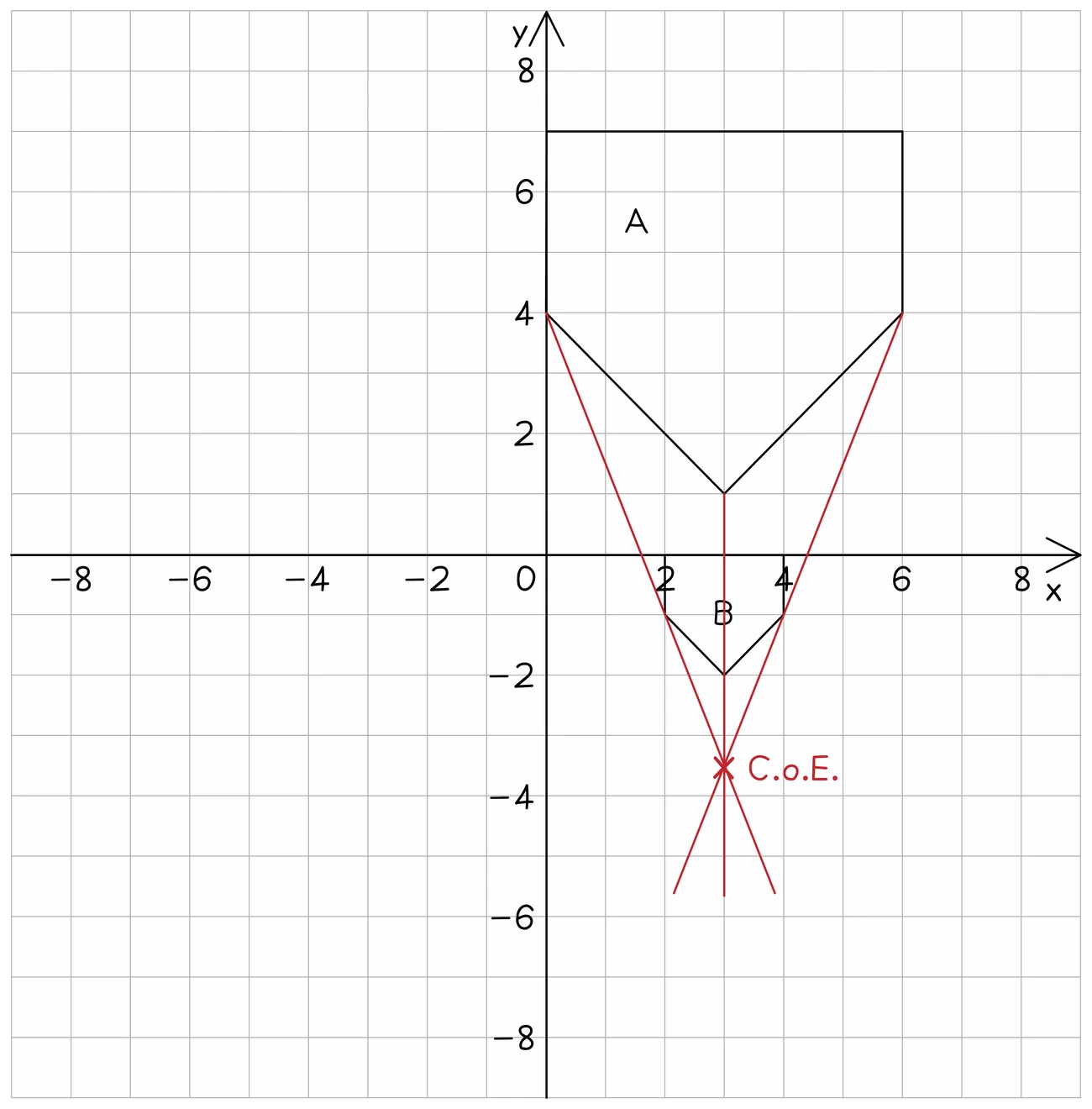
- Find the scale factor by dividing an image length by the matching object length
Worked example
Describing an enlargement
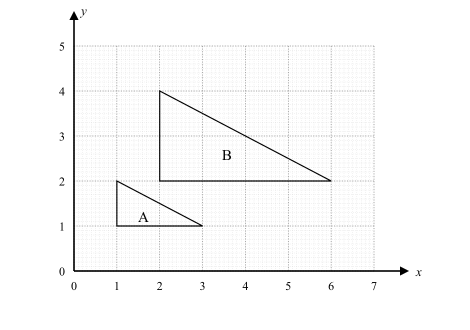
Triangle A has vertices (1, 1), (3, 1) and (1, 2). Triangle B has vertices (2, 2), (6, 2) and (2, 4). Describe fully the single transformation that maps A onto B.
Solution:
- B is bigger than A, so the only candidate is an enlargement: the other three keep the size the same
- Compare a pair of matching sides: A has a base from (1, 1) to (3, 1), which is 2 units, and B has a base from (2, 2) to (6, 2), which is 4 units
- Scale factor = 4 ÷ 2 = 2
- Draw a line through (1, 1) and (2, 2), another through (3, 1) and (6, 2), and a third through (1, 2) and (2, 4)
- All three meet at the origin, so that is the centre
- The full description is an enlargement, scale factor 2, centre (0, 0)
- Check: each vertex of B is exactly twice as far from the origin as the matching vertex of A
Exam tip
One transformation, every property
Name exactly one transformation, in its proper word: rotation, not turn or spin; enlargement, not dilation or reduction. Naming two scores nothing for the whole part, so a negative scale factor is one enlargement, never a rotation plus an enlargement. The name and each property (angle with direction, centre, scale factor, vector) earn a mark each, so write every one even when unsure of one. Describing a single transformation is set in 11 of the 21 papers.
Worked example
An enlargement with a negative scale factor
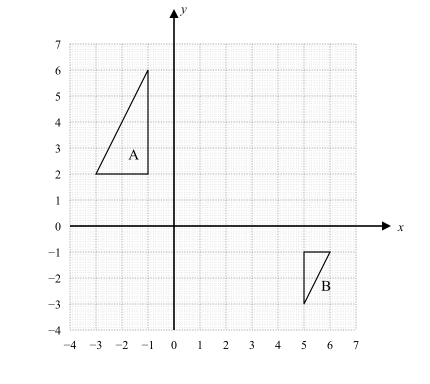
Triangle A has vertices (−1, 2), (−3, 2) and (−1, 6). Triangle B has vertices (5, −1), (6, −1) and (5, −3). Describe fully the single transformation that maps A onto B.
Solution:
- B is smaller than A, so this is an enlargement, the only one of the four transformations that changes size
- Compare matching sides: A's vertical side from (−1, 2) to (−1, 6) is 4 units, and B's from (5, −1) to (5, −3) is 2 units, so the size factor is 2 ÷ 4 = ½
- B is upside down: from the right angle, A's sides run up and to the left, while B's run down and to the right, so the image is inverted and the scale factor is negative, −½
- Join each pair of matching vertices: (−1, 2) to (5, −1), (−3, 2) to (6, −1), and (−1, 6) to (5, −3)
- The three lines cross at (3, 0), between the two shapes, which is where the centre of a negative enlargement always lies
- Check from the centre: (−1, 2) is 4 left and 2 up from (3, 0), and −½ of that is 2 right and 1 down, which lands on (5, −1)
- The full description is an enlargement, scale factor −½, centre (3, 0)