MathematicsExam code: 0580
Linear Graphs
Coordinate Geometry and Graphs
From an equation
- Build a small table of values by substituting three x values that are spread across the axes you are given
- Three points, not two: a slip in one of three points shows up because it misses the line through the other two, whereas two points always look convincing
- Plot the points and join them with a ruled line that runs the full width of the grid
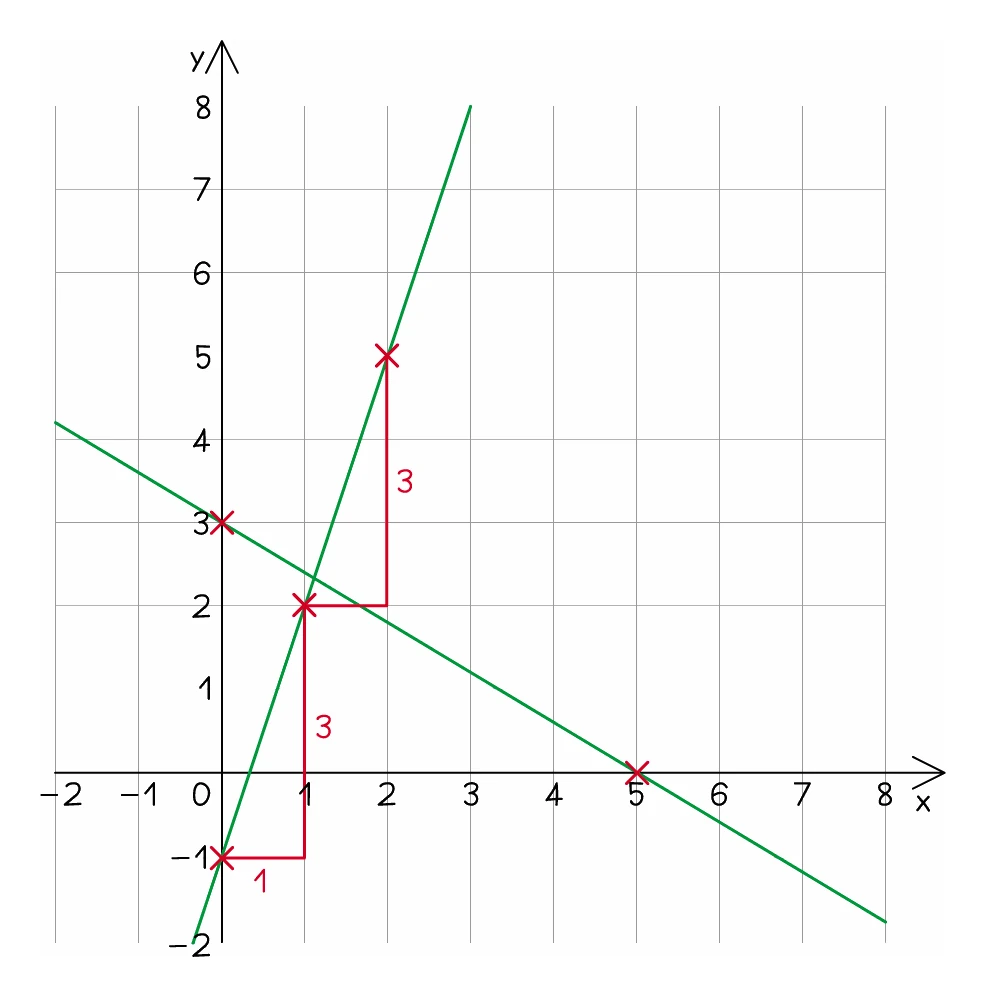
- Alternatively start at (0, c) and step out the gradient, going one right and m up each time, down instead if m is negative
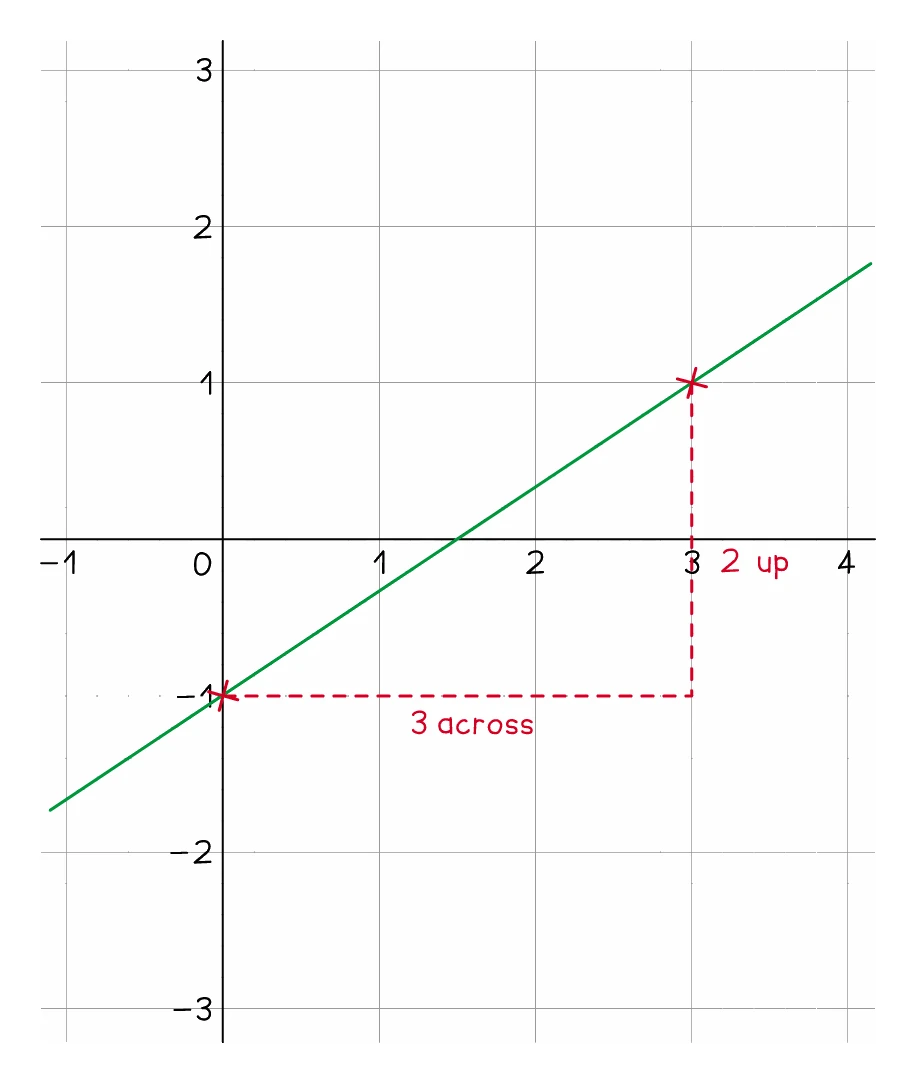
- For a gradient written as a fraction, step across by the bottom number and up by the top number
From the ax + by = c form
- A quicker route for this form is to find where the line meets each axis
- Substitute x = 0 to get the point on the y-axis, then y = 0 to get the point on the x-axis
- Join those two points and extend the line across the grid
- For 3x + 4y = 24, setting x = 0 gives (0, 6) and setting y = 0 gives (8, 0)
Worked example
Drawing a line two ways
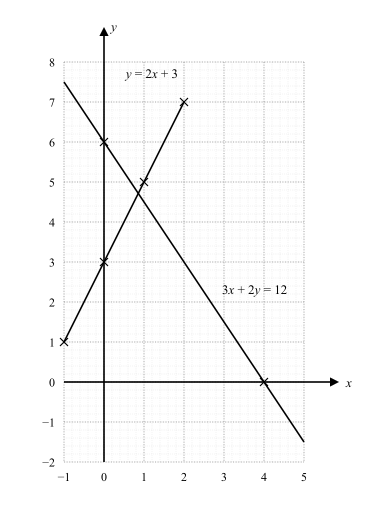
Draw y = 2x + 3 for x from −1 to 2, and draw 3x + 2y = 12.
Solution:
- For the first, build a short table of values
- x = −1 gives y = 1; x = 0 gives 3; x = 1 gives 5; x = 2 gives 7
- Plot (−1, 1), (0, 3), (1, 5) and (2, 7), and join them with a ruled line
- For the second, the cover-up method is quicker than rearranging
- Setting x = 0 gives 2y = 12, so y = 6 and the line passes through (0, 6)
- Setting y = 0 gives 3x = 12, so x = 4 and the line passes through (4, 0)
- Plot those two intercepts and rule the line through them
- Two points fix a straight line, but a third is worth plotting as a check