MathematicsExam code: 0580
Coordinate Geometry
Coordinate Geometry and Graphs
Pythagoras on the grid
- The distance between two points is the hypotenuse of a right-angled triangle drawn with one horizontal and one vertical side
- The horizontal side is the difference in the x values and the vertical side is the difference in the y values
- So the length is √((x₂ − x₁)² + (y₂ − y₁)²)
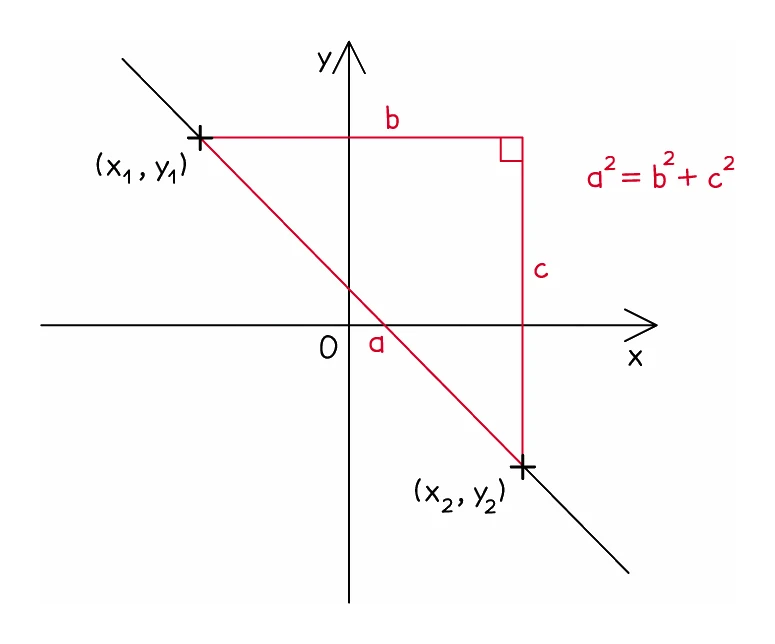
- Squaring removes any minus sign, so it does not matter which point is taken first
- Like the midpoint formula, this one is not printed in the paper
- Writing the two differences down before squaring them earns a mark on its own, and the completed substitution earns another
- Put brackets around negative coordinates as you subtract them, since a subtraction of a negative is where the sign errors happen
Worked example
A length that is a whole number
C is the point (2, −5) and D is the point (14, 4). Calculate the length of CD.
Solution:
- Difference in x: 14 − 2 = 12
- Difference in y: 4 − (−5) = 9
- Square and add: 12² + 9² = 144 + 81 = 225
- Take the square root: √225 = 15
- The length of CD is 15 units
Leaving the answer as a surd
- Where the number under the root is not a perfect square, the exact answer is a surd
- Simplify it by taking out the largest square factor, exactly as in the surds topic
- Questions on this specification regularly ask for the length in surd form, or state that it equals k√n and ask for k
- Without a calculator, leave a length that is not a whole number as an exact surd; on the calculator paper a decimal correct to 3 significant figures (or to the accuracy the question gives) also scores, unless the question asks for a surd or an exact answer
Worked example
A length in surd form
A is the point (−1, 4) and B is the point (5, 1). Find the exact length of AB, writing the surd in its simplest form.
Solution:
- Difference in x: 5 − (−1) = 6
- Difference in y: 1 − 4 = −3
- Square and add: 6² + (−3)² = 36 + 9 = 45
- So the length is √45
- The largest square factor of 45 is 9, and 45 = 9 × 5
- √45 = √9 × √5 = 3√5
- The length of AB is 3√5 units