Circle Theorems
Geometry
The angle at the centre is twice the angle at the circumference
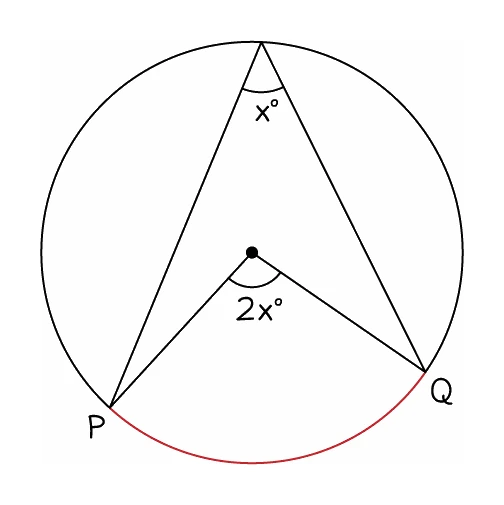
- Take a pair of points on the circumference and join each of them to the centre, and also to some third point on the circumference
- Whatever angle appears at the centre is double the one appearing at that third point
- The shape often looks like an arrowhead, and the two angles must be subtended by the same arc
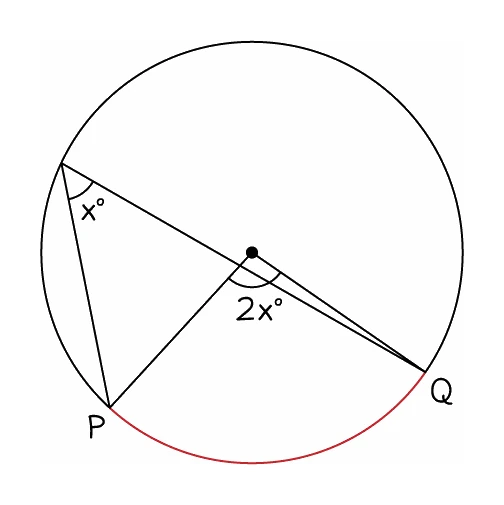
- Where the centre angle is reflex, it is that reflex value which doubles the circumference angle, not the smaller one beside it
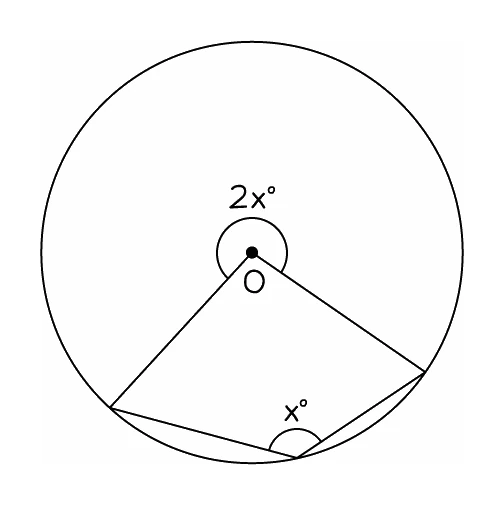
- An angle of 33° at the circumference gives 66° at the centre
Angles in the same segment are equal
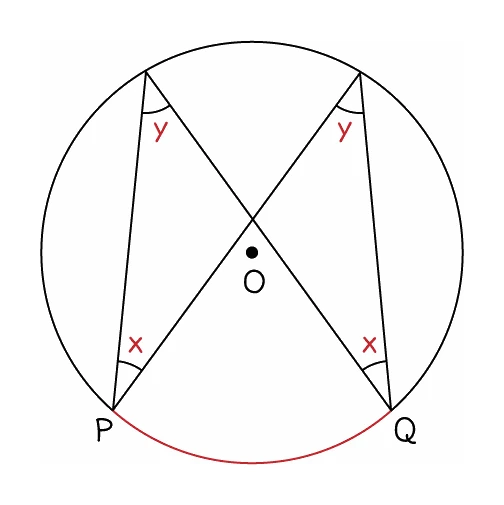
- Two points on the circumference joined to two different third points give two equal angles
- Both angles must start from the same pair of points, and both third points must lie on the same side of the chord joining them
- Drawing in that chord makes the segment visible and settles whether the two angles really match
Opposite angles in a cyclic quadrilateral add to 180°
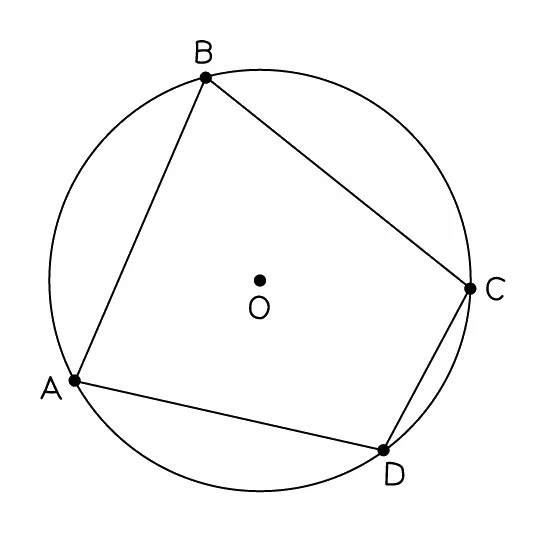
- A cyclic quadrilateral has all four of its corners on the circumference
- Its two pairs of opposite angles each total 180°
- An angle of 104° therefore sits opposite one of 76°
- Check all four corners are on the circle before using it, since a quadrilateral with only three on the circumference does not qualify
Worked example
The centre angle and a cyclic quadrilateral
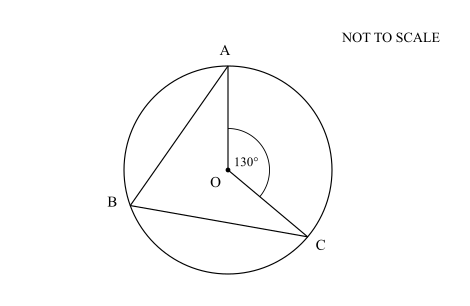
A circle has centre O, and A, B and C are points on it. Angle AOC at the centre is 130°, and B is on the major arc. (a) Find angle ABC. (b) D is a fourth point on the circle, on the minor arc AC, so ABCD is a cyclic quadrilateral. Angle BAD is 85°. Find angle BCD.
Solution:
- (a) Angle AOC at the centre and angle ABC at the circumference both stand on the same arc AC, so angle AOC is twice angle ABC
- Angle ABC = 130 ÷ 2 = 65°
- The reason is that the angle at the centre is twice any angle at the circumference standing on the same arc
- (b) BAD and BCD are opposite angles of a cyclic quadrilateral, so they add to 180°
- Angle BCD = 180 − 85 = 95°
- The reason is "opposite angles of a cyclic quadrilateral add to 180°"
- Check that all four corners really sit on the circumference before using that second theorem: a quadrilateral with one vertex at the centre, such as OABC, is not cyclic
The alternate segment theorem
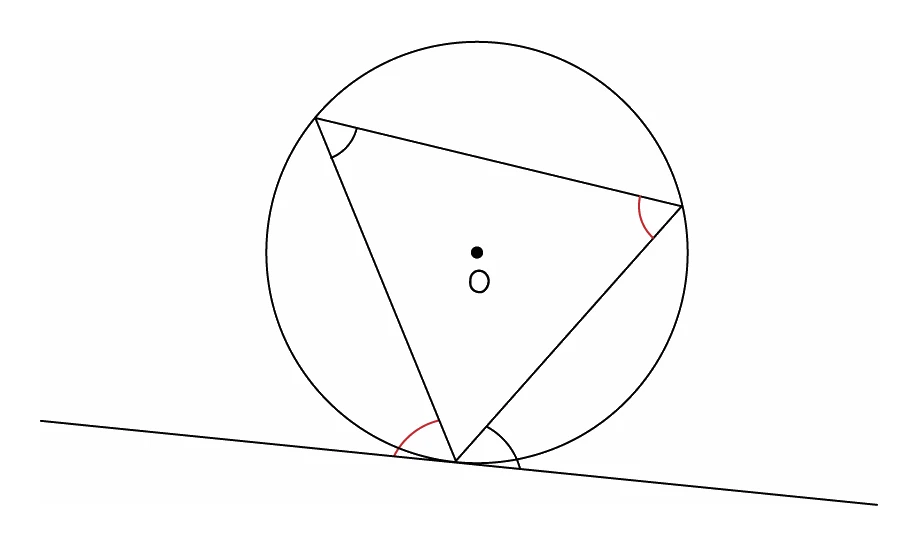
- The angle between a tangent and a chord equals the angle in the alternate segment, that is the angle at the circumference on the other side of that chord
- Look for a triangle with all three corners on the circle and one corner touching a tangent
- Find the side that forms the tangent angle, and the matching angle is the one facing it from across the triangle
- An angle of 58° between tangent and chord matches one of 58° in the alternate segment
- The name is the reason, so write "alternate segment theorem" in full
Exam tip
Write each reason as the whole theorem
A circle question asks for a reason in 8 of the 21 papers, and only the complete theorem earns that mark: "opposite angles of a cyclic quadrilateral add to 180°", "the angle in a semicircle is 90°", "alternate segment theorem". Schemes have refused "alternate segment" on its own, "AST" and "alternate angles" for the alternate segment theorem, and "right-angled triangle in a semicircle". "Supplementary" or "add to" in place of "sum to" is fine.
Worked example
Using the alternate segment theorem
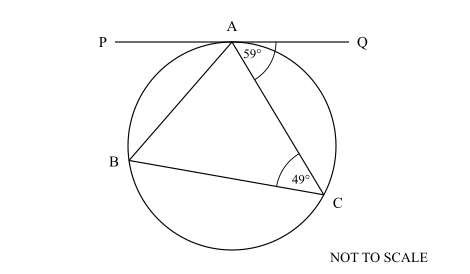
Triangle ABC has all three corners on a circle. The straight line PAQ is the tangent at A, with P nearer to B and Q nearer to C. Angle QAC is 59° and angle ACB is 49°. Find angle BAC, giving a reason for each step.
Solution:
- Angle QAC is the angle between the tangent AQ and the chord AC
- By the alternate segment theorem it equals the angle at the circumference on the other side of AC, which is angle ABC
- So angle ABC = 59°, and the reason is "alternate segment theorem"
- The three angles of triangle ABC add to 180°
- Angle BAC = 180 − 59 − 49 = 72°
- The second reason is that the angles in a triangle add to 180°
- Check: the same theorem with the chord AB gives angle PAB = angle ACB = 49°, and the angles on the straight line PAQ add up: 49 + 72 + 59 = 180