MathematicsExam code: 0580
Circle Theorems
Geometry
Three further facts
- Equal chords are equidistant from the centre, and the statement works in reverse too, so chords equidistant from the centre have equal length
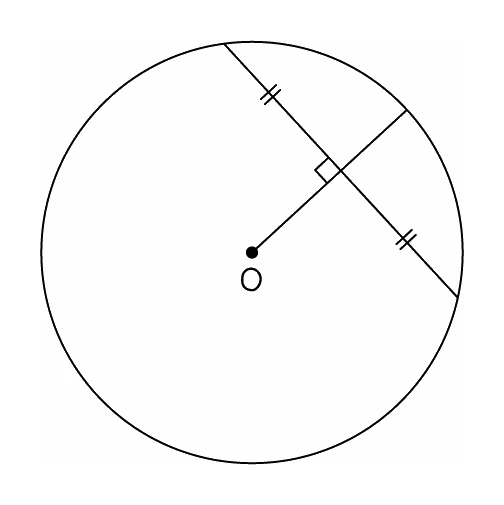
- The perpendicular bisector of a chord passes through the centre, which means a radius drawn to the midpoint of a chord meets it at a right angle and cuts it exactly in half
- Tangents from an external point are equal in length, which is the syllabus's own wording, and the two tangents with the two radii form a kite that has a line of symmetry
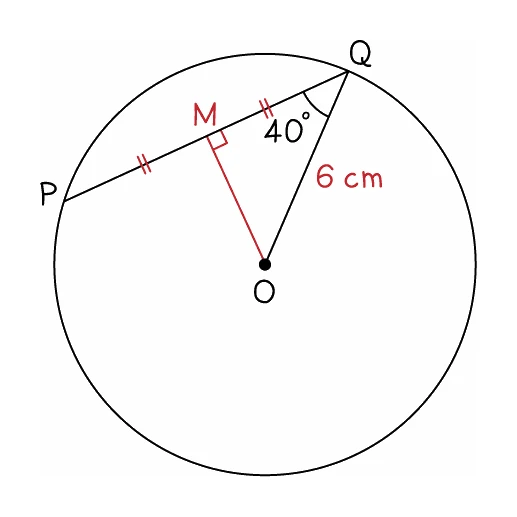
- The chord fact creates a right-angled triangle from the radius, half the chord and the distance to the centre, which is where Pythagoras comes in
- The tangent fact creates two congruent right-angled triangles back to back
Worked example
Pythagoras on a bisected chord
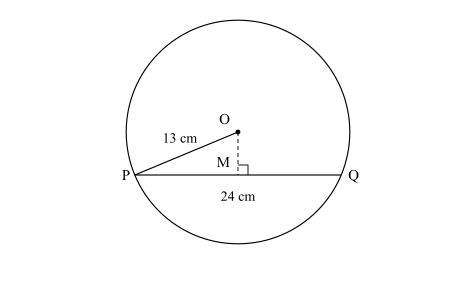
A circle has centre O and radius 13 cm. A chord PQ is 24 cm long. Find the distance from O to the chord.
Solution:
- Let M be the midpoint of PQ, and join OM
- The perpendicular bisector of a chord passes through the centre, so OM meets PQ at 90° and PM = MQ
- So PM = 24 ÷ 2 = 12 cm
- Triangle OMP has a right angle at M, with OP = 13 cm as the hypotenuse
- By Pythagoras, OM² = 13² − 12² = 169 − 144 = 25
- OM = √25 = 5 cm
- Check: 5² + 12² = 25 + 144 = 169 = 13²