Economic Systems: Market & Mixed
Allocation of Resources · 2 question types
An economic system is the way a country organises the use of its scarce resources to answer the three basic economic questions: what to produce, how to produce it, and for whom to produce it.
Every country faces the same basic economic problem (limited resources, unlimited wants), but different countries answer the three questions in different ways. The syllabus studies two systems: the and the . The fully planned (command) economy is not part of this syllabus, so you do not need to study or evaluate it. Real economies sit on a spectrum, from more planned to more market-led, with mixed economies in between.
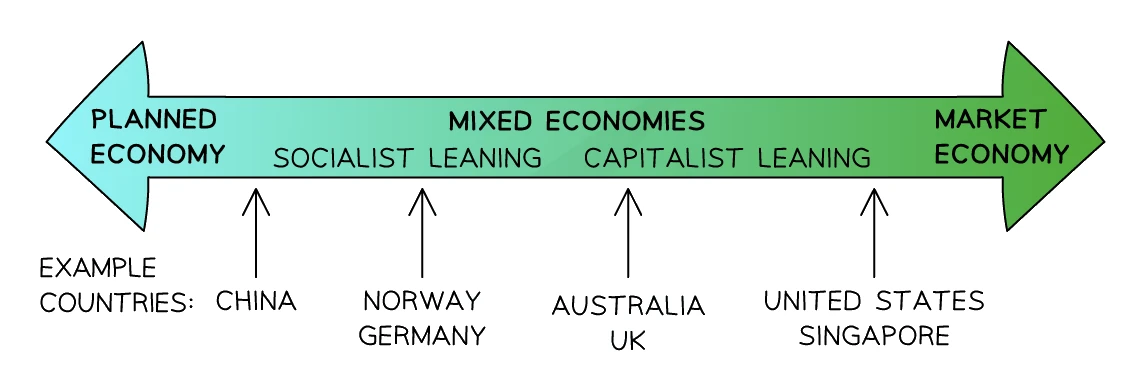
The systems differ in one central question: who allocates the resources. In a market system, private firms and consumers allocate resources through the price mechanism. In a mixed system, the private sector and the public sector (government) share that job.