0455
Economic Systems: Market & Mixed
Allocation of Resources · 2 question types
A mixed economic system is one in which both the private sector and the public sector (government) allocate resources. Most goods and services are left to the market, but the government intervenes where the market on its own would fail.
The mixed economy is the most common real-world system; almost every country is a mixed economy of some kind. The balance varies: some governments intervene heavily, others lightly.
In a mixed economy:
- The private sector / private firms produce most goods and services through the price mechanism, motivated by profit.
- The public sector / government provides goods the market under-supplies (public goods, merit goods), redistributes income through taxes and benefits, and regulates the harmful side-effects of private activity.
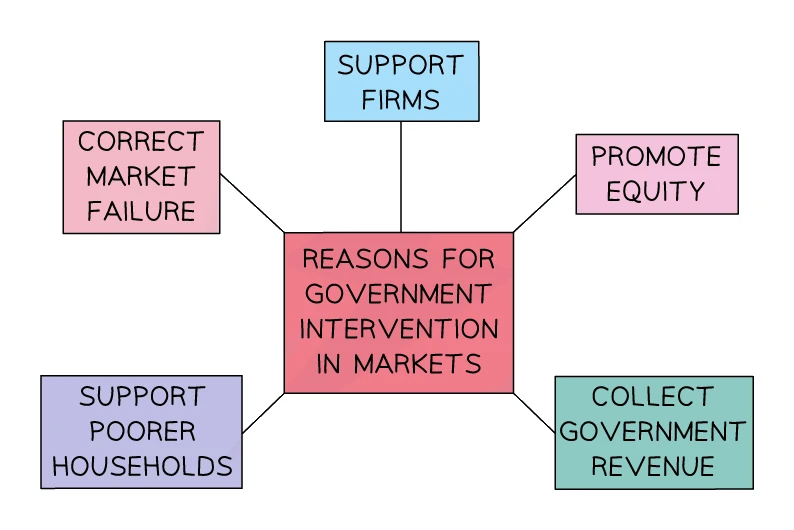
The government intervenes for several reasons: to correct market failure, to support firms, to promote equity, to support poorer households, and to collect government revenue.
Arguments for the mixed economic system
- Keeps the strengths of the market. Competition, choice, the profit incentive and efficiency are retained for most goods.
- Corrects market failure. The government provides public goods and merit goods, taxes goods with external costs, and subsidises goods with external benefits.
- Reduces poverty and inequality. Taxation and welfare benefits redistribute income; state healthcare and education give the poor access to essential services.
- Greater stability. The government can use policy to smooth booms and recessions.
Arguments against the mixed economic system
- Higher taxes. Government spending must be funded, so taxes reduce the incentive to work and invest.
- Inefficiency in the public sector. State-run organisations face no competition and may have weaker incentives to keep costs down.
- Risk of government failure. Intervention can be poorly designed; the cost of correcting a market failure can end up larger than the failure itself.
- Bureaucracy. Regulation and administration can slow firms down and add to their costs.