Economic Systems: Market & Mixed
Allocation of Resources · 2 question types
In a mixed economy the government uses a toolkit of measures to correct market failure. Each has advantages and disadvantages, and the best choice depends on the type of failure.
Price controls
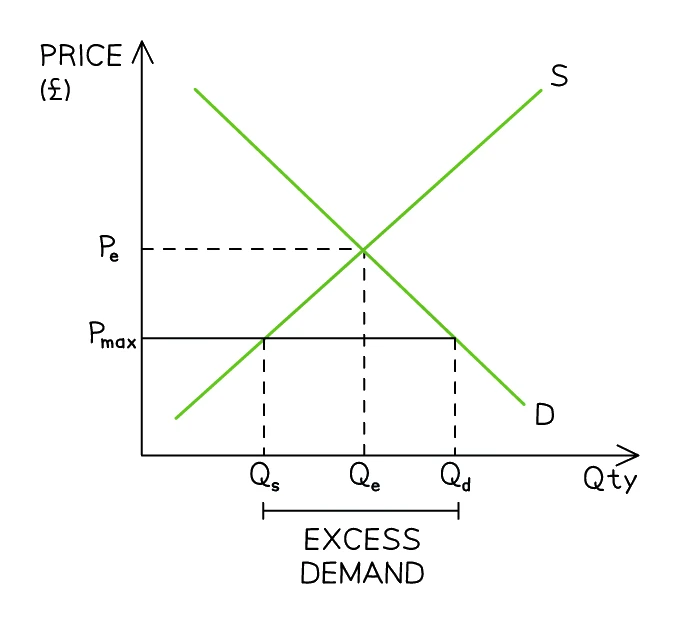
A maximum price is a legal cap set below the equilibrium, used to keep an essential good affordable. It causes a shortage (quantity demanded exceeds quantity supplied).
A minimum price is a legal floor set above the equilibrium, used to support producers or to discourage a demerit good. It causes a surplus (quantity supplied exceeds quantity demanded).
A maximum price set below the equilibrium price Pe holds the price down at Pmax. At that price the quantity demanded (Qd) exceeds the quantity supplied (Qs), so there is excess demand, that is, a shortage.
Indirect taxation
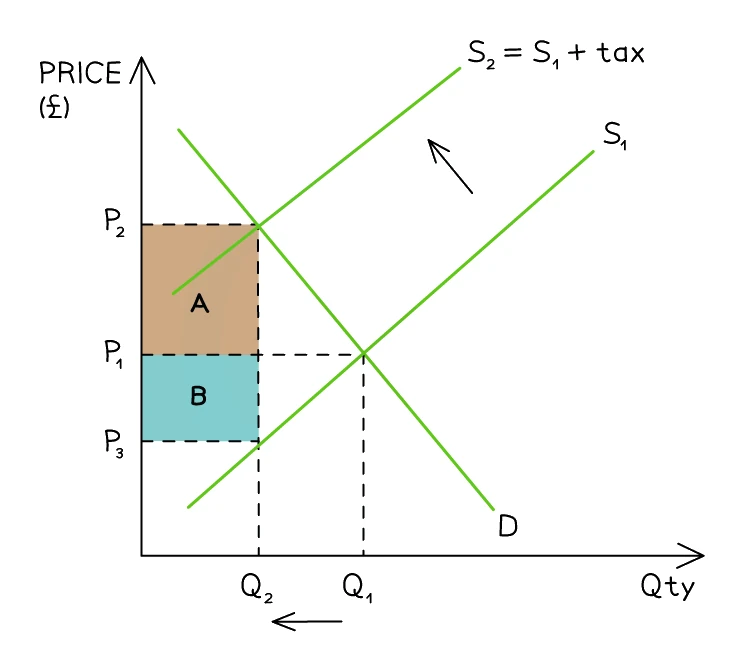
An indirect tax on goods with external costs (cigarettes, fuel, sugary drinks) raises their price and reduces the quantity consumed, helping the polluter or consumer to internalise the external cost. It also raises government revenue. The drawback is that for inelastic goods, demand barely falls, so the harmful activity continues.
Subsidies
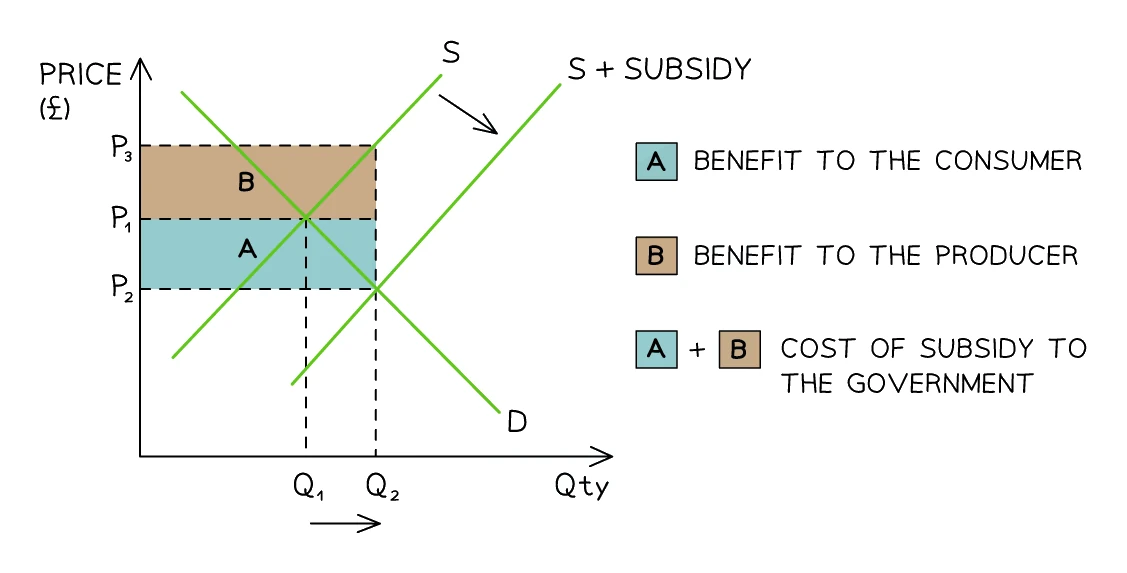
A subsidy is a payment to producers of goods with external benefits (solar panels, public transport, vaccination). It lowers the price and raises the quantity consumed. The drawback is the opportunity cost of the tax money used to fund it, and the risk that firms become dependent on the subsidy.
Regulation
Laws and standards restrict harmful activity directly: emission limits, minimum ages for buying alcohol, bans on dangerous products. Regulation is effective when the harm is severe, but it can be costly to monitor and enforce, and over-tight rules can raise firms' costs.
Privatisation and nationalisation
Privatisation is the transfer of a business or industry from public (government) ownership to private ownership. The aim is to raise efficiency through competition and the profit motive.
Nationalisation is the opposite: bringing a private industry into government ownership, often to secure the supply of an essential service or to control a natural monopoly.
Privatisation works when the industry is opened up to real competition: rival firms have to hold costs and prices down and offer consumers more choice, and the sale itself brings in revenue for the government. The risks are that the industry becomes a private monopoly that raises prices instead, that social objectives such as running loss-making rural services are abandoned once profit is the target, and that cost-cutting leads to job losses.
Nationalisation can guarantee that an essential service keeps running, stop a natural monopoly exploiting consumers, and let the government take social costs and benefits into account rather than private profit alone. Against that, without the profit motive there may be less incentive to keep costs under control, buying the industry and covering any later losses has an opportunity cost for taxpayers, and decisions can be driven by political rather than economic considerations.
Direct provision
The government can provide goods and services itself, free or subsidised at the point of use, funded by taxation. This is the usual solution for public goods (defence, street lighting) and major merit goods (state education and healthcare), because it guarantees access regardless of ability to pay. The drawbacks are that the tax revenue used to fund it has an opportunity cost, that a service which is free at the point of use can be over-used or wasted, and that with no competing suppliers there is weaker pressure to keep quality high and costs down.
Quotas
A quota sets a legal limit on quantity — for example, a cap on the volume of a natural resource that may be extracted. Quotas can protect resources from over-exploitation, but they can be hard to police and may push activity into illegal markets.
Discuss whether government intervention will correct a market failure
What comes up: an 8-mark "Discuss whether or not [a tax / subsidy / regulation / direct provision] will [reduce external costs / improve the allocation of resources]."
Write (why it can): name the chain — e.g. an indirect tax raises price, reduces quantity demanded and so reduces the harmful activity and the external cost; direct provision guarantees that under-provided merit and public goods are actually supplied.
Write (why it might not): for an inelastic good, a tax barely changes consumption; intervention has an opportunity cost and may suffer government failure (poor information, high administration costs, unintended effects).
Watch out: both sides must be developed and a judgement reached; the effectiveness usually depends on the price elasticity of demand for the good and on how well the policy is designed.