Types of Software
Software
Software vs Hardware
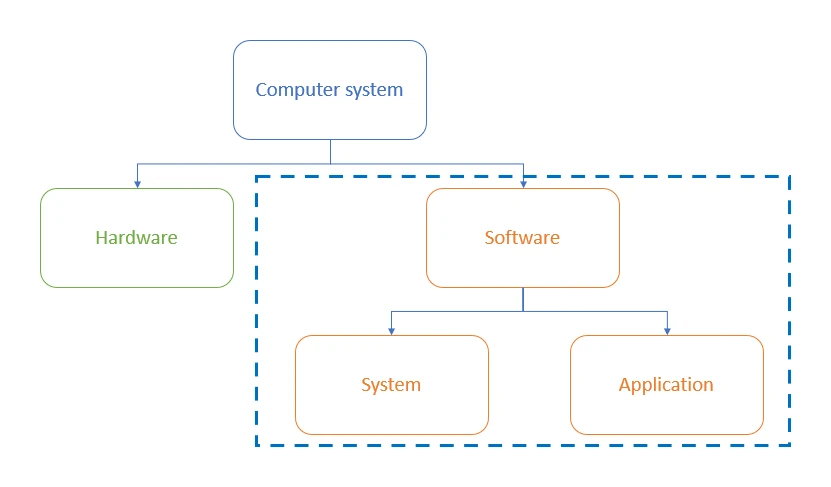
A computer is built from two things working together:
- Hardware: the physical parts you can touch (CPU, RAM, hard drive, keyboard, screen).
- Software: the programs that tell the hardware what to do, made of binary instructions stored in memory.
Software itself splits into two big categories:
- System software: programs needed to make the computer itself usable. The operating system and utility programs belong here.
- Application software: programs that the user chooses to install in order to do a specific job (write a document, edit photos, play a game).
Common exam question
Naming the type of software from its description
Question: Identify the type of software that does a stated job, or write the matching term beside each description in a table (1 mark per term).
Asked in 3 of the 17 papers, one mark per term. Software is the programs or instructions that operate the computer; hardware is the collective term for its physical components. Application software provides the services the user requires and lets the user carry out tasks. The operating system looks after the computer's main functions, such as files, memory and multitasking; it is also the software that manages inputs and outputs (or system software) and manages interrupts (or the interrupt handler). Firmware is the software stored in ROM, including the BIOS and the bootloader.
Utility software maintains and protects the computer: in a list of spreadsheet, anti-virus, web browser and database, the utility is the anti-virus, and the other three are applications.
Exam tip
Say whether the software serves the computer or the user
A four-mark question contrasting system software with application software, with an example of each, gives two marks for the contrast and one per example. The contrast is who is served: system software provides the services the computer requires, application software those the user requires. Give the operating system or a utility (defragmentation software, antivirus, a firewall) for system software and a generic type (word processor, web browser, video editor) for application software. Almost every Paper 1 scheme says brand names of software or hardware earn nothing, so write "word processor" and "operating system", never a product name such as "Windows".