Number Systems
Data Representation · 4 question types
Inside every computer, every piece of information is stored and processed as patterns of ones and zeros. The reason is physical: a computer's circuits are built from millions of tiny switches called logic gates, and each switch has only two stable states, on or off. The two binary digits 1 and 0 map directly onto those two states: 1 represents "on" and 0 represents "off".
This two-state design is what makes computers fast and reliable. A circuit only has to distinguish between "voltage present" and "no voltage", which is easy to do millions of times per second without errors. A system with more states (say, ten different voltage levels for the ten denary digits) would be slower, more expensive, and more prone to errors.
Every other kind of data is just a clever way of encoding it as binary:
- Magnetic hard drives store data as patches of north or south polarity (1 or 0).
- Optical discs (CD, DVD, Blu-ray) store data as flat areas (lands = 1) and pits = 0.
- Solid-state drives store data as charged or uncharged transistors.
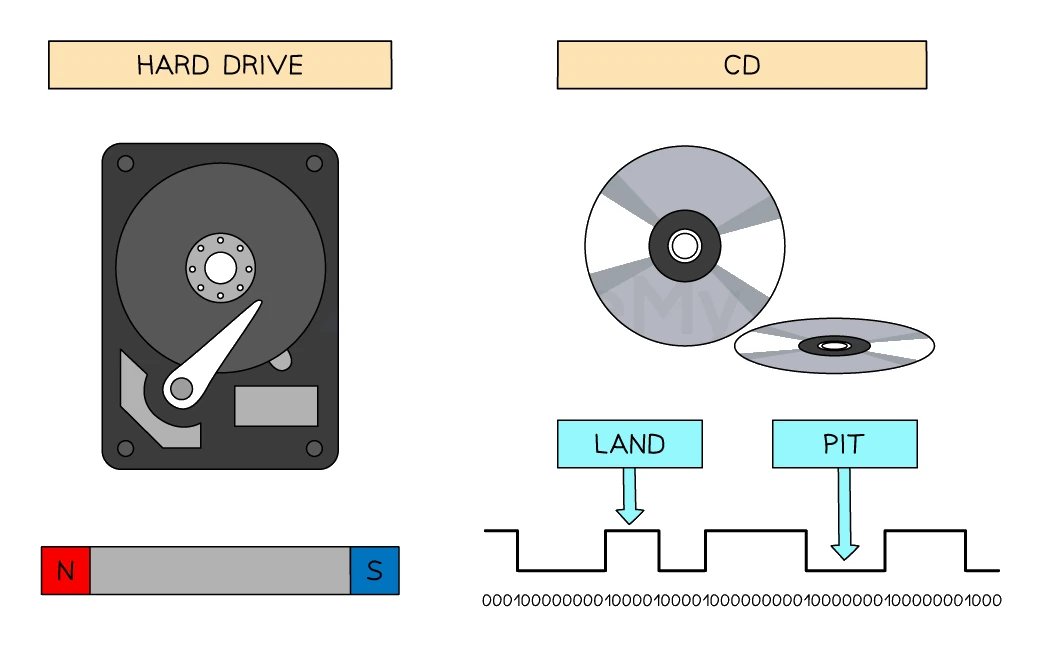
Mark-scheme phrase to remember: computers process data using logic gates that can only have two states (1 and 0).
Why computers use binary
What comes up: "Explain why data is stored in binary" or "give the reason computers use binary" (1–2 marks).
Watch out: the credited reason is the physical two-state nature of the hardware — switches/logic gates that are either on or off, mapping to 1 and 0. A mark is not given for saying "computers only accept 1s and 0s" as if it were a human choice.