Types and Methods of Data Transmission
Data Transmission · 4 question types
When a large piece of data travels across a network, it is rarely sent in one go. Instead, the data is divided into small that travel across the network independently and are reassembled at the far end. Breaking data into packets and routing each one is handled generically by the network: on the internet the packets carry IP addresses and are routed at the IP layer, not by any single protocol on its own.
Small packets are easier to route, because each one can take the quickest available path through the network rather than waiting for one huge chunk to find an uncongested route.
Inside a packet
Every packet contains three sections:
| Section | What it holds |
|---|---|
| Header | The source IP address (which device sent it), the destination IP address (where it is going), and the packet number (e.g. "packet 3 of 5") so the pieces can be put back in order |
| Payload | The actual data being transported (part of an email, part of a web page, part of a video, etc.) |
| Trailer | An end-of-packet marker and an error-check value (a checksum or parity bit) so the receiver can detect corruption |
If a packet is corrupted in transit, the receiver can ask the sender to resend just that one packet rather than the whole message.
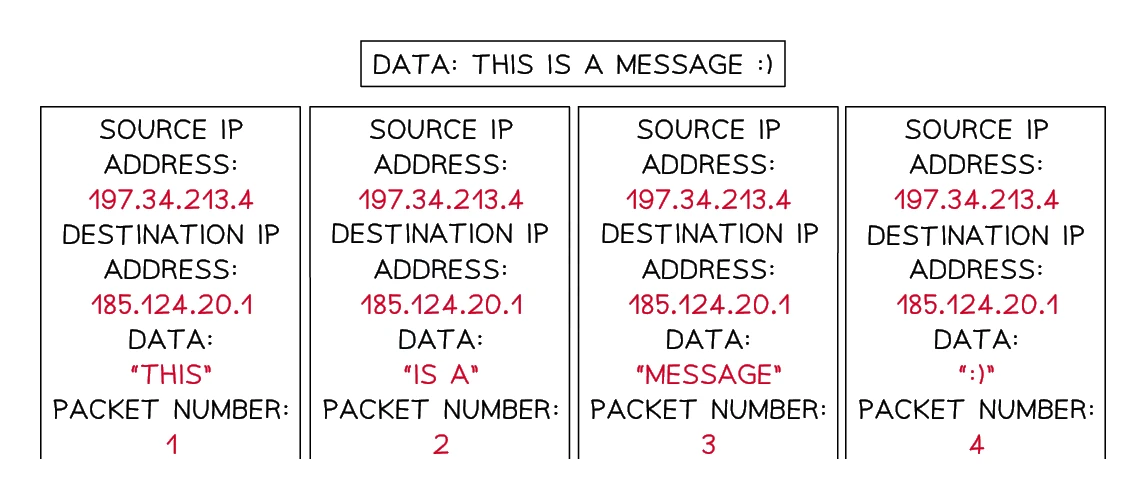
Describing the contents of a data packet
What comes up: state or describe what a packet contains (the header / payload / trailer fields).
Watch out: keep the fields in the right section — the error-detection value is in the trailer, not the header, and the packet number is in the header. Forgetting the packet number is a common dropped mark.