Encryption
Data Transmission · 4 question types
What Encryption Is
When data crosses a network, anyone who can intercept the cable or radio signal could potentially read it. stops that by scrambling the data into a form that only the intended recipient can unscramble.
Encryption is the process of converting (readable data) into (unreadable, scrambled data) using an algorithm and a , so that only someone with the correct key can convert the ciphertext back into plaintext.
The five terms that matter most:
| Term | Meaning |
|---|---|
| Plaintext | The original, readable data before encryption |
| Ciphertext | The scrambled, unreadable data after encryption |
| Encryption algorithm | The mathematical procedure that turns plaintext into ciphertext (and back) |
| Key | A piece of secret information (usually a binary string of a fixed length) that controls how the algorithm scrambles the data |
| Decryption | The reverse process: turning ciphertext back into plaintext using the key |
Encryption does not stop an attacker from intercepting the data. It only stops them from understanding it.
State the purpose of encryption
What comes up: a 1-mark question asking you to state the purpose of, or the reason for, encrypting data before transmission.
Write: If the data is intercepted, it cannot be understood by the person who intercepted it, because they do not have the key needed to decrypt it.
Watch out: A common dropped mark is saying encryption "prevents" data from being intercepted or stolen — it does not. The data can still be captured; encryption only makes it meaningless to whoever captures it.
Why encryption matters more on wireless than wired networks
Both wired and wireless networks need encryption, but wireless networks are especially exposed because the signal travels through the air and can be picked up by any nearby radio receiver. Anyone within range of a Wi-Fi access point can in principle capture the radio waves. On a wired network, an attacker would have to physically tap into the cable to intercept anything.
Wireless networks therefore use dedicated security protocols such as WPA2 (Wi-Fi Protected Access 2) to encrypt all traffic between the device and the access point.
How a Wi-Fi network encrypts data
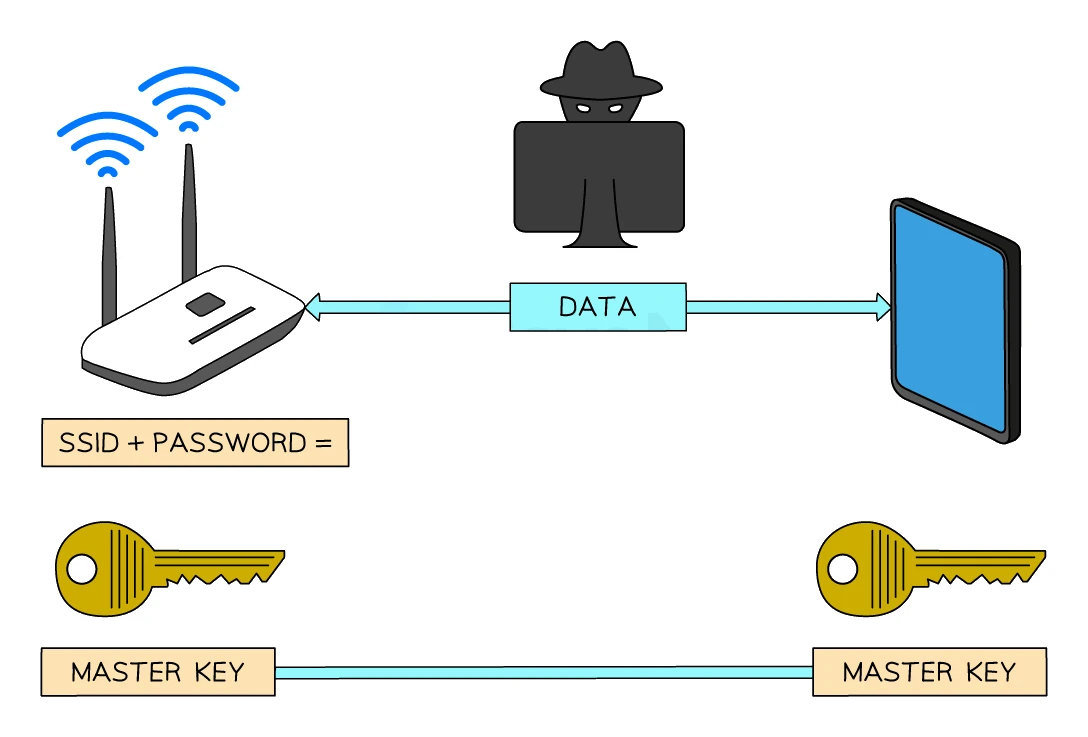
A typical wireless connection works like this:
- The Wi-Fi network is identified by an SSID (Service Set Identifier), which is the name of the network.
- The user enters the SSID and a password when joining the network.
- The SSID and password are combined to derive a master .
- Every device on the network has the same master key.
- The master key never travels across the network. Lacking the key, an eavesdropper sees the captured packets only as scrambled bytes.
- Data sent from a device is encrypted with the master key into before transmission.
- The receiving end decrypts the ciphertext using the same master key.