Reproduction
Reproduction and Inheritance · 7 question types
From puberty (around age 11–14) until menopause (around age 50), the female body runs a roughly 28-day cycle that prepares for possible pregnancy each month. If pregnancy does not happen, the body sheds the prepared lining and starts again.
What happens during the cycle
The cycle is usually counted from day 1, which is the first day of menstruation (the period).
- Days 1–5: Menstruation. The thick uterine lining that was prepared during the previous cycle breaks down and is shed through the vagina. About 30–80 ml of blood and tissue are lost.
- Days 5–14: Lining rebuilds, egg matures. The uterus rebuilds a thick blood-rich lining ready for a possible fertilised egg. Meanwhile, one egg matures in one ovary.
- Day 14: Ovulation. The mature egg is released from the ovary into the oviduct. This is the only fertile day in the cycle.
- Days 14–28: Lining maintained, waiting. The lining stays thick, waiting for a fertilised egg to implant.
- Day 28: If no has happened, the lining breaks down and the next cycle begins. If fertilisation has happened, the lining stays intact and pregnancy continues.
The four hormones that run the cycle
Four hormones coordinate the menstrual cycle, working in a carefully timed sequence. Two come from the pituitary gland in the brain, and two come from the ovaries.
| Hormone | Made in | Main role |
|---|---|---|
| FSH (follicle-stimulating hormone) | Pituitary gland | Causes an egg to mature inside a follicle in the ovary; stimulates the ovary to release oestrogen |
| Oestrogen | Ovaries | Rebuilds the uterine lining after menstruation; inhibits further FSH release; triggers the LH surge that causes ovulation |
| LH (luteinising hormone) | Pituitary gland | Triggers ovulation (the release of the mature egg); causes the empty follicle to become the corpus luteum and start making progesterone |
| Progesterone | Ovaries (corpus luteum) | Maintains the thick uterine lining for the second half of the cycle. If pregnancy does not occur, progesterone drops, triggering menstruation |
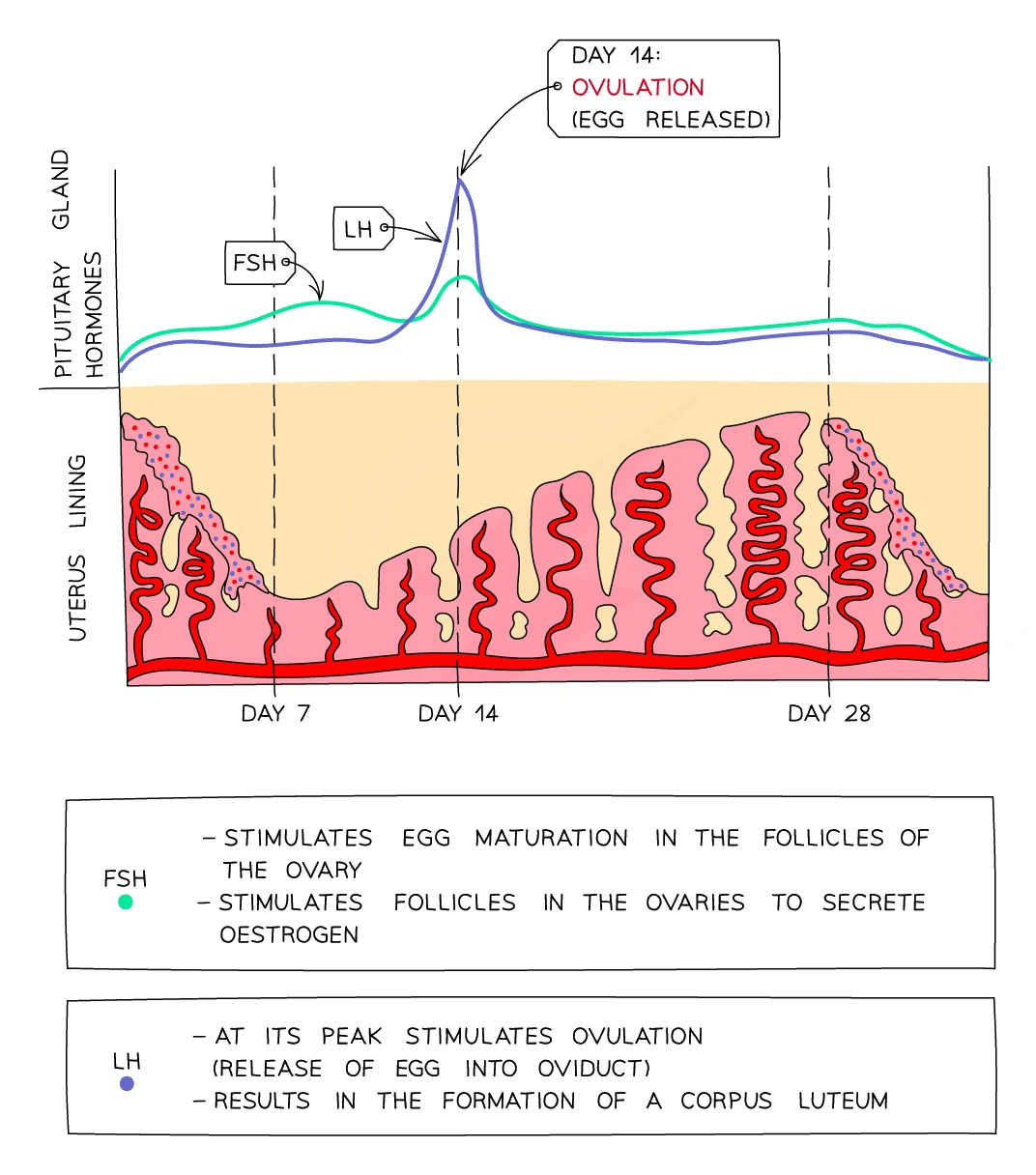
The interaction between the four hormones
- At the start of the cycle, the pituitary releases .
- FSH causes a follicle in the ovary to develop, and the follicle starts releasing .
- Rising oestrogen levels:
- Rebuild the uterine lining
- Inhibit FSH (so no further follicles develop)
- Stimulate release as oestrogen peaks
- The LH surge around day 13–14 triggers ovulation.
- The empty follicle becomes the corpus luteum, which secretes .
- Progesterone maintains the thick uterine lining and inhibits both FSH and LH.
- If the egg is not fertilised, the corpus luteum breaks down, progesterone levels fall, and the uterine lining breaks down → menstruation begins → the cycle starts again.
- If the egg is fertilised, the corpus luteum is kept active by hormones from the developing embryo, progesterone stays high, the lining is maintained, and pregnancy continues.
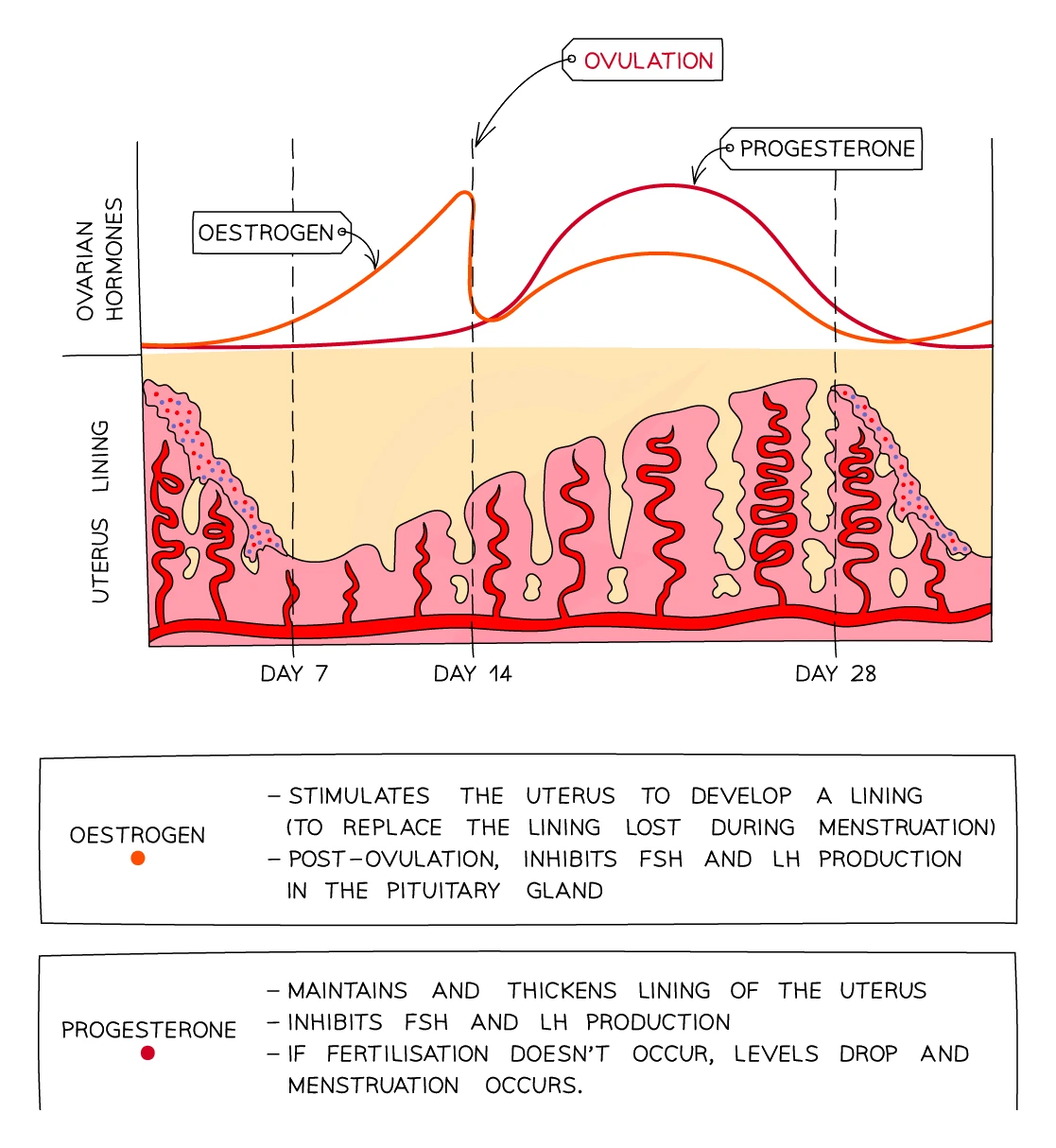
Roles of FSH, oestrogen, LH and progesterone
Describing the menstrual-cycle hormones comes up (often with a graph), so you need to know: FSH matures an egg in a follicle and triggers oestrogen; LH triggers ovulation and the corpus luteum, which releases progesterone to maintain the uterine lining. Don't confuse oestrogen (rebuilds the lining) with progesterone (maintains it).