Reproduction
Reproduction and Inheritance · 7 question types
Flower structure
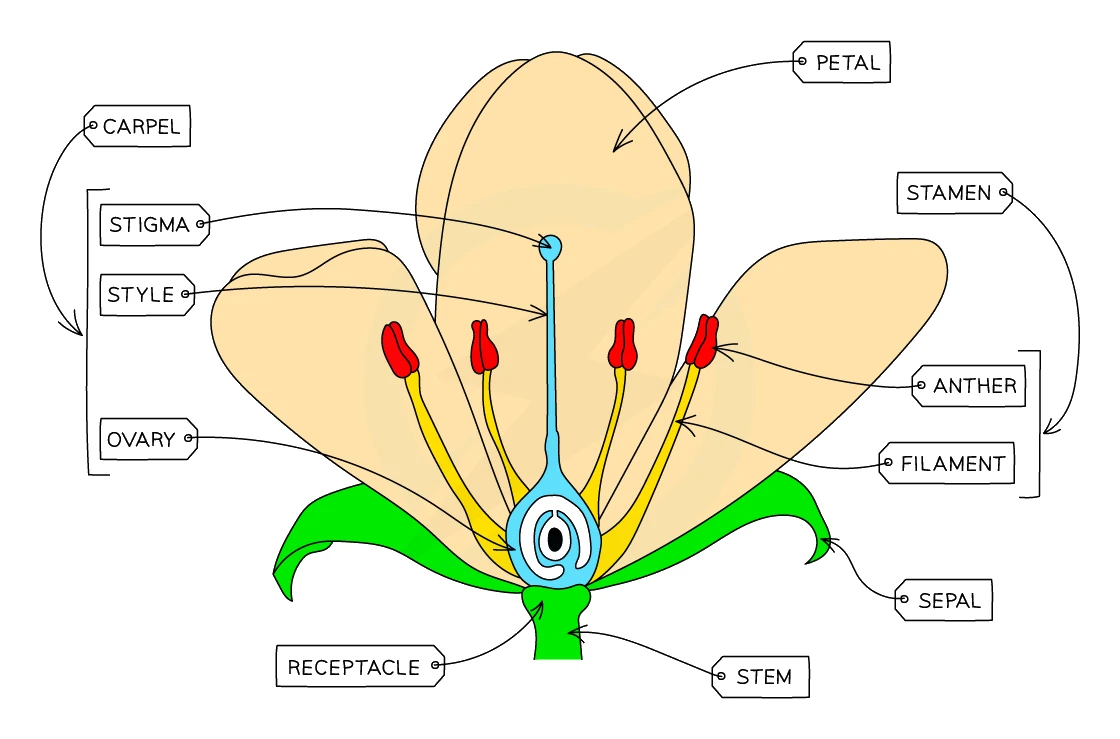
A flower is the reproductive organ of a flowering plant. It contains the male and female parts in one structure.
The main parts of a flower:
| Part | What it does |
|---|---|
| Sepal | A green leaf-like structure that protects the flower bud before it opens |
| Petals | Colourful (in insect-pollinated flowers) or small and dull (in wind-pollinated). Attract insects in the first case |
| Stamen (male part) | Made of an anther at the top, supported by a thin stalk called the filament |
| Anther | Produces and releases pollen grains, which contain the male gametes |
| Filament | The stalk that holds the anther in position |
| Carpel (female part) | Made of the stigma, style and ovary |
| Stigma | The top of the carpel, where pollen lands during pollination. May be sticky or feathery |
| Style | A tube connecting the stigma to the ovary |
| Ovary | Contains the ovules, which hold the female gametes |
| Ovule | The structure containing the female gamete; develops into a seed after fertilisation |
Pollination
Pollination is the transfer of pollen from the anther of one flower to the stigma of another flower (or the same flower) of the same species
Pollination is not the same as fertilisation. Pollination is just the journey of the pollen grain to the stigma. Fertilisation is what happens later, when the male gamete inside the pollen fuses with the female gamete in the ovule.
There are two main methods of pollination: by insects and by wind. Flowers that use each method look quite different.
Insect-pollinated flowers
Insect-pollinated flowers are designed to attract insects (or birds, or bats) and to make sure pollen sticks to the visitor's body for the journey to the next flower.
Adaptations:
- Large, brightly coloured petals to attract insects from a distance
- Sweet scent and sugary nectar at the base of the flower (in a nectary) to lure insects in close
- Anthers held inside the flower so insects must brush past them to reach the nectar, picking up pollen on their bodies as they go
- Sticky stigmas inside the flower so that pollen on a visiting insect transfers across
- Pollen grains are larger, fewer, and stickier (with rough or spiky surfaces) so they cling to insects easily
Examples: roses, sunflowers, snapdragons, orchids.
Wind-pollinated flowers
Wind-pollinated flowers are designed to release pollen into the air and catch pollen blowing past, with no help from animals.
Adaptations:
- Small, dull-coloured petals (often green or brown) since there is no need to attract animals
- No nectar and no scent (making them would be wasted energy)
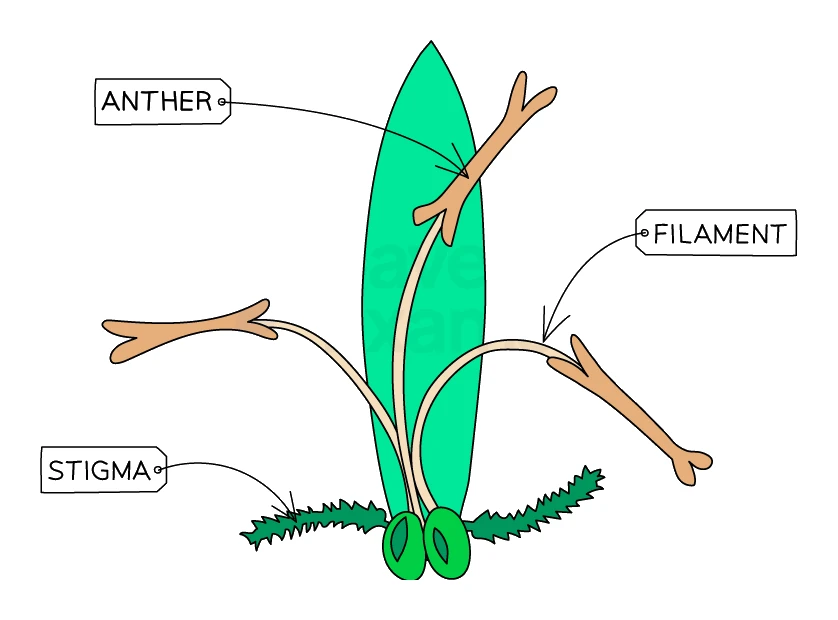
- Anthers hang outside the flower on long filaments so they can sway in the breeze and release pollen into the air
- Long, feathery stigmas hang outside the flower to maximise the chance of catching airborne pollen
- Pollen grains are smaller, much more numerous, and lighter (smooth and dry) so they are easily blown long distances
Examples: grasses, cereals (wheat, rice, maize), most trees (oak, birch, hazel).
Side-by-side comparison
| Feature | Insect-pollinated | Wind-pollinated |
|---|---|---|
| Petals | Large, brightly coloured | Small, dull (often green) |
| Scent and nectar | Strong scent, sweet nectar | None |
| Anthers | Inside the flower, stiff | Hang outside on long filaments |
| Stigmas | Sticky, inside the flower | Feathery, hang outside |
| Pollen grains | Large, few, sticky, often rough or spiky | Small, many, smooth, light |
Wind- vs insect-pollinated flowers
Identifying or describing wind- vs insect-pollinated flowers comes up, so you need to know the wind-pollinated features — feathery stigma hanging outside, anthers outside on long filaments, small, light, smooth pollen — versus insect-pollinated — large coloured petals, sticky stigma inside, large sticky pollen. "No nectary" alone isn't credited without the functional point.
Fertilisation in plants
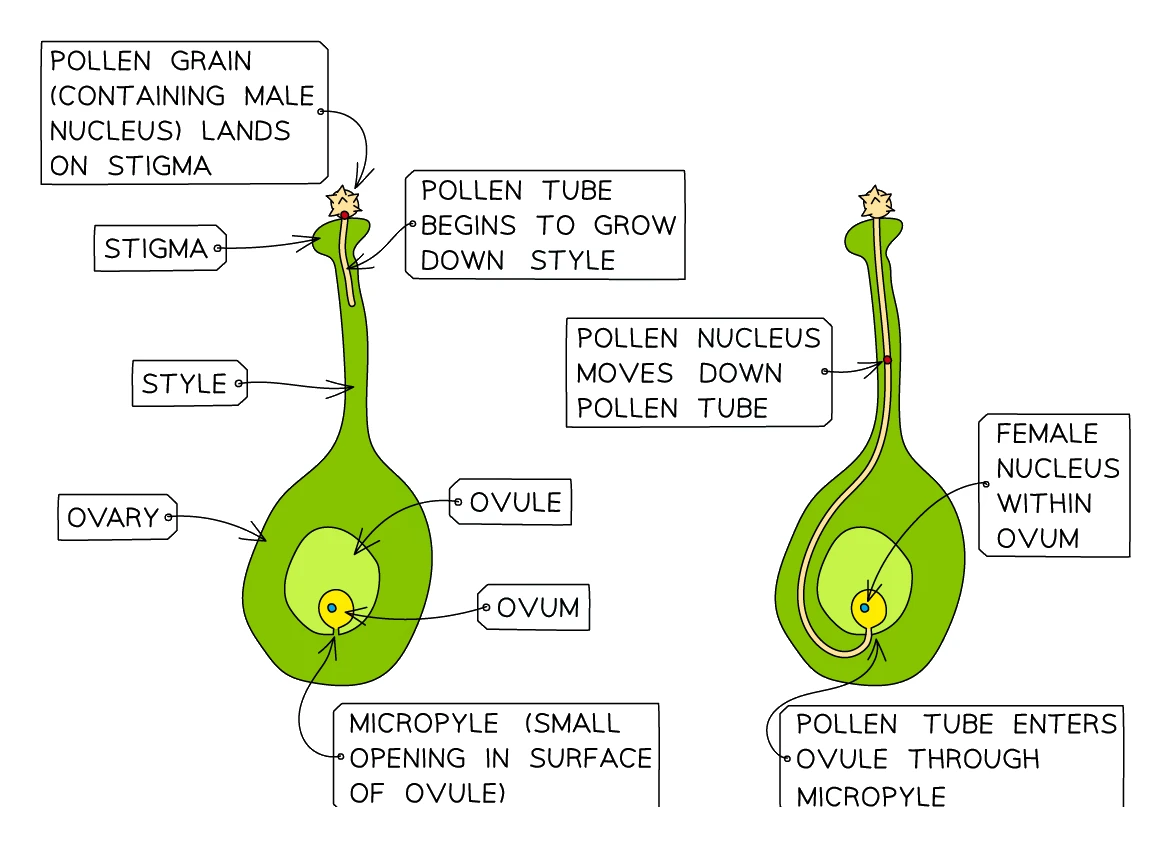
Once a pollen grain lands on a compatible stigma, the male gamete still has to travel down to the ovule. The journey takes a few hours to a few days:
- The pollen grain lands on the stigma (pollination).
- A pollen tube grows out of the pollen grain, down through the style towards the ovary.
- The pollen tube delivers the male nucleus to an ovule inside the ovary.
- The male nucleus fuses with the female nucleus inside the ovule. This is .
- The fertilised ovule develops into a seed.
- The surrounding ovary develops into a fruit that contains the seed (or seeds).
Pollination vs fertilisation
Stating the difference between pollination and fertilisation comes up, so you need to know: pollination = transfer of pollen from anther to stigma (same species); fertilisation = fusion of the male nucleus with the female nucleus in the ovule. The common error is saying pollen "fuses with the egg during pollination" — no fusion happens until the pollen tube has grown down.
Seed dispersal
A new seedling that grows right next to its parent has to compete with the parent for light, water and nutrients. Plants therefore have many ways of dispersing their seeds so the next generation gets enough resources of its own:
- Wind dispersal: seeds have wings or parachutes that catch the air (e.g. sycamore "helicopters", dandelion "clocks").
- Animal dispersal: fleshy fruits are eaten and the seeds pass through the animal's gut undamaged, being deposited elsewhere in faeces (e.g. blackberries, tomatoes). Other seeds have hooks or burrs that stick to animal fur (e.g. cleavers).
- Self-dispersal (explosive): pods dry out and split suddenly, flinging the seeds out (e.g. pea pods, gorse).
- Water dispersal: lightweight floating seeds (e.g. coconut, water lily) drift on currents to new shores.
Germination
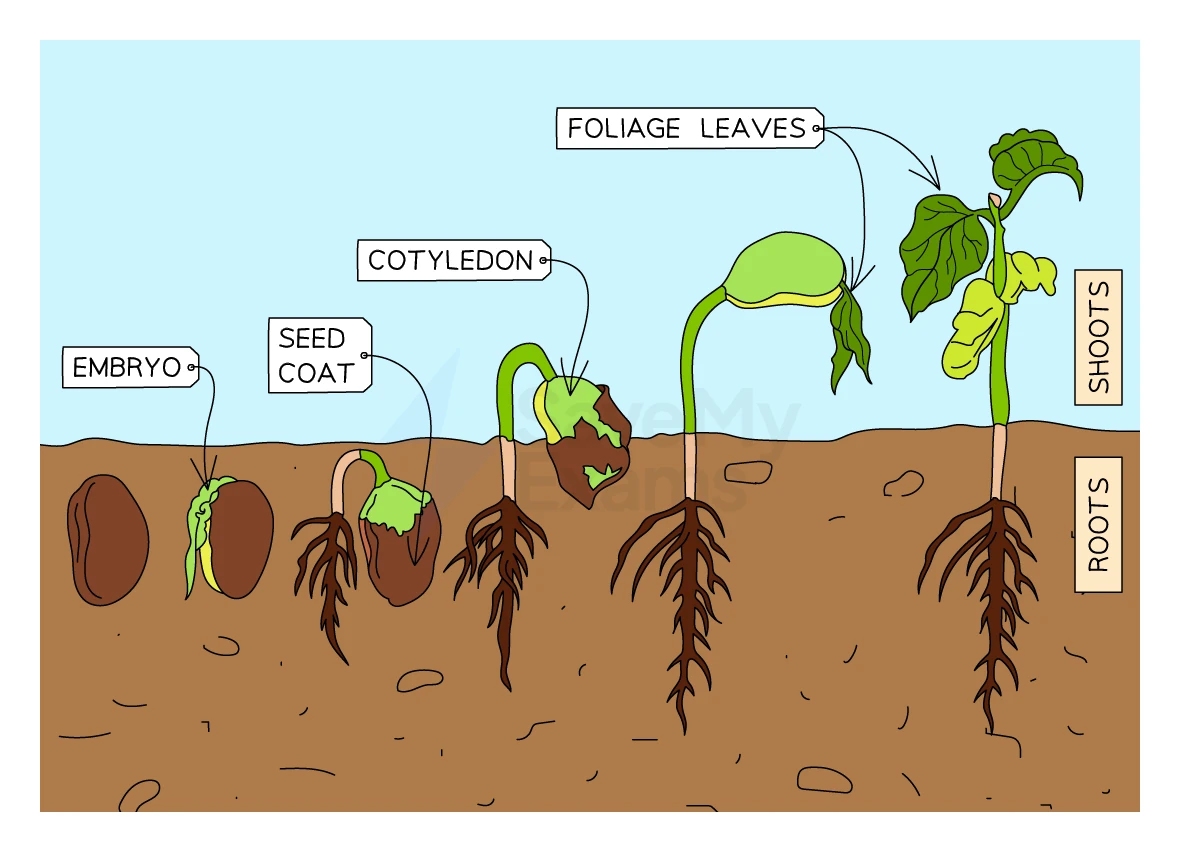
Germination is the process by which a seed begins to grow into a new plant
A seed contains:
- An embryo root (the radicle)
- An embryo shoot (the plumule)
- Seed leaves (cotyledons), which contain a food store of starch and sometimes lipids
- A tough protective seed coat (testa)
Three things are needed for germination:
- Water: swells the seed, softens the seed coat, and activates the enzymes that digest the food store
- Oxygen: needed for aerobic respiration, which releases the energy the embryo needs to grow
- Warmth: enzymes work faster at higher temperatures (up to their optimum)
A seed without any of these three things stays dormant and does not germinate. Light is not needed at the early stages, because the seedling uses its starch food store, not photosynthesis, until its first true leaves emerge.
Core practical: investigating the conditions needed for germination
Aim: to investigate which conditions (water, oxygen, warmth) are needed for seeds to germinate.
Method:
- Set up four test tubes labelled A to D, each containing cotton wool and 10 cress seeds.
- Tube A: dry cotton wool, kept at room temperature. (Tests whether water is needed.)
- Tube B: moist cotton wool, kept at room temperature. (This is the control with all three conditions.)
- Tube C: cotton wool moistened with boiled water (which has had the dissolved oxygen driven out) and covered with a layer of oil that blocks any new oxygen from entering. Room temperature. (Tests whether oxygen is needed.)
- Tube D: moist cotton wool, kept in a fridge at about 4 °C. (Tests whether warmth is needed.)
- After 3 to 5 days, count how many seeds have germinated in each tube.
Expected results:
| Tube | Conditions removed | Outcome |
|---|---|---|
| A | Water absent | No germination |
| B | (control: all present) | Most seeds germinate |
| C | Oxygen absent | No germination |
| D | Warmth absent | No germination |
Conclusion: all three of water, oxygen and warmth are needed for germination. Removing any one of them stops the process.