4BI1
Reproduction
Reproduction and Inheritance · 7 question types
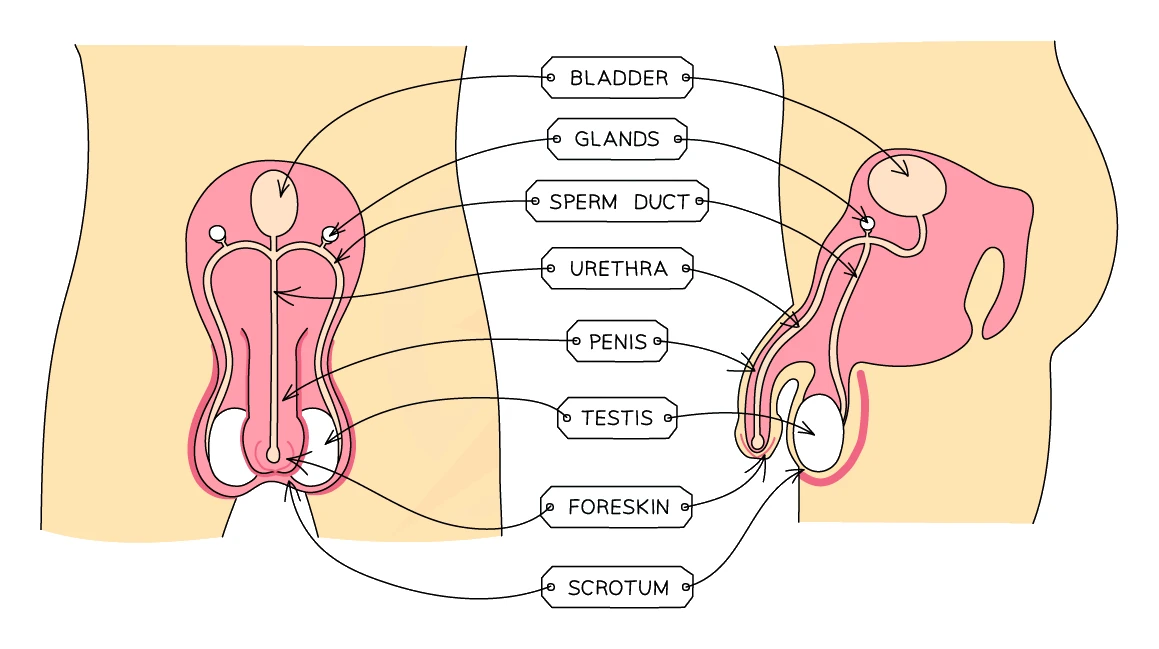
Male reproductive system
| Structure | Function |
|---|---|
| Testes (singular: testis) | Produce sperm (the male gametes) and testosterone (the male hormone). Kept outside the body in the scrotum because sperm need a temperature slightly below body temperature to develop properly |
| Scrotum | A pouch of skin holding the testes outside the body |
| Sperm duct | The tube that carries sperm from the testis to the urethra; sperm are mixed here with fluids from glands to make semen |
| Prostate gland and other glands | Add fluids that nourish the sperm and help them move |
| Urethra | The single tube running along the inside of the penis; carries either urine (from the bladder) or semen (during ejaculation), but never both at once. A small ring of muscle stops the two mixing |
| Penis | Delivers semen into the female reproductive system during sexual intercourse |
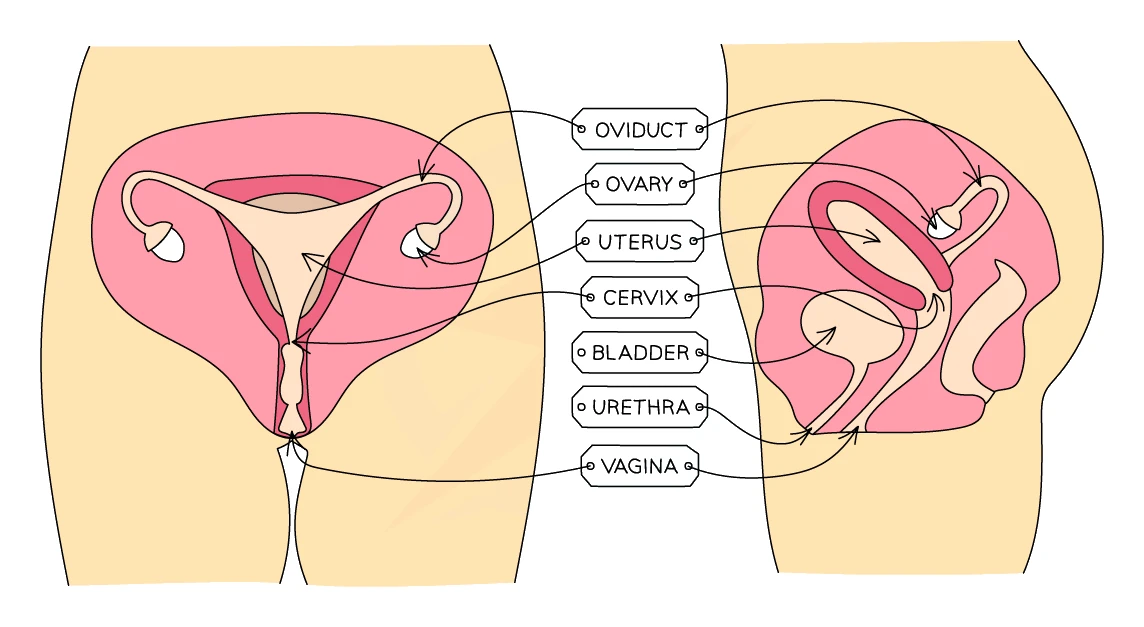
Female reproductive system
| Structure | Function |
|---|---|
| Ovaries | Contain eggs (ova) from birth. From puberty onwards, one ovary releases a mature egg roughly every 28 days. Also produce the female hormones oestrogen and progesterone |
| Oviduct (also called the fallopian tube) | A muscular tube that carries the released egg from the ovary towards the uterus. Fertilisation usually happens here. The inner surface is lined with cilia that gently waft the egg along |
| Uterus (womb) | A muscular sac with a thick blood-rich lining (the endometrium) in which an embryo can implant and develop into a fetus |
| Cervix | A ring of muscle at the lower end of the uterus. Holds the developing fetus in place during pregnancy and opens during birth |
| Vagina | A muscular tube from the cervix to the outside of the body. Receives the penis during sexual intercourse; also the birth canal |
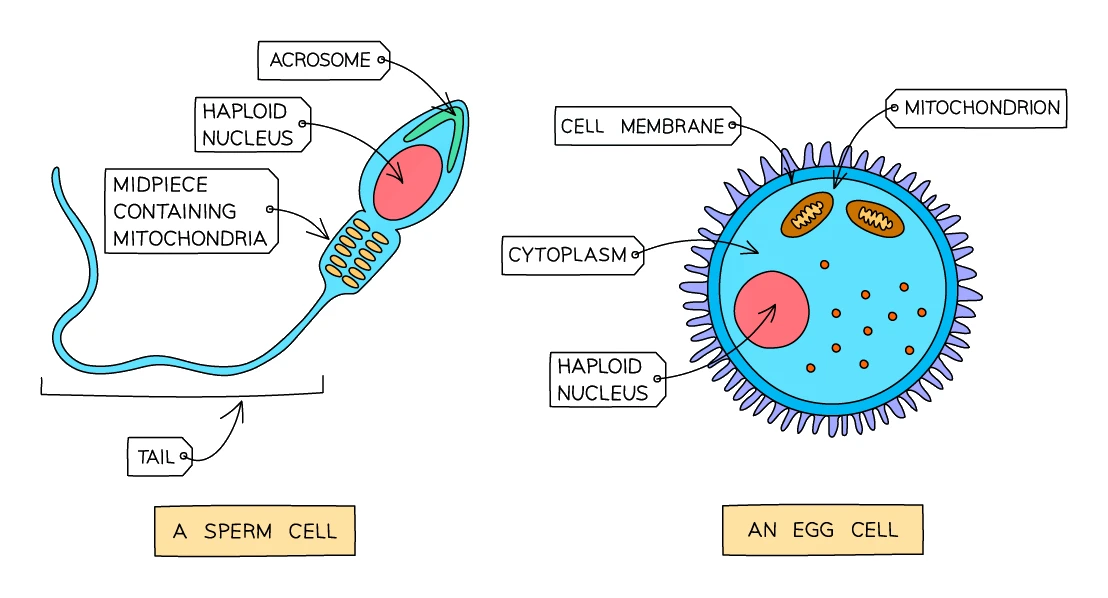
The gametes: sperm and egg
| Feature | Sperm (spermatozoon) | Egg (ovum) |
|---|---|---|
| Size | Tiny, around 0.05 mm long | Large, around 0.1 mm across (one of the largest cells in the body) |
| Made in | Testes | Ovaries |
| Number produced | Millions per day | Around one per month from puberty to menopause |
| Shape | Streamlined head, middle section, long tail (flagellum) | Roughly spherical |
| Special features | Tail for swimming; many mitochondria in the middle for energy; acrosome at the tip with enzymes to break through the egg's outer layer | Cytoplasm packed with nutrients to feed the early embryo; outer jelly-like coat that hardens after one sperm enters |
| Genetic content | Haploid (23 chromosomes); 50:50 mix of X-carrying and Y-carrying sperm | Haploid (23 chromosomes); always carries an X chromosome |
The male gamete is small, mobile and produced in vast numbers. The female gamete is large, immobile and produced one at a time. Both contain 23 chromosomes, half the normal number; when they fuse at fertilisation, the resulting zygote has the full 46.
Fertilisation in humans
During sexual intercourse, semen (containing roughly 200–500 million sperm) is deposited near the cervix. From there:
- Sperm swim up through the cervix into the uterus and then into the oviducts.
- If an egg is present in one oviduct (usually for about a day after ovulation), sperm cluster around it.
- One sperm uses the enzymes in its acrosome to break through the egg's outer jelly coat.
- The nuclei of the sperm and egg fuse together, forming a with 46 chromosomes (23 from each parent).
- Within seconds, the egg's outer membrane hardens, preventing any other sperm from entering.
- The zygote begins dividing by mitosis as it travels down the oviduct.
- By the time it reaches the uterus, it is a tiny ball of cells called a blastocyst, which implants into the soft endometrium and begins to develop into an embryo.
Only one sperm successfully fertilises the egg; the rest are prevented from entering once the egg's membrane hardens.