MathematicsExam code: 0580
Number Toolkit
Number
Column multiplication
- Multiply the top number by each digit of the bottom number in turn, working right to left
- Write a zero as a place holder for each column moved leftwards through the bottom number
- Add the partial products to reach the final answer
The grid method
- The grid method splits each number into its place-value parts, so no carrying is needed until the final addition
- For 246 × 34, split 246 into 200, 40 and 6, and 34 into 30 and 4
| × | 200 | 40 | 6 |
|---|---|---|---|
| 30 | 6 000 | 1 200 | 180 |
| 4 | 800 | 160 | 24 |
- Adding every cell gives 6 000 + 1 200 + 180 + 800 + 160 + 24 = 8 364
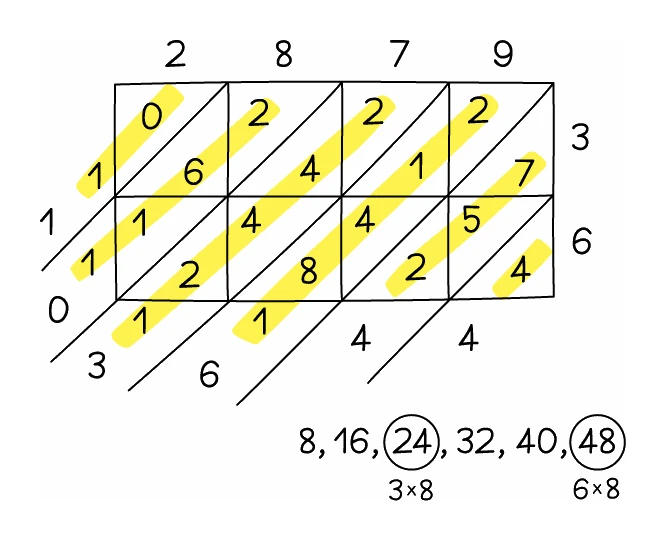
The lattice method
- Every product stays a single-digit pair in this layout, which is what makes it reliable for longer numbers
- Each cell is split by a diagonal, with the tens digit above the diagonal and the ones digit below
- The digits are then summed along each diagonal, carrying leftwards where a diagonal totals ten or more
Short division
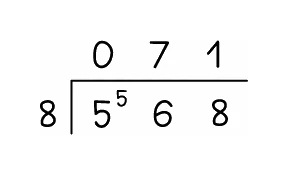
- Short division divides by a single digit, carrying any remainder into the next digit of the number
- The remainder at each step is written as a small digit in front of the next digit
- Only one written method for each operation needs to be known, provided it is used accurately
Shortcuts worth spotting
- Multiplying or dividing by a power of ten shifts every digit along the place-value columns, one column for each zero
- 380 ÷ 10 = 38, 45 ÷ 100 = 0.45 and 28 ÷ 1000 = 0.028
- 3.7 × 100 = 370
- Writing the leading zeros in first makes the shift easier to see, so 0028 ÷ 1000 becomes 0.028
- A division by a larger number can be simplified first, exactly as a fraction is cancelled
- 1008 ÷ 28 is 1008/28, which halves to 504/14 and again to 252/7, and short division finishes it as 36
- Halving repeatedly divides by a power of 2, so 568 ÷ 8 is 284, then 142, then 71
Worked example
A long multiplication and a short division
Without a calculator, work out 384 × 27 and 4 718 ÷ 7.
Solution:
- For the multiplication, split 27 into 20 and 7 and multiply separately
- 384 × 20 = 7 680
- 384 × 7 = 2 688
- Add the partial products: 7 680 + 2 688 = 10 368
- Estimate as a check: 400 × 27 = 10 800, so 10 368 is sensible
- For the division, work left to right carrying each remainder
- 7 into 4 does not go, so carry the 4 onto the next digit to make 47
- 7 into 47 goes 6 times with 5 left over, so write 6 and carry the 5 onto the 1 to make 51
- 7 into 51 goes 7 times with 2 left over, so write 7 and carry the 2 onto the 8 to make 28
- 7 into 28 goes 4 times exactly
- The answer is 674, and 7 × 674 = 4 718 confirms it