Mathematics (Core)Exam code: 0580
Symmetry and Shapes
Geometry
Counting the order
- The order of rotational symmetry counts how many times a shape looks unchanged during one full turn about its centre
- Returning to the starting position always counts, so the smallest possible order is 1
- A shape of order 1 is normally described as having no rotational symmetry
- With tracing paper, draw an arrow to mark the starting position so you can tell when a full turn is complete
- A parallelogram has order 2 with no lines of symmetry, which shows the two kinds of symmetry are independent
- A regular polygon with n sides has order n and n lines of symmetry
Worked example
Shading for rotational symmetry
A pattern is drawn on a 4 by 4 grid of squares. Counting rows from the top and columns from the left, the shaded squares are in row 1, columns 1 and 2; row 2, column 3; row 3, column 2; and row 4, column 4. Shade one more square so that the pattern has rotational symmetry of order 2.
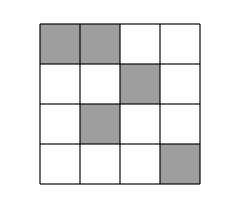
Solution:
- Order 2 means the pattern looks the same after a half turn about the centre of the grid
- A half turn sends every square to the one directly opposite it through the centre: row 1 swaps with row 4, row 2 with row 3, column 1 with column 4 and column 2 with column 3
- Row 1, column 1 goes to row 4, column 4, which is shaded
- Row 2, column 3 and row 3, column 2 go to each other, and both are shaded
- Row 1, column 2 goes to row 4, column 3, which is empty, so that is the square to shade
- Shade row 4, column 3
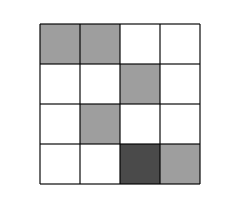
- Check with tracing paper: trace the new pattern, turn it half a turn, and every shaded square lands on a shaded one
- A quarter turn would send row 1, column 1 to a corner that is empty, so the order is exactly 2