Mathematics (Core)Exam code: 0580
Linear Graphs
Coordinate Geometry and Graphs
From a graph
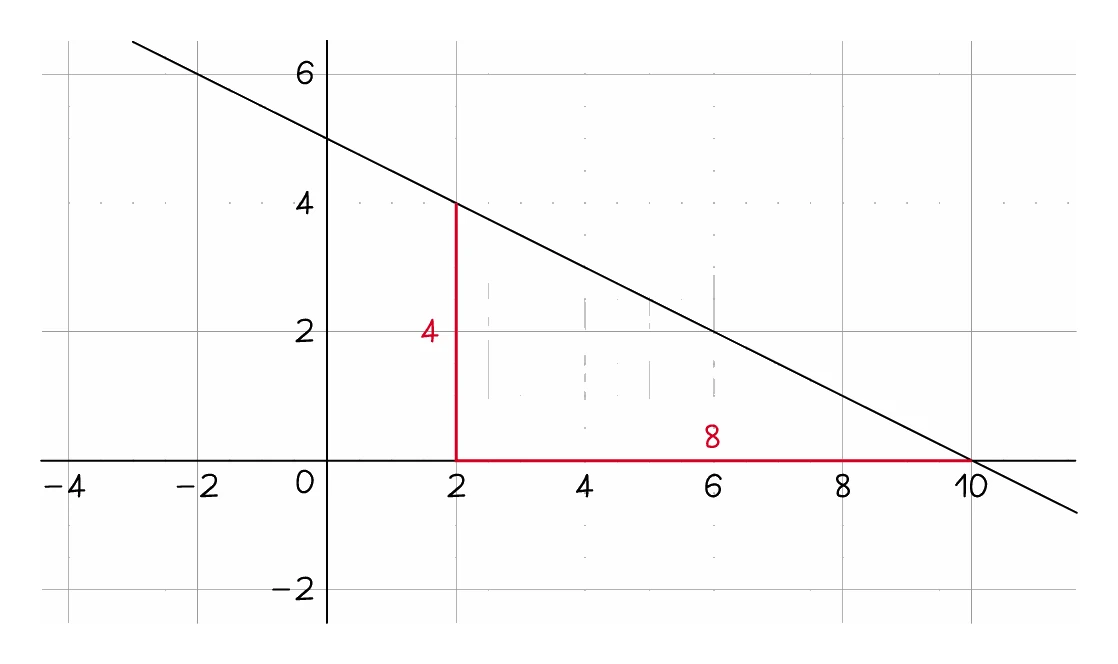
- Work out the gradient from a triangle, then read where the line crosses the y-axis
- Put both numbers into y = mx + c and write the equation out
- If the crossing point is off the edge of the grid, use a point the line does pass through instead
Exam tip
The equation is marked in pieces
Finding the equation of a line from a grid is marked in pieces. A right-angled triangle drawn on the grid, with the correct rise and run written on it, earns a method mark on its own. In the answer, the right gradient scores even with a wrong c, and the right c scores even with a wrong gradient, so always finish with a whole equation, y = mx + c.
Worked example
The equation of a line from a grid
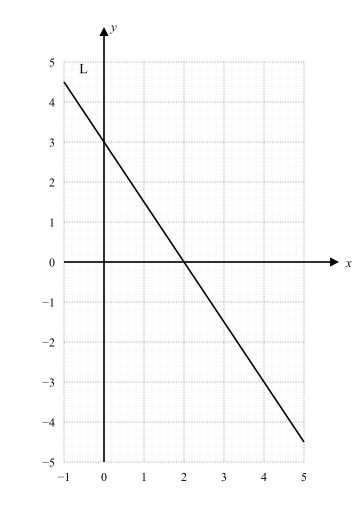
Line L is drawn on the grid below. Find its equation in the form y = mx + c.
Solution:
- Use two points where L crosses the grid exactly, as far apart as the grid allows: (0, 3) and (4, −3)
- Draw a right-angled triangle between them and read its sides off the grid
- The run is 4 to the right and the line drops 6, so the rise is −6 because L slopes downhill
- Gradient = rise ÷ run = −6 ÷ 4 = −1.5
- L crosses the y-axis at 3, so c = 3
- The equation is y = −1.5x + 3
- Check with the other point: −1.5 × 4 + 3 = −6 + 3 = −3
From a gradient and a point
- Write y = mx + c with the gradient filled in and c left as a letter
- Substitute the coordinates of the known point and solve the resulting equation for c
- Rewrite the equation with that value in place
Worked example
A gradient and one point
Find the equation of the line with gradient 5 that passes through (3, 7). Give your answer in the form y = mx + c.
Solution:
- Start from y = 5x + c
- Substitute x = 3 and y = 7: 7 = 5 × 3 + c
- So 7 = 15 + c
- Subtract 15: c = −8
- The equation is y = 5x − 8