Mathematics (Core)Exam code: 0580
Further Graphs
Coordinate Geometry and Graphs
Recognising the Standard Shapes
The families you must know
- Being able to match an equation to the right picture saves plotting and catches plotting errors
- Linear, written y = mx + c, or as a vertical line x = k, is a straight line
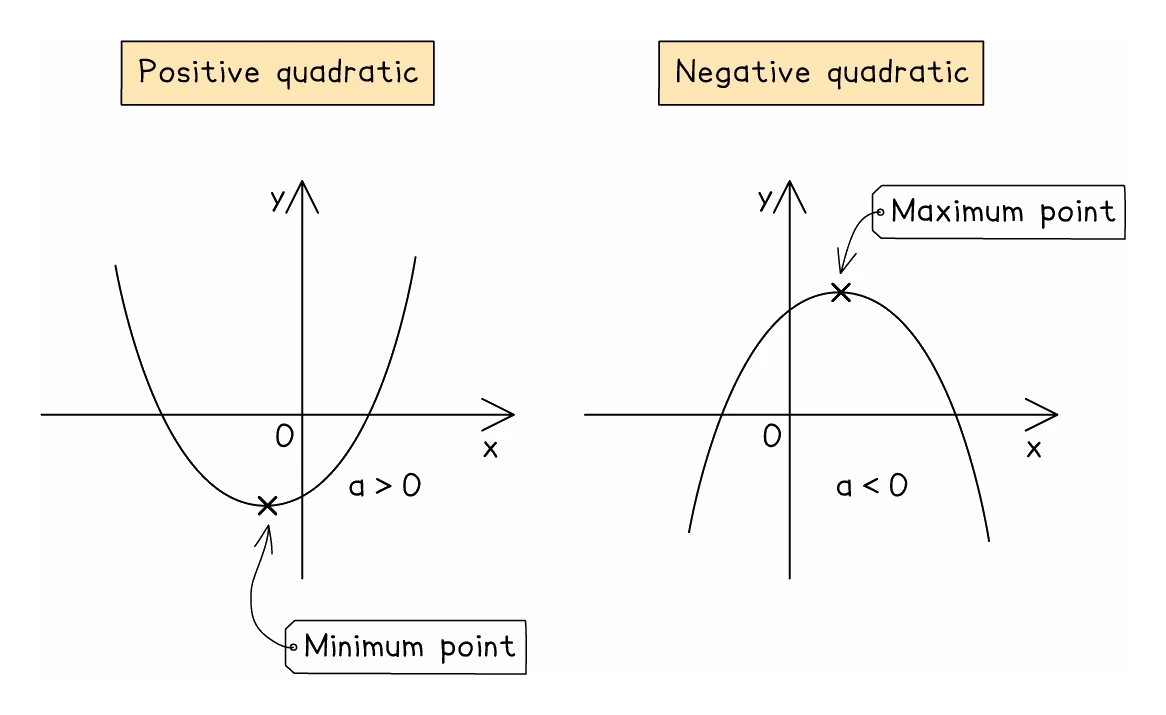
- Quadratic, written y = ax² + bx + c, is a single u-shape or n-shape, symmetrical about a vertical line through its lowest or highest point
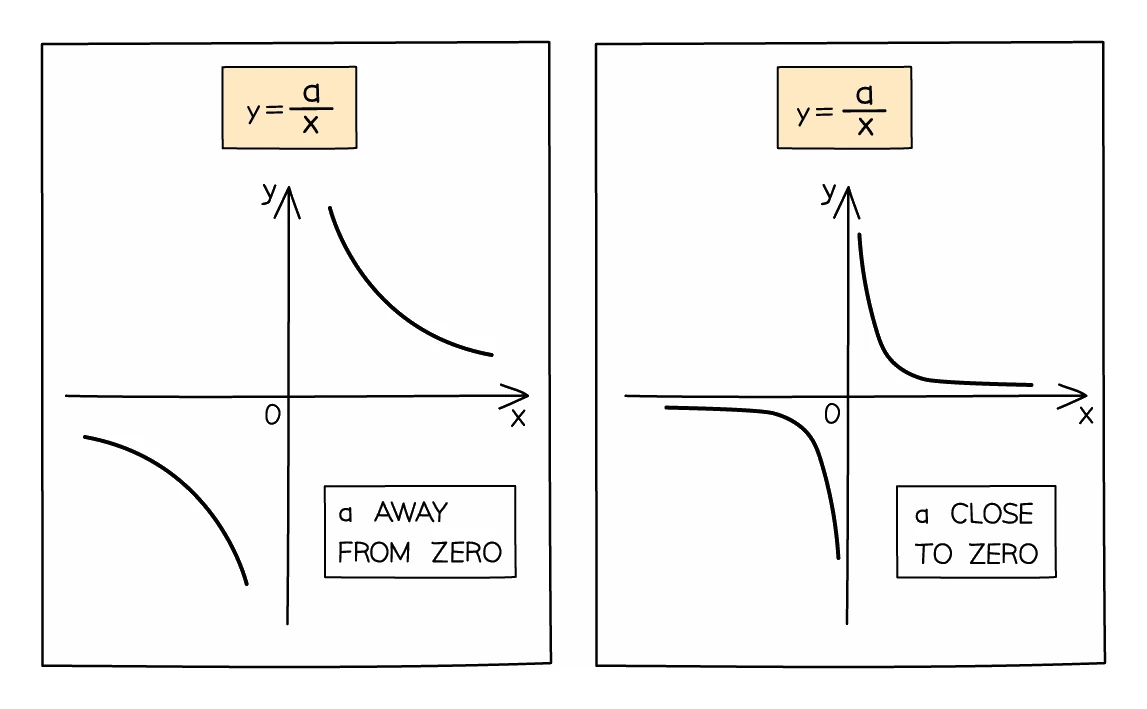
- Reciprocal, written y = a ÷ x, is two separate branches that never meet either axis
- The sign of the number in front reflects each shape vertically, so y = −x² is an n-shape where y = x² is a u-shape
Worked example
Matching an equation to its shape
Say what shape each of these graphs has: (a) y = 2x + 3 (b) y = x² − 4 (c) y = 6/x (d) y = 5 − x²
Solution:
- Read the highest power of x first, because that is what fixes the family
- (a) The highest power is 1, so it is a straight line, sloping up with gradient 2
- (b) The highest power is 2, so it is a parabola, u-shaped because the number in front of x² is positive
- (c) x is on the bottom of a fraction, so it is a reciprocal graph: two separate branches, one in each of two opposite quadrants
- (d) The highest power is again 2, so this is a parabola too, but the number in front of x² is negative, so it is n-shaped
- Comparing (b) and (d) shows that the sign in front of the squared term, not the rest of the equation, decides which way up the curve sits