Money & Banking
Microeconomic Decision Makers · 2 question types
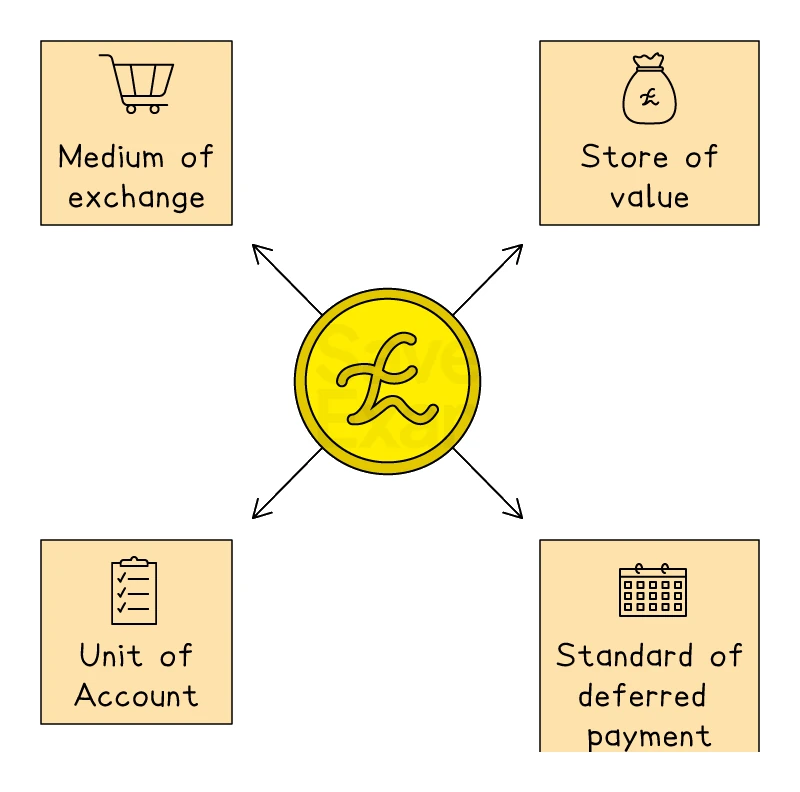
The syllabus expects you to know the four functions of money.
| Function | What it means |
|---|---|
| Medium of exchange | Money is accepted in return for goods and services, so people no longer need a double coincidence of wants. It is used to buy, sell and trade. |
| Store of value | Money keeps its value over time, so people can save now and spend later (this only holds well when inflation is low). |
| Unit of account (measure of value) | Money provides a common measure in which the price of every good can be expressed and compared. |
| Standard of deferred payment | Money lets people buy now and pay later, so debts, loans and contracts can be set in money terms. |
Explain the functions of money (2 or 4 marks)
What comes up: "Identify two functions of money" (2 marks) or "Explain two functions of money" (4 marks).
Write: Name a function and develop it: Medium of exchange (1) — money is used to buy and sell products and to trade (1). Store of value (1) — money can be saved and keeps its value over a period of time (1). For "identify" questions, simply naming two (medium of exchange, store of value, unit of account, standard of deferred payment) earns the marks.
Watch out: The mark scheme accepts a correct description of a function even without the technical term (for example, "money can be used to buy and sell products"), but a vague answer like "money helps the economy" earns nothing. Match each function to a distinct role.