Money & Banking
Microeconomic Decision Makers
For something to work well as money it needs certain physical and practical qualities.
| Characteristic | Why it matters |
|---|---|
| Acceptability | Everyone must be willing to take it in exchange, or it cannot act as a medium of exchange. |
| Durability | It must last and not wear out or decay quickly, so it can act as a store of value. |
| Portability | It must be easy to carry so it can be used in everyday transactions. |
| Divisibility | It must split into smaller units so it can pay for cheap as well as expensive goods. |
| Scarcity (limited supply) | It must be hard to copy or produce freely, otherwise it loses value. |
| Uniformity | Each unit must be the same as every other of the same value, so prices are clear. |
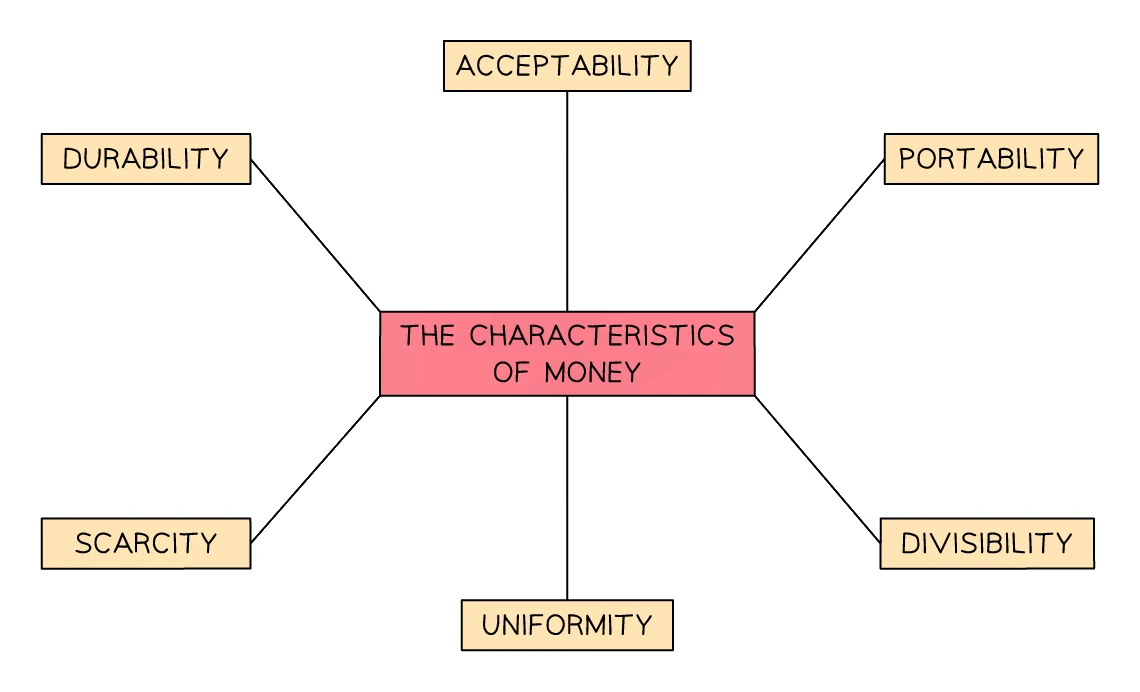
This is why modern economies use notes, coins and bank deposits rather than, say, perishable goods: a basket of fruit fails durability and divisibility, so it is poor money.
Common exam question
Telling a characteristic of money from a function
Question: Choose the option that pairs a characteristic of money with a function, or the item that is not a function (1 mark, multiple choice); or explain two characteristics of money (4 marks).
Set in 2 of the 13 multiple-choice papers. Asked in 1 of the 11 structured papers. A function is a job money does; a characteristic is a quality that lets it do the job (acceptable, durable, portable, divisible, limited in supply, uniform). The options mix the two lists, plus forms of money such as cash or a bank deposit, so label each option first: portability is a quality, not a function.
For the 4-mark question, name each characteristic (1) and say why it matters (1): acceptable, so people take it in payment; durable, so it lasts and can be saved; limited in supply, so it keeps its value; divisible, so there are units of different value. Recognisable was credited too, and "breakable" was accepted for divisible.