Market Failure & Externalities
Allocation of Resources · 5 question types
Positive externalities require the opposite policy mix: encourage more production and consumption.
Producer subsidies
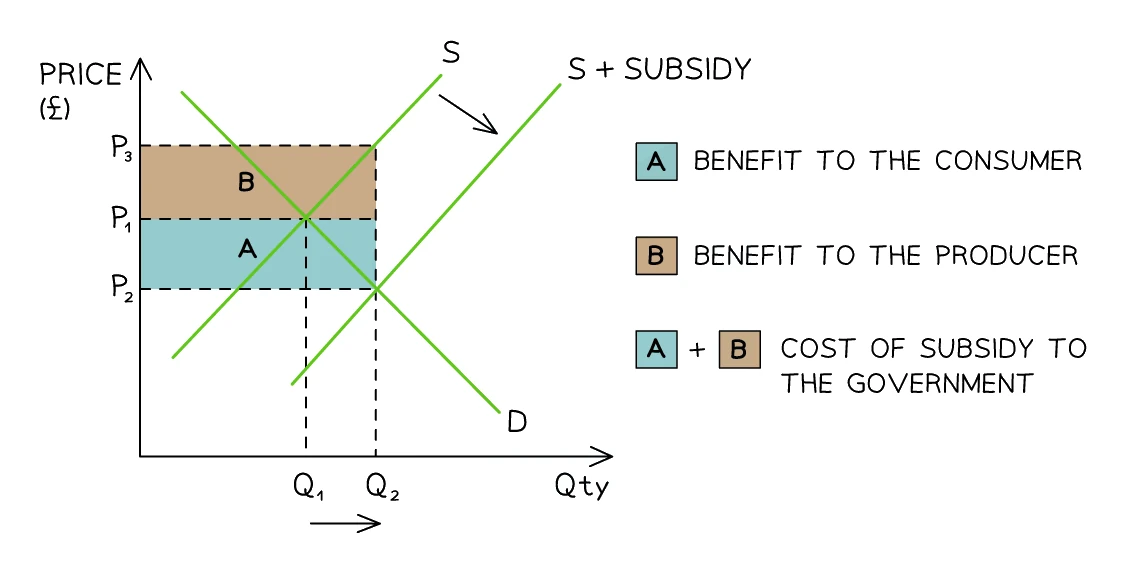
A subsidy is a payment from the government to the producer per unit of output. The subsidy lowers the producer's effective cost, shifts the supply curve to the right, lowers the market price and raises the quantity sold. This boosts the production of goods that generate positive externalities (e.g. solar panels, electric vehicles).
Like a tax, a subsidy is shared between producer and consumer. The split depends on price elasticity of demand: an inelastic good's subsidy mostly reaches consumers as a lower retail price; an elastic good's subsidy is mostly retained by producers.
State provision
The government can simply provide the good itself, free at the point of use, funded through taxation. This is common for education and basic healthcare. State provision guarantees that everyone can access the good regardless of ability to pay, capturing the positive externality fully.