Market Failure & Externalities
Allocation of Resources · 5 question types
A 4-mark "how can the government correct a negative externality" question usually rewards two clearly distinct policies, each with a short explanation.
Indirect taxation (Pigouvian tax)
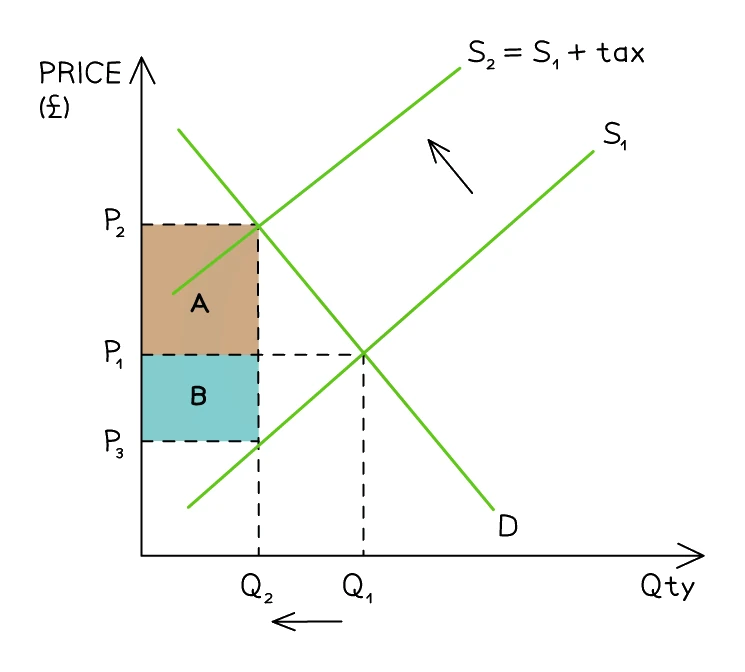
The government levies an indirect tax on the producer or consumer of the good. If the tax is set equal to the per unit, it forces the producer or consumer to internalise the externality: their private cost now matches the social cost.
On a diagram, the tax shifts the supply curve to the left (from S₁ to S₂ = S₁ + tax). The equilibrium price rises from P₁ to P₂ and the equilibrium quantity falls from Q₁ to Q₂, bringing output back toward the socially optimal level. The two shaded areas split the tax by incidence: area A is the part passed on to consumers as a higher price and area B the part absorbed by producers.
A higher price funded by the tax also raises government revenue, which can be used to fund the clean-up or to compensate affected third parties.
Discuss whether a tax can reduce external costs [8 marks]
What comes up: An 8-mark two-sided "Discuss whether or not a tax on a product can reduce external costs."
Write (why it can): A tax raises the price of the good, reducing quantity demanded. If demand is price elastic, the fall in quantity demanded will be large, significantly cutting the activity that creates the external cost. The tax also gives the government revenue that can be used to subsidise cleaner alternatives or compensate those affected.
Write (why it might not): If demand is price inelastic (e.g. addictive goods such as cigarettes), consumers barely cut back even after a large price rise — quantity demanded barely changes, so external costs remain. Tax avoidance, unofficial markets, and evasion can also mean the intended reduction in consumption does not occur.
Watch out: Both sides must be developed for full marks. A one-sided answer is capped at Level 2 (max 5 marks). End with a judgement: the effectiveness depends critically on the price elasticity of demand for the good being taxed.
A complication commonly tested: the incidence of the tax (who actually pays it) depends on price elasticity of demand. For an inelastic good (cigarettes, petrol), most of the tax is passed on to the consumer as higher prices, because demand barely falls. For an elastic good, most of the tax is absorbed by the producer (the firm has to swallow the cost or risk losing too many sales).
Regulation, bans, and standards
The government can use laws to restrict the harmful activity directly. Examples:
- Emission caps for industrial plants.
- Bans on the sale of certain pesticides.
- A minimum legal age for buying alcohol or tobacco.
- Smoke-free zones in public buildings.
Regulation works by setting a maximum quantity or by removing the activity altogether, rather than relying on price. It is most effective when the external cost is severe or when monitoring individual emissions is expensive.
Minimum prices
The government can set a minimum price above the free-market price to discourage consumption of a demerit good (e.g. minimum unit pricing for alcohol). The higher legal price reduces quantity demanded.