Workers & Wages
Microeconomic Decision Makers · 4 question types
A 4-mark "explain the factors that determine wages" question rewards distinct, well-explained reasons. They fall into demand-side, supply-side and institutional groups.
Demand-side and supply-side factors
Demand for labour depends on the demand for the product the worker helps to make (derived demand) and on the worker's productivity. A worker who produces more output per hour, or output the firm can sell for more, is worth more, so firms demand such workers more strongly and pay them more.
Supply of labour depends on how many workers have the relevant skills and are willing and able to do the job. The fewer the qualified workers available, the higher the wage employers must offer to attract them.
- Skills and qualifications. Jobs that need long training (surgeon, airline pilot, engineer) have a small pool of qualified candidates, so pay is high. Jobs almost anyone can do (cleaner, fast-food worker) have a large pool, so pay is low.
- Demand for the product. Demand for software engineers has risen with demand for software; demand for typists has fallen with the rise of personal computers.
- Productivity. A worker who generates more revenue per hour is worth more to the firm, which is willing to pay more to recruit and keep them.
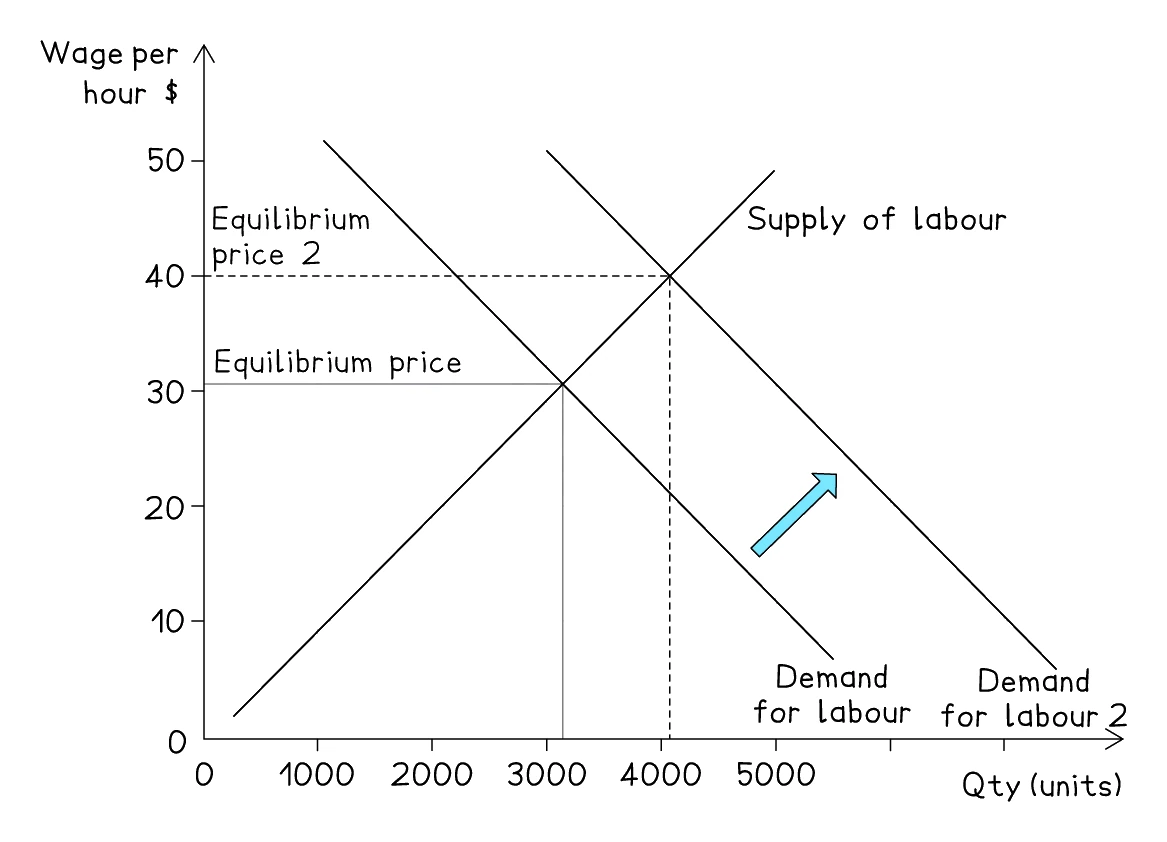
Because demand for labour is derived, a rise in demand for the product shifts the demand for labour to the right. The demand curve moves from Demand for labour to Demand for labour 2, and along the unchanged supply curve the wage is bid up (here from the original equilibrium price to the higher equilibrium price 2) while the quantity of workers employed rises.
A shift in supply works the same way on the other curve. If fewer workers hold the necessary qualifications, if workers emigrate, or if a professional body lengthens the training needed to enter the job, the supply of labour falls and the SL curve shifts left to SL2. Reading off the unchanged DL curve, the equilibrium wage rises and the equilibrium quantity of labour falls: employers have to offer more to attract the smaller pool of available workers, and at that higher wage they take on fewer of them. The mirror case runs in reverse. If immigration, retraining schemes or a large cohort of new entrants increase the supply of labour, SL shifts right, the equilibrium wage falls and the quantity of workers employed rises. When a question asks you to use a diagram, label both curves, show the shifted curve as SL2, and mark the new wage and the new quantity on the axes.
Institutional factors
Two institutions can lift wages above the level the market alone would set: a can negotiate higher pay for its members through collective bargaining, and a national sets a legal floor below which employers cannot pay.
Analyse how market forces can change wages (6 marks)
What comes up: A 6-mark question asking you to analyse how the demand for and supply of labour push a wage up (or down).
Write (two marks each): (1) An increase in demand for labour — because labour demand is a derived demand, when demand for the product rises firms expand output and compete for more workers, driving the wage up. (2) A fall in the supply of labour — if fewer workers are qualified, or the labour force shrinks, employers must offer more to attract the workers available. (3) Higher productivity — a worker who generates more revenue per hour is worth more, so the firm will pay more to retain them.
Watch out: Do not write "demand for labour rises" without saying why. The second mark is for tracing it back to demand for the firm's product (derived demand); a bare "demand rises" earns only one of the two marks.