Workers & Wages
Microeconomic Decision Makers · 4 question types
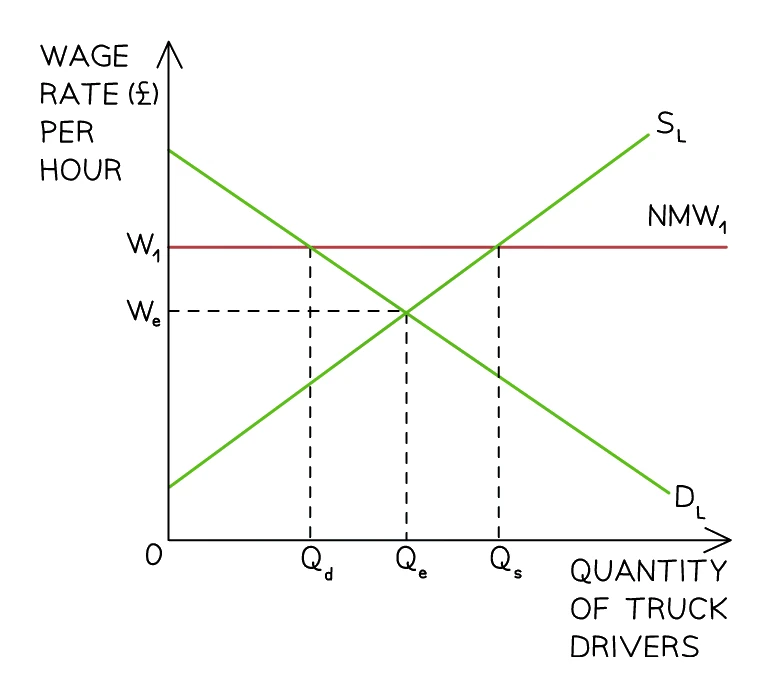
A national minimum wage is a legally imposed floor on wages: the lowest hourly rate at which an employer can lawfully pay a worker.
How it works on a labour-market diagram
If the NMW is set above the free-market equilibrium We, two things happen:
- Quantity of labour supplied rises (more workers want the higher-paid jobs), a movement up the SL curve.
- Quantity of labour demanded falls (firms hire fewer workers because labour is more expensive), a movement up the DL curve.
The result is an excess supply of labour at the NMW: more workers want to work at this wage than firms want to hire. The gap is unemployment caused by the minimum wage. If the NMW is set at or below the equilibrium, it is non-binding and has no effect on employment.
Advantages and disadvantages
| Advantages | Disadvantages |
|---|---|
| Raises pay of the lowest-paid workers, reducing in-work poverty | If set above equilibrium, can cause unemployment among low-skilled workers |
| Reduces wage exploitation in vulnerable industries | Raises firms' production costs, which may be passed on as higher consumer prices |
| Reduces wage discrimination (everyone gets at least the minimum) | Small firms may struggle to absorb higher wage costs and may close |
| Higher incomes for low-paid workers can boost consumer spending and total demand | May encourage firms to substitute capital (machines) for labour |
Analyse how a minimum wage could affect unemployment (6 marks)
What comes up: A 6-mark question on the unemployment effects of a minimum wage. Mark schemes credit both an increase and a decrease, so develop both directions.
Write — how it may raise unemployment: A minimum wage set above the equilibrium acts as a wage floor. The quantity of labour supplied rises while the quantity demanded falls, leaving an excess supply of labour that is unemployment. Firms may also substitute capital for labour to cut costs, reducing employment further.
Write — how it may lower unemployment: Higher pay can lift worker motivation and productivity, raising firms' demand for labour; higher incomes for the lowest-paid boost consumer spending and total demand, encouraging firms to expand and hire.
Watch out: State that the wage must be set above the equilibrium to have any effect. The mark scheme credits the point that a minimum wage set at or below equilibrium is non-binding; do not assume it automatically causes unemployment.