Fiscal & Monetary Policy
Government and the Macroeconomy · 4 question types
The money supply is the total amount of money in circulation in an economy: cash held by the public plus the deposits held in bank accounts.
Monetary policy is the central bank's use of interest rates and the money supply to influence the economy.
The central bank is independent of the elected government in most modern economies (e.g. the Bank of England, the European Central Bank, the US Federal Reserve). Independence is meant to keep monetary decisions away from short-term political pressure.
The main tool is the the central bank charges on its loans to commercial banks. Changes in the base rate flow through to all other interest rates in the economy: mortgages, business loans, savings accounts, credit cards.
Higher interest rates: contractionary monetary policy
When the central bank raises interest rates, borrowing becomes more expensive and saving becomes more attractive. Households and firms spend less and save more, so falls.
What follows:
- Mortgage payments rise → households have less disposable income.
- Business loans are more expensive → firms invest less.
- Saving is more attractive → households save more, spend less.
- The currency often strengthens (foreign investors want higher-yielding assets in this country) → imports become cheaper, exports more expensive.
The combined effect is lower aggregate demand, which slows demand-pull inflation. Higher rates are the central bank's main weapon against inflation.
Lower interest rates: expansionary monetary policy
When the central bank cuts interest rates, borrowing becomes cheap and saving becomes unattractive. Households and firms spend and invest more, so aggregate demand rises.
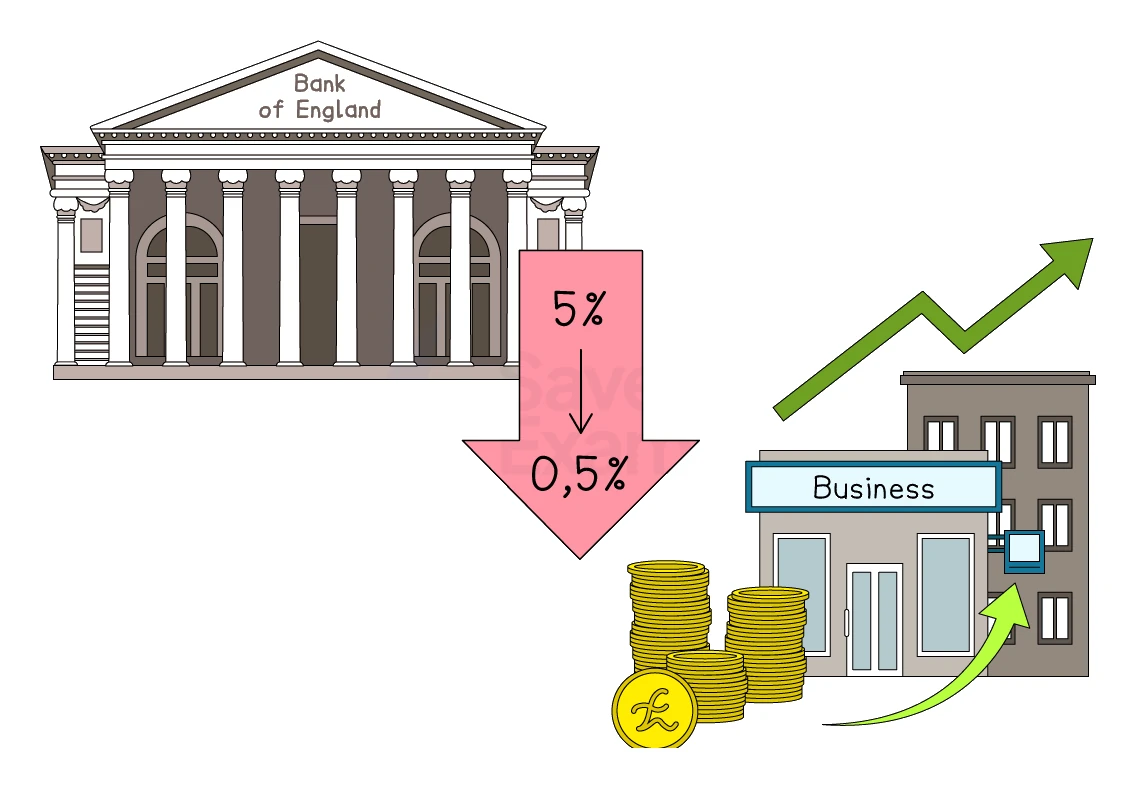
What follows:
- Mortgage payments fall → households have more disposable income.
- Business loans are cheaper → firms invest more.
- Saving is less attractive → households spend more.
- The currency often weakens → exports cheaper abroad.
The combined effect is higher aggregate demand, which lifts growth and reduces unemployment. Lower rates are the central bank's main weapon in a recession.
Other monetary tools
- (QE). The central bank creates new money to buy government bonds (and sometimes corporate bonds), pushing more cash into the financial system. Used when interest rates are already near zero.
- Money-supply changes. Some central banks directly control the amount of money in circulation, though this is less common in advanced economies.
- Changes in the foreign exchange rate. The central bank can act on the exchange rate deliberately, not just as a side effect of an interest-rate decision. Buying its own currency using its foreign-currency reserves raises demand for that currency and pushes the rate up; selling its own currency to buy foreign currency raises the supply of it and pushes the rate down. A lower rate makes exports cheaper abroad and imports dearer at home, which raises total demand and so supports growth and employment, although the dearer imports add to cost-push inflation. A higher rate does the reverse: cheaper imports help hold inflation down, but export sales and jobs in exporting industries suffer. (Topic 20 develops these consequences.)
Identifying monetary policy measures (2 marks)
What comes up: a 2-mark question asking you to identify or state two monetary policy measures.
Write: name any two of: (1) changes in interest rates, (2) changes in the money supply, (3) changes in the foreign exchange rate.
Watch out: the mark scheme accepts quantitative easing as an alternative way of expressing a change in money supply, but does not expect it by name. Do not list fiscal tools (taxation, government spending) — those belong to a different policy family entirely.
"Discuss whether a cut in interest rates will [reduce inflation / stimulate growth]" (8 marks)
What comes up: an 8-mark Discuss question on whether lower interest rates achieve a macroeconomic aim. The examiner expects you to show the transmission mechanism and then challenge it.
Write (both sides): Why lower interest rates will help: (1) Borrowing becomes cheaper and saving less attractive, so households spend more and firms invest more, raising total (aggregate) demand and output. (2) Cheaper loans reduce firms' costs of production, which can lower cost-push inflation and encourage firms to expand and hire. (3) The currency may weaken, making exports cheaper abroad and stimulating external demand.
Why lower interest rates may not succeed: (1) If households and firms are pessimistic, they may not borrow or spend even when rates fall. (2) Cutting rates raises consumer spending and reduces saving, which increases total (aggregate) demand and can push up demand-pull inflation rather than reducing it. (3) If rates are already very low, there is little room to cut them further, so the policy has little effect.
Watch out: for a question about whether a cut reduces inflation, the "why it will not" side is actually that lower rates can increase spending and therefore raise demand-pull inflation — this is the counterargument, not a reversal of the "will reduce" points. Keep both chains of reasoning distinct.
Limitations of monetary policy
- Time lags. It takes 6–18 months for a rate change to feed fully through to spending and inflation. The central bank has to act on its forecast, not on what is happening today.
- Confidence matters. If households and firms are pessimistic, cheap loans alone may not persuade them to spend. (The "you can lead a horse to water…" problem.)
- Limited room to cut. When rates are already very low, the central bank has little scope to cut them further, so monetary policy loses traction. This was the position of many central banks for most of the 2010s.
- Effects on the housing market. Rate changes have large and sometimes unintended effects on house prices, which complicates social policy.