Firms: Types, Mergers & Scale
Microeconomic Decision Makers
Firms can be classified in several ways. The syllabus expects you to know the two below, by sector of production and by ownership, and a third, by size, which section 2 covers.
By sector of production:
Primary-sector firms extract raw materials from nature (farming, fishing, mining, forestry).
Secondary-sector firms turn raw materials into finished or semi-finished goods (manufacturing, construction).
Tertiary-sector firms provide services (retailing, banking, transport, tourism).
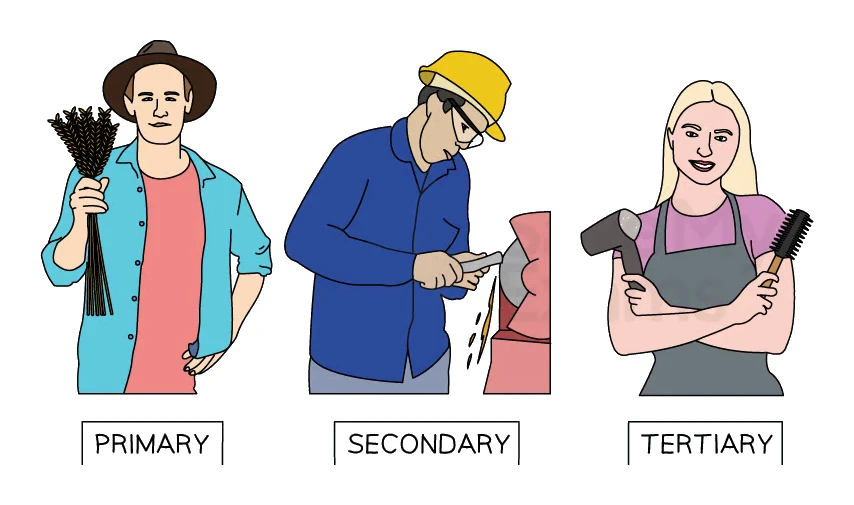
By ownership:
Private-sector firms are owned by private individuals and usually aim to make a profit (sole traders, partnerships, companies).
Public-sector firms are owned and run by the government, often to provide an important service (state-owned utilities, public transport) rather than purely for profit.
Common exam question
Classifying firms by sector
Question: Define a sector with an example, name a sector's products, or explain two ways firms can be classified (2–4 marks).
Asked in 3 of the 11 structured papers. A definition earns a mark for the meaning and one for an example: the secondary sector manufactures, builds or processes raw materials; the tertiary sector provides services. Give one example, not one the question rules out: a scheme may credit only the first. Primary-sector products are raw materials such as fish, wheat or coal (fishing is accepted). To explain two ways firms are classified, name and explain each, a mark each: by stage of production (primary, secondary or tertiary), by ownership (private or public) or by size (output or number of workers).
Common exam question
Private and public sector firms
Question: Explain how the private and public sectors differ, or discuss whether private sector firms charge lower prices than public ones (4–8 marks).
Asked in 2 of the 11 structured papers. For the difference, give each sector's owner and aim, a mark each: private firms belong to individuals or firms and pursue profit; public firms belong to the government and pursue the welfare of society. The 8-mark Discuss weighs private firms' competition and cost cutting against their profit motive or monopoly power, and against public firms' subsidised prices.