Logic Gates and Circuits
Boolean Logic · 5 question types
When the question gives you a circuit and a specific set of input values (for example A = 1, B = 0, C = 1), the safest method is to process the gates from left to right, in the order the signals flow. In the circuit below, an OR gate combines A and B, a NOT gate inverts C, and an AND gate combines those two results to give the output P.
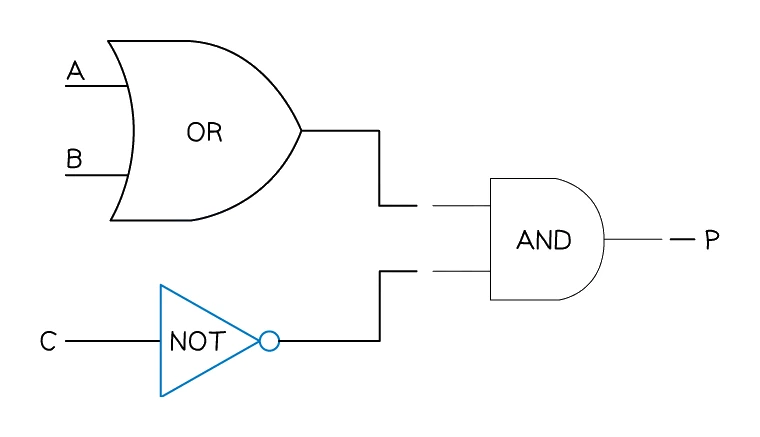
Method. (1) Mark each input on the diagram with its 0 or 1. (2) For each gate, look only at the values arriving at its inputs and apply the gate's rule to get its output. (3) Pass that output forward as one of the inputs to the next gate. (4) Repeat until you reach the final output
P.
Always write down the intermediate value at the output of every gate, even if you can do the calculation in your head. Examiners award method marks for the intermediates, so if your final P is wrong, you still pick up marks for the steps.
Finding a circuit's output for a given set of inputs
What comes up: the exam shows a logic circuit with a specific set of input values (for example A = 1, B = 0, C = 1) and asks you to find the final output.
Write (two marks): (1) Work through every gate in signal-flow order and write the output value of each gate as you go — one labelled value per intermediate gate. (2) Apply the final gate's rule to its incoming values to state the output Q.
Watch out: many students go straight to the final answer without showing intermediate gate values. The mark scheme awards a mark for each correct intermediate output, so skipping them throws away method marks even when the final answer is right.