Exam Frequency Analysis
Past paper frequency (2018 to 2024)
This topic accounts for approximately 7% of your exam marks.
stable
Low
Stable7%
Network topologies, protocols (HTTP, TCP/IP, FTP, DNS) and network hardware appear consistently.
A network topology is the physical or logical arrangement of devices in a network: who is connected to whom.
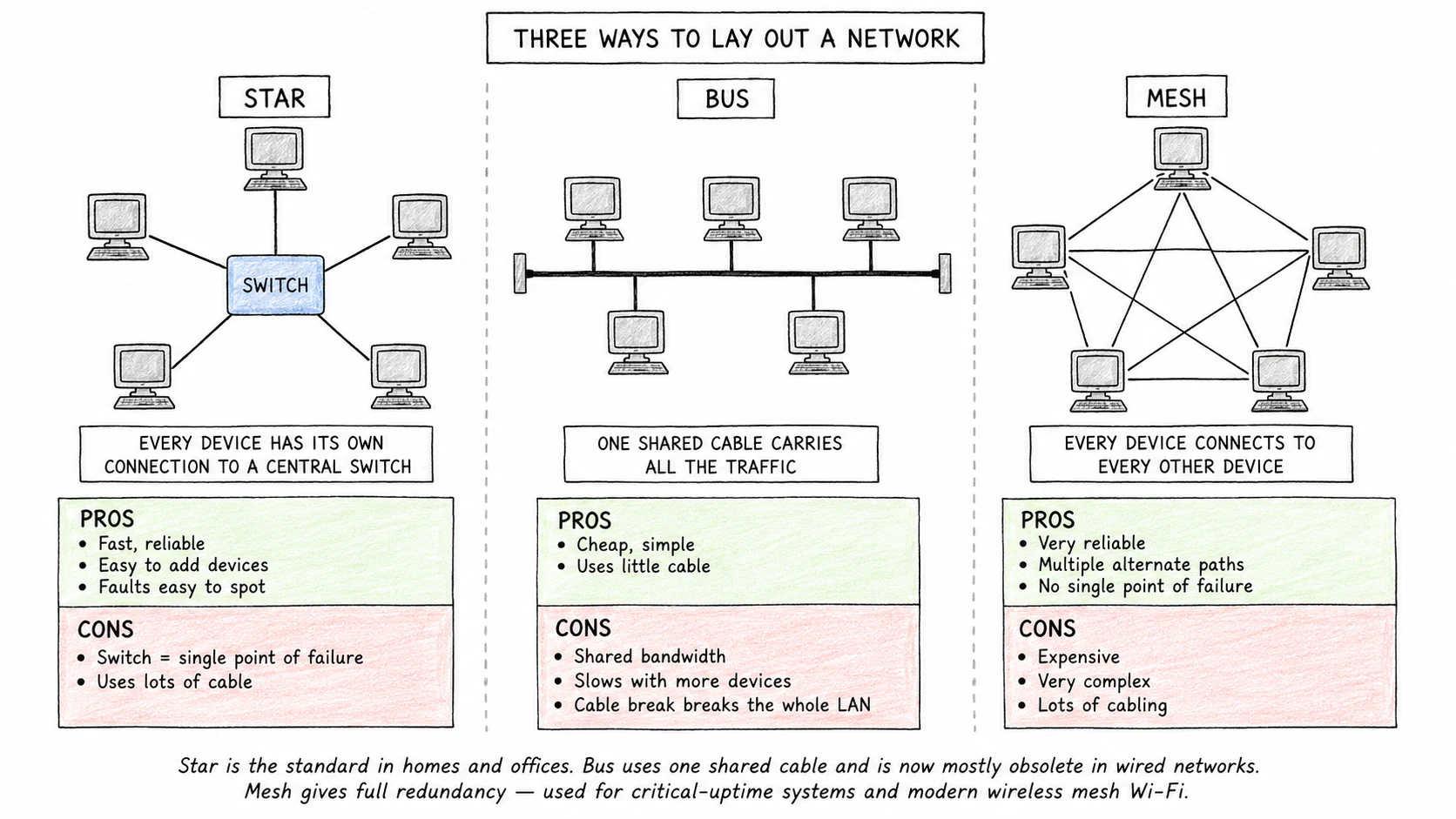
The syllabus names three topologies: star, bus and mesh.
Star topology
In a star topology, every device connects to a central or . Data going from one device to another passes through that central point.
       device
         |
device --- SWITCH --- device
         |
       device
Advantages:
- Fast and reliable because each device has its own connection to the switch.
- Easy to add or remove devices without disturbing the others.
- A single failing device does not affect the network (its cable just stops working).
- Easy to detect faults: the switch can identify which cable or device is misbehaving.
Disadvantages:
- All traffic passes through the central switch; if the switch fails, the whole network stops working.
- Requires lots of cable (one per device) and a powerful central switch.
- Higher cost than simpler topologies because of the central hardware.
This is the most common topology in home and office networks.
Bus topology
In a bus topology, every device connects to a single shared cable (the "bus") with terminators at both ends. Data sent by any device travels along the cable in both directions and is read by whichever device the address matches.
+--+----+----+----+----+--+
|  |    |    |    |    |  |
T  D1   D2   D3   D4   D5 T
Advantages:
- Cheap and easy to install in small temporary setups.
- Uses less cable than star.
- Easy to add a new device by attaching to the shared cable.
Disadvantages:
- The shared cable is a single point of failure: if it breaks, the whole network is down.
- All devices share the same bandwidth, so the network slows as more devices join.
- Only one device can send data at a time (collisions can occur if two send at once).
- Privacy is poor: every device on the bus can see every packet.
Bus topology is largely obsolete in modern wired networks.
Mesh topology
In a mesh topology, every device connects to every other device (full mesh) or to several others (partial mesh). Data can take many possible paths from source to destination.
       D1 ----- D2
       /\       /\
      /  \     /  \
    D5   D3---D6   ...
      \  /     \  /
       \/       \/
       D4 ----- D7
Advantages:
- Highly reliable: if one connection fails, data can take a different route.
- No single point of failure (in a full mesh).
- Fast: short paths between many pairs of devices.
- Easy to spot a faulty link because the rest of the network keeps running.
Disadvantages:
- Very expensive: needs many cables and many ports per device.
- Complex to install and maintain.
- Most household devices do not have enough ports for a full mesh.
Mesh topology is used in wireless mesh networks (e.g. mesh Wi-Fi systems that flood a house with signal) and in critical infrastructure where uptime matters more than cost.
Side-by-side comparison
| Feature | Star | Bus | Mesh |
|---|---|---|---|
| Central device needed? | Yes (switch/router) | No | No (in pure mesh) |
| If one device fails | Other devices unaffected | Other devices unaffected | Other devices unaffected |